return to home page Computational Chemistry Comparison and Benchmark DataBase Release 22 (May 2022) Standard Reference Database 101 National Institute of Standards and Technology
You are here: Calculated > Energy > Optimized > Energy

All results from a given calculation for CH3COCH2 (Acetonyl radical)

using model chemistry: QCISD(T)/cc-pVDZ

19 10 17 12 22

States and conformations

State Conformation minimum conformation conformer description state description
1 1 yes CS 2A"
Energy calculated at QCISD(T)/cc-pVDZ
 hartrees
Energy at 0K-191.981217
Energy at 298.15K-191.985838
HF Energy-191.357230
Nuclear repulsion energy110.904234
The energy at 298.15K was derived from the energy at 0K and an integrated heat capacity that used the calculated vibrational frequencies.
Vibrational Frequencies calculated at QCISD(T)/cc-pVDZ
Mode Number Symmetry Frequency
(cm-1)
Scaled Frequency
(cm-1)
IR Intensities
(km mol-1)
Raman Act
(Å4/u)
Dep P Dep U
1 A' 3284 3130        
2 A' 3173 3024        
3 A' 3159 3010        
4 A' 3050 2907        
5 A' 1644 1567        
6 A' 1468 1399        
7 A' 1452 1384        
8 A' 1386 1321        
9 A' 1267 1208        
10 A' 1057 1008        
11 A' 917 874        
12 A' 826 787        
13 A' 517 492        
14 A' 375 358        
15 A" 3130 2984        
16 A" 1470 1401        
17 A" 1016 969        
18 A" 689 657        
19 A" 496 473        
20 A" 349 332        
21 A" 93 89        

Unscaled Zero Point Vibrational Energy (zpe) 15408.5 cm-1
Scaled (by 0.9531) Zero Point Vibrational Energy (zpe) 14685.9 cm-1
See section III.C.1 List or set vibrational scaling factors to change the scale factors used here.
See section III.C.2 Calculate a vibrational scaling factor for a given set of molecules to determine the least squares best scaling factor.
Rotational Constants (cm-1) from geometry optimized at QCISD(T)/cc-pVDZ
ABC
0.35683 0.29850 0.16773

See section I.F.4 to change rotational constant units
Geometric Data calculated at QCISD(T)/cc-pVDZ

Point Group is Cs

Cartesians (Å)
Atom x (Å) y (Å) z (Å)
C1 0.000 0.152 0.000
O2 0.420 1.317 0.000
C3 -1.437 -0.120 0.000
C4 0.947 -1.046 0.000
H5 -2.128 0.730 0.000
H6 -1.834 -1.143 0.000
H7 1.990 -0.687 0.000
H8 0.772 -1.677 0.892
H9 0.772 -1.677 -0.892

Atom - Atom Distances (Å)
  C1 O2 C3 C4 H5 H6 H7 H8 H9
C11.23891.46221.52762.20502.24512.15922.17642.1764
O21.23892.34832.42172.61493.33692.54553.14393.1439
C31.46222.34832.55771.09591.09733.47272.84572.8457
C41.52762.42172.55773.55162.78321.10231.10661.1066
H52.20502.61491.09593.55161.89614.35453.87303.8730
H62.24513.33691.09732.78321.89613.85062.80602.8060
H72.15922.54553.47271.10234.35453.85061.80491.8049
H82.17643.14392.84571.10663.87302.80601.80491.7849
H92.17643.14392.84571.10663.87302.80601.80491.7849

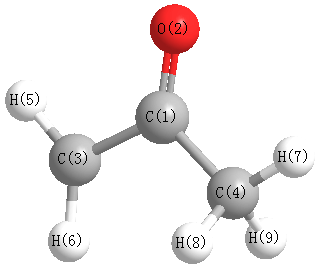
picture of Acetonyl radical state 1 conformation 1
More geometry information
Calculated Bond Angles
atom1 atom2 atom3 angle atom1 atom2 atom3 angle
C1 C3 H5 118.380 C1 C3 H6 121.956
C1 C4 H7 109.307 C1 C4 H8 110.399
C1 C4 H9 110.399 O2 C1 C3 120.559
O2 C1 C4 121.832 C3 C1 C4 117.609
H5 C3 H6 119.664 H7 C4 H8 109.598
H7 C4 H9 109.598 H8 C4 H9 107.515
Electronic energy levels
Charges, Dipole, Quadrupole and Polarizability