return to home page Computational Chemistry Comparison and Benchmark DataBase Release 22 (May 2022) Standard Reference Database 101 National Institute of Standards and Technology
You are here: Calculated > Energy > Optimized > Energy

All results from a given calculation for CH3COCH2 (Acetonyl radical)

using model chemistry: CCSD(T)=FULL/cc-pVDZ

19 10 17 12 22

States and conformations

State Conformation minimum conformation conformer description state description
1 1 yes CS 2A"
Energy calculated at CCSD(T)=FULL/cc-pVDZ
 hartrees
Energy at 0K-191.989231
Energy at 298.15K-191.993872
HF Energy-191.357508
Nuclear repulsion energy111.038443
The energy at 298.15K was derived from the energy at 0K and an integrated heat capacity that used the calculated vibrational frequencies.
Vibrational Frequencies calculated at CCSD(T)=FULL/cc-pVDZ
Mode Number Symmetry Frequency
(cm-1)
Scaled Frequency
(cm-1)
IR Intensities
(km mol-1)
Raman Act
(Å4/u)
Dep P Dep U
1 A' 3291 3170        
2 A' 3181 3064        
3 A' 3165 3049        
4 A' 3057 2944        
5 A' 1649 1589        
6 A' 1470 1416        
7 A' 1454 1401        
8 A' 1389 1337        
9 A' 1269 1222        
10 A' 1060 1021        
11 A' 918 884        
12 A' 829 798        
13 A' 519 500        
14 A' 376 363        
15 A" 3138 3022        
16 A" 1472 1418        
17 A" 1019 982        
18 A" 694 669        
19 A" 502 483        
20 A" 357 343        
21 A" 93 90        

Unscaled Zero Point Vibrational Energy (zpe) 15450.6 cm-1
Scaled (by 0.9632) Zero Point Vibrational Energy (zpe) 14882.1 cm-1
See section III.C.1 List or set vibrational scaling factors to change the scale factors used here.
See section III.C.2 Calculate a vibrational scaling factor for a given set of molecules to determine the least squares best scaling factor.
Rotational Constants (cm-1) from geometry optimized at CCSD(T)=FULL/cc-pVDZ
ABC
0.35773 0.29918 0.16813

See section I.F.4 to change rotational constant units
Geometric Data calculated at CCSD(T)=FULL/cc-pVDZ

Point Group is Cs

Cartesians (Å)
Atom x (Å) y (Å) z (Å)
C1 0.000 0.152 0.000
O2 0.419 1.316 0.000
C3 -1.435 -0.121 0.000
C4 0.947 -1.044 0.000
H5 -2.127 0.727 0.000
H6 -1.831 -1.144 0.000
H7 1.988 -0.684 0.000
H8 0.773 -1.674 0.892
H9 0.773 -1.674 -0.892

Atom - Atom Distances (Å)
  C1 O2 C3 C4 H5 H6 H7 H8 H9
C11.23681.46081.52592.20312.24302.15702.17402.1740
O21.23682.34542.41842.61233.33302.54263.13993.1399
C31.46082.34542.55491.09491.09633.46922.84252.8425
C41.52592.41842.55493.54802.78021.10111.10541.1054
H52.20312.61231.09493.54801.89434.35033.86893.8689
H62.24303.33301.09632.78021.89433.84662.80282.8028
H72.15702.54263.46921.10114.35033.84661.80301.8030
H82.17403.13992.84251.10543.86892.80281.80301.7830
H92.17403.13992.84251.10543.86892.80281.80301.7830

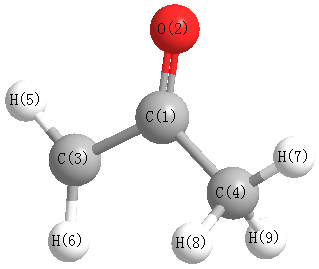
picture of Acetonyl radical state 1 conformation 1
More geometry information
Calculated Bond Angles
atom1 atom2 atom3 angle atom1 atom2 atom3 angle
C1 C3 H5 118.391 C1 C3 H6 121.957
C1 C4 H7 109.320 C1 C4 H8 110.400
C1 C4 H9 110.400 O2 C1 C3 120.567
O2 C1 C4 121.834 C3 C1 C4 117.599
H5 C3 H6 119.652 H7 C4 H8 109.595
H7 C4 H9 109.595 H8 C4 H9 107.505
Electronic energy levels
Charges, Dipole, Quadrupole and Polarizability