Jump to
S1C2
Energy calculated at B2PLYP=FULL/cc-pVDZ
| | hartrees |
|---|
| Energy at 0K | -168.439521 |
| Energy at 298.15K | |
| HF Energy | -168.267044 |
| Nuclear repulsion energy | 60.054608 |
The energy at 298.15K was derived from the energy at 0K
and an integrated heat capacity that used the calculated vibrational frequencies.
Vibrational Frequencies calculated at B2PLYP=FULL/cc-pVDZ
| Mode Number |
Symmetry |
Frequency
(cm-1) |
Scaled Frequency
(cm-1) |
IR Intensities
(km mol-1) |
Raman Act
(Å4/u) |
Dep P |
Dep U |
|---|
| 1 |
Σ |
3535 |
3389 |
266.75 |
30.37 |
0.27 |
0.43 |
| 2 |
Σ |
2301 |
2205 |
347.52 |
12.29 |
0.09 |
0.16 |
| 3 |
Σ |
1304 |
1249 |
74.70 |
25.51 |
0.29 |
0.45 |
| 4 |
Π |
561 |
537 |
1.18 |
0.32 |
0.75 |
0.86 |
| 4 |
Π |
561 |
537 |
1.18 |
0.32 |
0.75 |
0.86 |
| 5 |
Π |
266i |
255i |
84.46 |
2.34 |
0.75 |
0.86 |
| 5 |
Π |
266i |
255i |
84.46 |
2.34 |
0.75 |
0.86 |
Unscaled Zero Point Vibrational Energy (zpe) 3864.5 cm
-1
Scaled (by 0.9585) Zero Point Vibrational Energy (zpe) 3704.1 cm
-1
See section
III.C.1 List or set vibrational scaling factors
to change the scale factors used here.
See section
III.C.2
Calculate a vibrational scaling factor for a given set of molecules
to determine the least squares best scaling factor.
Geometric Data calculated at B2PLYP=FULL/cc-pVDZ
Point Group is C∞v
Cartesians (Å)
| Atom |
x (Å) |
y (Å) |
z (Å) |
|---|
| O1 |
0.000 |
0.000 |
1.188 |
| N2 |
0.000 |
0.000 |
-0.014 |
| C3 |
0.000 |
0.000 |
-1.191 |
| H4 |
0.000 |
0.000 |
-2.260 |
Atom - Atom Distances (Å)
| |
O1 |
N2 |
C3 |
H4 |
| O1 | | 1.2026 | 2.3792 | 3.4480 |
N2 | 1.2026 | | 1.1766 | 2.2454 | C3 | 2.3792 | 1.1766 | | 1.0688 | H4 | 3.4480 | 2.2454 | 1.0688 | |
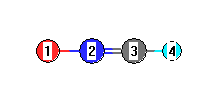 More geometry information
Calculated Bond Angles
| atom1 |
atom2 |
atom3 |
angle |
|
atom1 |
atom2 |
atom3 |
angle |
| O1 |
N2 |
C3 |
180.000 |
|
N2 |
C3 |
H4 |
180.000 |
Electronic energy levels
Charges, Dipole, Quadrupole and Polarizability
Jump to
S1C1
Energy calculated at B2PLYP=FULL/cc-pVDZ
| | hartrees |
|---|
| Energy at 0K | -168.439979 |
| Energy at 298.15K | -168.440683 |
| HF Energy | -168.265001 |
| Nuclear repulsion energy | 60.014549 |
The energy at 298.15K was derived from the energy at 0K
and an integrated heat capacity that used the calculated vibrational frequencies.
Vibrational Frequencies calculated at B2PLYP=FULL/cc-pVDZ
| Mode Number |
Symmetry |
Frequency
(cm-1) |
Scaled Frequency
(cm-1) |
IR Intensities
(km mol-1) |
Raman Act
(Å4/u) |
Dep P |
Dep U |
|---|
| 1 |
A' |
3477 |
3333 |
186.36 |
|
|
|
| 2 |
A' |
2265 |
2171 |
360.69 |
|
|
|
| 3 |
A' |
1308 |
1254 |
52.79 |
|
|
|
| 4 |
A' |
555 |
532 |
5.07 |
|
|
|
| 5 |
A' |
369 |
353 |
156.47 |
|
|
|
| 6 |
A" |
559 |
536 |
1.60 |
|
|
|
Unscaled Zero Point Vibrational Energy (zpe) 4266.4 cm
-1
Scaled (by 0.9585) Zero Point Vibrational Energy (zpe) 4089.3 cm
-1
See section
III.C.1 List or set vibrational scaling factors
to change the scale factors used here.
See section
III.C.2
Calculate a vibrational scaling factor for a given set of molecules
to determine the least squares best scaling factor.
Geometric Data calculated at B2PLYP=FULL/cc-pVDZ
Point Group is Cs
Cartesians (Å)
| Atom |
x (Å) |
y (Å) |
z (Å) |
|---|
| O1 |
-1.016 |
-0.608 |
0.000 |
| N2 |
0.000 |
0.029 |
0.000 |
| C3 |
1.068 |
0.544 |
0.000 |
| H4 |
1.715 |
1.400 |
0.000 |
Atom - Atom Distances (Å)
| |
O1 |
N2 |
C3 |
H4 |
| O1 | | 1.1992 | 2.3813 | 3.3900 |
N2 | 1.1992 | | 1.1858 | 2.1958 | C3 | 2.3813 | 1.1858 | | 1.0733 | H4 | 3.3900 | 2.1958 | 1.0733 | |
More geometry information
Calculated Bond Angles
| atom1 |
atom2 |
atom3 |
angle |
|
atom1 |
atom2 |
atom3 |
angle |
| O1 |
N2 |
C3 |
173.594 |
|
N2 |
C3 |
H4 |
152.777 |
Electronic energy levels
Charges, Dipole, Quadrupole and Polarizability
