Jump to
S1C2
Energy calculated at QCISD/cc-pVDZ
| | hartrees |
|---|
| Energy at 0K | -151.520334 |
| Energy at 298.15K | |
| HF Energy | -151.095096 |
| Nuclear repulsion energy | 51.921927 |
The energy at 298.15K was derived from the energy at 0K
and an integrated heat capacity that used the calculated vibrational frequencies.
Vibrational Frequencies calculated at QCISD/cc-pVDZ
| Mode Number |
Symmetry |
Frequency
(cm-1) |
Scaled Frequency
(cm-1) |
IR Intensities
(km mol-1) |
Raman Act
(Å4/u) |
Dep P |
Dep U |
|---|
| 1 |
Σ |
3480 |
3339 |
120.67 |
|
|
|
| 2 |
Σ |
2092 |
2007 |
181.21 |
|
|
|
| 3 |
Σ |
1295 |
1243 |
20.47 |
|
|
|
| 4 |
Π |
564 |
541 |
0.07 |
|
|
|
| 4 |
Π |
517 |
496 |
4.38 |
|
|
|
| 5 |
Π |
346 |
332 |
30.27 |
|
|
|
| 5 |
Π |
422i |
405i |
124.16 |
|
|
|
Unscaled Zero Point Vibrational Energy (zpe) 3936.2 cm
-1
Scaled (by 0.9594) Zero Point Vibrational Energy (zpe) 3776.4 cm
-1
See section
III.C.1 List or set vibrational scaling factors
to change the scale factors used here.
See section
III.C.2
Calculate a vibrational scaling factor for a given set of molecules
to determine the least squares best scaling factor.
Geometric Data calculated at QCISD/cc-pVDZ
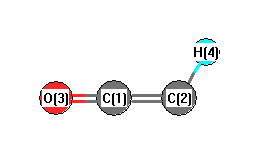
Point Group is C∞v
Cartesians (Å)
| Atom |
x (Å) |
y (Å) |
z (Å) |
|---|
| C1 |
0.000 |
0.000 |
0.022 |
| C2 |
0.000 |
0.000 |
-1.256 |
| O3 |
0.000 |
0.000 |
1.217 |
| H4 |
0.000 |
0.000 |
-2.332 |
Atom - Atom Distances (Å)
| |
C1 |
C2 |
O3 |
H4 |
| C1 | | 1.2785 | 1.1949 | 2.3537 |
C2 | 1.2785 | | 2.4734 | 1.0752 | O3 | 1.1949 | 2.4734 | | 3.5486 | H4 | 2.3537 | 1.0752 | 3.5486 | |
 More geometry information
Calculated Bond Angles
| atom1 |
atom2 |
atom3 |
angle |
|
atom1 |
atom2 |
atom3 |
angle |
| C1 |
C2 |
H4 |
180.000 |
|
C2 |
C1 |
O3 |
180.000 |
Electronic energy levels
Charges, Dipole, Quadrupole and Polarizability
Jump to
S1C1
Energy calculated at QCISD/cc-pVDZ
| | hartrees |
|---|
| Energy at 0K | -151.524597 |
| Energy at 298.15K | |
| HF Energy | -151.094782 |
| Nuclear repulsion energy | 51.744740 |
The energy at 298.15K was derived from the energy at 0K
and an integrated heat capacity that used the calculated vibrational frequencies.
Vibrational Frequencies calculated at QCISD/cc-pVDZ
| Mode Number |
Symmetry |
Frequency
(cm-1) |
Scaled Frequency
(cm-1) |
IR Intensities
(km mol-1) |
Raman Act
(Å4/u) |
Dep P |
Dep U |
|---|
| 1 |
A' |
3333 |
3197 |
23.34 |
|
|
|
| 2 |
A' |
2065 |
1981 |
309.54 |
|
|
|
| 3 |
A' |
1221 |
1171 |
4.23 |
|
|
|
| 4 |
A' |
596 |
572 |
138.46 |
|
|
|
| 5 |
A' |
520 |
499 |
119.19 |
|
|
|
| 6 |
A" |
490 |
470 |
3.71 |
|
|
|
Unscaled Zero Point Vibrational Energy (zpe) 4111.9 cm
-1
Scaled (by 0.9594) Zero Point Vibrational Energy (zpe) 3944.9 cm
-1
See section
III.C.1 List or set vibrational scaling factors
to change the scale factors used here.
See section
III.C.2
Calculate a vibrational scaling factor for a given set of molecules
to determine the least squares best scaling factor.
Geometric Data calculated at QCISD/cc-pVDZ
Point Group is Cs
Cartesians (Å)
| Atom |
x (Å) |
y (Å) |
z (Å) |
|---|
| C1 |
0.000 |
0.064 |
0.000 |
| C2 |
1.104 |
-0.669 |
0.000 |
| O3 |
-1.096 |
0.498 |
0.000 |
| H4 |
2.146 |
-0.350 |
0.000 |
Atom - Atom Distances (Å)
| |
C1 |
C2 |
O3 |
H4 |
| C1 | | 1.3251 | 1.1792 | 2.1856 |
C2 | 1.3251 | | 2.4907 | 1.0895 | O3 | 1.1792 | 2.4907 | | 3.3516 | H4 | 2.1856 | 1.0895 | 3.3516 | |
More geometry information
Calculated Bond Angles
| atom1 |
atom2 |
atom3 |
angle |
|
atom1 |
atom2 |
atom3 |
angle |
| C1 |
C2 |
H4 |
129.441 |
|
C2 |
C1 |
O3 |
168.039 |
Electronic energy levels
Charges, Dipole, Quadrupole and Polarizability
