Jump to
S1C2
Energy calculated at QCISD(T)=FULL/cc-pVDZ
| | hartrees |
|---|
| Energy at 0K | -151.541969 |
| Energy at 298.15K | |
| HF Energy | -151.094380 |
| Nuclear repulsion energy | 51.779286 |
The energy at 298.15K was derived from the energy at 0K
and an integrated heat capacity that used the calculated vibrational frequencies.
Vibrational Frequencies calculated at QCISD(T)=FULL/cc-pVDZ
Geometric Data calculated at QCISD(T)=FULL/cc-pVDZ
Point Group is C∞v
Cartesians (Å)
| Atom |
x (Å) |
y (Å) |
z (Å) |
|---|
| C1 |
0.000 |
0.000 |
0.022 |
| C2 |
0.000 |
0.000 |
-1.260 |
| O3 |
0.000 |
0.000 |
1.220 |
| H4 |
0.000 |
0.000 |
-2.336 |
Atom - Atom Distances (Å)
| |
C1 |
C2 |
O3 |
H4 |
| C1 | | 1.2822 | 1.1983 | 2.3585 |
C2 | 1.2822 | | 2.4806 | 1.0762 | O3 | 1.1983 | 2.4806 | | 3.5568 | H4 | 2.3585 | 1.0762 | 3.5568 | |
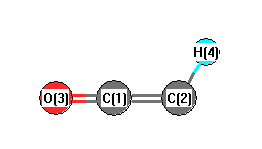 More geometry information
Calculated Bond Angles
| atom1 |
atom2 |
atom3 |
angle |
|
atom1 |
atom2 |
atom3 |
angle |
| C1 |
C2 |
H4 |
180.000 |
|
C2 |
C1 |
O3 |
180.000 |
Electronic energy levels
Charges, Dipole, Quadrupole and Polarizability
Jump to
S1C1
Energy calculated at QCISD(T)=FULL/cc-pVDZ
| | hartrees |
|---|
| Energy at 0K | -151.547344 |
| Energy at 298.15K | |
| HF Energy | -151.093682 |
| Nuclear repulsion energy | 51.572025 |
The energy at 298.15K was derived from the energy at 0K
and an integrated heat capacity that used the calculated vibrational frequencies.
Vibrational Frequencies calculated at QCISD(T)=FULL/cc-pVDZ
| Mode Number |
Symmetry |
Frequency
(cm-1) |
Scaled Frequency
(cm-1) |
IR Intensities
(km mol-1) |
Raman Act
(Å4/u) |
Dep P |
Dep U |
|---|
| 1 |
A' |
3310 |
3174 |
|
|
|
|
| 2 |
A' |
2050 |
1966 |
|
|
|
|
| 3 |
A' |
1198 |
1149 |
|
|
|
|
| 4 |
A' |
620 |
594 |
|
|
|
|
| 5 |
A' |
518 |
496 |
|
|
|
|
| 6 |
A" |
486 |
466 |
|
|
|
|
Unscaled Zero Point Vibrational Energy (zpe) 4090.4 cm
-1
Scaled (by 0.959) Zero Point Vibrational Energy (zpe) 3922.7 cm
-1
See section
III.C.1 List or set vibrational scaling factors
to change the scale factors used here.
See section
III.C.2
Calculate a vibrational scaling factor for a given set of molecules
to determine the least squares best scaling factor.
Geometric Data calculated at QCISD(T)=FULL/cc-pVDZ
Point Group is Cs
Cartesians (Å)
| Atom |
x (Å) |
y (Å) |
z (Å) |
|---|
| C1 |
0.000 |
0.069 |
0.000 |
| C2 |
1.133 |
-0.629 |
0.000 |
| O3 |
-1.120 |
0.452 |
0.000 |
| H4 |
2.157 |
-0.251 |
0.000 |
Atom - Atom Distances (Å)
| |
C1 |
C2 |
O3 |
H4 |
| C1 | | 1.3310 | 1.1834 | 2.1803 |
C2 | 1.3310 | | 2.4989 | 1.0911 | O3 | 1.1834 | 2.4989 | | 3.3509 | H4 | 2.1803 | 1.0911 | 3.3509 | |
More geometry information
Calculated Bond Angles
| atom1 |
atom2 |
atom3 |
angle |
|
atom1 |
atom2 |
atom3 |
angle |
| C1 |
C2 |
H4 |
128.089 |
|
C2 |
C1 |
O3 |
167.266 |
Electronic energy levels
Charges, Dipole, Quadrupole and Polarizability
