Jump to
S1C2
Energy calculated at ROHF/cc-pVDZ
| | hartrees |
|---|
| Energy at 0K | -151.088998 |
| Energy at 298.15K | |
| HF Energy | -151.088998 |
| Nuclear repulsion energy | 53.178919 |
The energy at 298.15K was derived from the energy at 0K
and an integrated heat capacity that used the calculated vibrational frequencies.
Vibrational Frequencies calculated at ROHF/cc-pVDZ
| Mode Number |
Symmetry |
Frequency
(cm-1) |
Scaled Frequency
(cm-1) |
IR Intensities
(km mol-1) |
Raman Act
(Å4/u) |
Dep P |
Dep U |
|---|
| 1 |
Σ |
3636 |
3129 |
208.21 |
|
|
|
| 2 |
Σ |
2363 |
2034 |
796.50 |
|
|
|
| 3 |
Σ |
1422 |
1224 |
22.71 |
|
|
|
| 4 |
Π |
657 |
566 |
4.41 |
|
|
|
| 4 |
Π |
615 |
529 |
17.45 |
|
|
|
| 5 |
Π |
281 |
242 |
39.14 |
|
|
|
| 5 |
Π |
322i |
277i |
179.67 |
|
|
|
Unscaled Zero Point Vibrational Energy (zpe) 4326.3 cm
-1
Scaled (by 0.8607) Zero Point Vibrational Energy (zpe) 3723.6 cm
-1
See section
III.C.1 List or set vibrational scaling factors
to change the scale factors used here.
See section
III.C.2
Calculate a vibrational scaling factor for a given set of molecules
to determine the least squares best scaling factor.
Geometric Data calculated at ROHF/cc-pVDZ
Point Group is C∞v
Cartesians (Å)
| Atom |
x (Å) |
y (Å) |
z (Å) |
|---|
| C1 |
0.000 |
0.000 |
0.033 |
| C2 |
0.000 |
0.000 |
-1.232 |
| O3 |
0.000 |
0.000 |
1.186 |
| H4 |
0.000 |
0.000 |
-2.292 |
Atom - Atom Distances (Å)
| |
C1 |
C2 |
O3 |
H4 |
| C1 | | 1.2643 | 1.1532 | 2.3249 |
C2 | 1.2643 | | 2.4174 | 1.0606 | O3 | 1.1532 | 2.4174 | | 3.4780 | H4 | 2.3249 | 1.0606 | 3.4780 | |
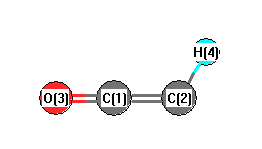 More geometry information
Calculated Bond Angles
| atom1 |
atom2 |
atom3 |
angle |
|
atom1 |
atom2 |
atom3 |
angle |
| C1 |
C2 |
H4 |
180.000 |
|
C2 |
C1 |
O3 |
180.000 |
Electronic energy levels
Charges, Dipole, Quadrupole and Polarizability
Charges from optimized geometry at ROHF/cc-pVDZ
Charges (e)
| Number |
Element |
Mulliken |
CHELPG |
AIM |
ESP |
| 1 |
C |
0.285 |
|
|
|
| 2 |
C |
-0.172 |
|
|
|
| 3 |
O |
-0.209 |
|
|
|
| 4 |
H |
0.096 |
|
|
|
Electric dipole moments
Electric dipole components in Debye
(What's a Debye? See section
VII.A.3)
| |
x |
y |
z |
Total |
| |
0.000 |
0.000 |
-2.295 |
2.295 |
| CHELPG |
|
|
|
|
| AIM |
|
|
|
|
| ESP |
|
|
|
|
Electric Quadrupole moment
Quadrupole components in D Å
| Primitive |
|---|
| | x | y | z |
|---|
| x |
-16.090 |
0.000 |
0.000 |
| y |
0.000 |
-17.903 |
0.000 |
| z |
0.000 |
0.000 |
-15.317 |
|
| Traceless |
|---|
| | x | y | z |
|---|
| x |
0.519 |
0.000 |
0.000 |
| y |
0.000 |
-2.199 |
0.000 |
| z |
0.000 |
0.000 |
1.680 |
|
| Polar |
|---|
| 3z2-r2 | 3.360 |
|---|
| x2-y2 | 1.812 |
|---|
| xy | 0.000 |
|---|
| xz | 0.000 |
|---|
| yz | 0.000 |
|---|
|
Polarizabilities
Components of the polarizability tensor.
Units are
Å
3 (Angstrom cubed)
Change units.
| |
x |
y |
z |
| x |
0.000 |
0.000 |
0.000 |
| y |
0.000 |
0.000 |
0.000 |
| z |
0.000 |
0.000 |
0.000 |
<r2> (average value of r
2) Å
2
| <r2> |
35.878 |
| (<r2>)1/2 |
5.990 |
Jump to
S1C1
Energy calculated at ROHF/cc-pVDZ
| | hartrees |
|---|
| Energy at 0K | -151.091633 |
| Energy at 298.15K | |
| HF Energy | -151.091633 |
| Nuclear repulsion energy | 52.960209 |
The energy at 298.15K was derived from the energy at 0K
and an integrated heat capacity that used the calculated vibrational frequencies.
Vibrational Frequencies calculated at ROHF/cc-pVDZ
| Mode Number |
Symmetry |
Frequency
(cm-1) |
Scaled Frequency
(cm-1) |
IR Intensities
(km mol-1) |
Raman Act
(Å4/u) |
Dep P |
Dep U |
|---|
| 1 |
A' |
3479 |
2994 |
54.70 |
|
|
|
| 2 |
A' |
2330 |
2005 |
908.61 |
|
|
|
| 3 |
A' |
1313 |
1130 |
0.02 |
|
|
|
| 4 |
A' |
672 |
579 |
78.57 |
|
|
|
| 5 |
A' |
471 |
406 |
332.30 |
|
|
|
| 6 |
A" |
581 |
500 |
27.02 |
|
|
|
Unscaled Zero Point Vibrational Energy (zpe) 4422.7 cm
-1
Scaled (by 0.8607) Zero Point Vibrational Energy (zpe) 3806.6 cm
-1
See section
III.C.1 List or set vibrational scaling factors
to change the scale factors used here.
See section
III.C.2
Calculate a vibrational scaling factor for a given set of molecules
to determine the least squares best scaling factor.
Geometric Data calculated at ROHF/cc-pVDZ
Point Group is Cs
Cartesians (Å)
| Atom |
x (Å) |
y (Å) |
z (Å) |
|---|
| C1 |
0.000 |
0.049 |
0.000 |
| C2 |
0.736 |
-1.035 |
0.000 |
| O3 |
-0.778 |
0.881 |
0.000 |
| H4 |
1.806 |
-1.138 |
0.000 |
Atom - Atom Distances (Å)
| |
C1 |
C2 |
O3 |
H4 |
| C1 | | 1.3103 | 1.1388 | 2.1610 |
C2 | 1.3103 | | 2.4418 | 1.0747 | O3 | 1.1388 | 2.4418 | | 3.2788 | H4 | 2.1610 | 1.0747 | 3.2788 | |
More geometry information
Calculated Bond Angles
| atom1 |
atom2 |
atom3 |
angle |
|
atom1 |
atom2 |
atom3 |
angle |
| C1 |
C2 |
H4 |
129.679 |
|
C2 |
C1 |
O3 |
171.102 |
Electronic energy levels
Charges, Dipole, Quadrupole and Polarizability
Charges from optimized geometry at ROHF/cc-pVDZ
Charges (e)
| Number |
Element |
Mulliken |
CHELPG |
AIM |
ESP |
| 1 |
C |
0.295 |
|
|
|
| 2 |
C |
-0.241 |
|
|
|
| 3 |
O |
-0.177 |
|
|
|
| 4 |
H |
0.123 |
|
|
|
Electric dipole moments
Electric dipole components in Debye
(What's a Debye? See section
VII.A.3)
| |
x |
y |
z |
Total |
| |
1.714 |
0.272 |
0.000 |
1.736 |
| CHELPG |
|
|
|
|
| AIM |
|
|
|
|
| ESP |
|
|
|
|
Electric Quadrupole moment
Quadrupole components in D Å
| Primitive |
|---|
| | x | y | z |
|---|
| x |
-15.098 |
-0.006 |
0.002 |
| y |
-0.006 |
-20.500 |
-0.003 |
| z |
0.002 |
-0.003 |
-16.269 |
|
| Traceless |
|---|
| | x | y | z |
|---|
| x |
3.286 |
-0.006 |
0.002 |
| y |
-0.006 |
-4.816 |
-0.003 |
| z |
0.002 |
-0.003 |
1.530 |
|
| Polar |
|---|
| 3z2-r2 | 3.059 |
|---|
| x2-y2 | 5.401 |
|---|
| xy | -0.006 |
|---|
| xz | 0.002 |
|---|
| yz | -0.003 |
|---|
|
Polarizabilities
Components of the polarizability tensor.
Units are
Å
3 (Angstrom cubed)
Change units.
| |
x |
y |
z |
| x |
0.000 |
0.000 |
0.000 |
| y |
0.000 |
0.000 |
0.000 |
| z |
0.000 |
0.000 |
0.000 |
<r2> (average value of r
2) Å
2
| <r2> |
36.094 |
| (<r2>)1/2 |
6.008 |
