Jump to
S1C2
Energy calculated at PBE1PBE/cc-pVDZ
| | hartrees |
|---|
| Energy at 0K | -93.851894 |
| Energy at 298.15K | -93.853189 |
| HF Energy | -93.851894 |
| Nuclear repulsion energy | 28.117253 |
The energy at 298.15K was derived from the energy at 0K
and an integrated heat capacity that used the calculated vibrational frequencies.
Vibrational Frequencies calculated at PBE1PBE/cc-pVDZ
| Mode Number |
Symmetry |
Frequency
(cm-1) |
Scaled Frequency
(cm-1) |
IR Intensities
(km mol-1) |
Raman Act
(Å4/u) |
Dep P |
Dep U |
|---|
| 1 |
A' |
3316 |
3188 |
5.47 |
|
|
|
| 2 |
A' |
2995 |
2880 |
49.81 |
|
|
|
| 3 |
A' |
1881 |
1809 |
27.15 |
|
|
|
| 4 |
A' |
1016 |
977 |
146.94 |
|
|
|
| 5 |
A' |
872 |
838 |
91.94 |
|
|
|
| 6 |
A" |
906 |
871 |
3.21 |
|
|
|
Unscaled Zero Point Vibrational Energy (zpe) 5493.1 cm
-1
Scaled (by 0.9615) Zero Point Vibrational Energy (zpe) 5281.6 cm
-1
See section
III.C.1 List or set vibrational scaling factors
to change the scale factors used here.
See section
III.C.2
Calculate a vibrational scaling factor for a given set of molecules
to determine the least squares best scaling factor.
Geometric Data calculated at PBE1PBE/cc-pVDZ
Point Group is Cs
Cartesians (Å)
| Atom |
x (Å) |
y (Å) |
z (Å) |
|---|
| C1 |
0.113 |
0.636 |
0.000 |
| N2 |
0.113 |
-0.591 |
0.000 |
| H3 |
-0.676 |
1.416 |
0.000 |
| H4 |
-0.789 |
-1.095 |
0.000 |
Atom - Atom Distances (Å)
| |
C1 |
N2 |
H3 |
H4 |
| C1 | | 1.2268 | 1.1093 | 1.9522 |
N2 | 1.2268 | | 2.1563 | 1.0336 | H3 | 1.1093 | 2.1563 | | 2.5140 | H4 | 1.9522 | 1.0336 | 2.5140 | |
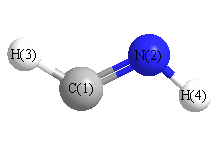 More geometry information
Calculated Bond Angles
| atom1 |
atom2 |
atom3 |
angle |
|
atom1 |
atom2 |
atom3 |
angle |
| C1 |
N2 |
H4 |
119.215 |
|
H3 |
C1 |
N2 |
134.694 |
Electronic energy levels
Charges, Dipole, Quadrupole and Polarizability
Charges from optimized geometry at PBE1PBE/cc-pVDZ
Charges (e)
| Number |
Element |
Mulliken |
CHELPG |
AIM |
ESP |
| 1 |
C |
-0.052 |
|
|
|
| 2 |
N |
-0.142 |
|
|
|
| 3 |
H |
0.076 |
|
|
|
| 4 |
H |
0.118 |
|
|
|
Electric dipole moments
Electric dipole components in Debye
(What's a Debye? See section
VII.A.3)
| |
x |
y |
z |
Total |
| |
-2.113 |
0.369 |
0.000 |
2.145 |
| CHELPG |
|
|
|
|
| AIM |
|
|
|
|
| ESP |
|
|
|
|
Electric Quadrupole moment
Quadrupole components in D Å
| Primitive |
|---|
| | x | y | z |
|---|
| x |
-11.917 |
0.590 |
0.000 |
| y |
0.590 |
-11.019 |
0.000 |
| z |
0.000 |
0.000 |
-12.424 |
|
| Traceless |
|---|
| | x | y | z |
|---|
| x |
-0.195 |
0.590 |
0.000 |
| y |
0.590 |
1.151 |
0.000 |
| z |
0.000 |
0.000 |
-0.957 |
|
| Polar |
|---|
| 3z2-r2 | -1.913 |
|---|
| x2-y2 | -0.897 |
|---|
| xy | 0.590 |
|---|
| xz | 0.000 |
|---|
| yz | 0.000 |
|---|
|
Polarizabilities
Components of the polarizability tensor.
Units are
Å
3 (Angstrom cubed)
Change units.
| |
x |
y |
z |
| x |
2.090 |
0.058 |
0.000 |
| y |
0.058 |
3.818 |
0.000 |
| z |
0.000 |
0.000 |
1.336 |
<r2> (average value of r
2) Å
2
| <r2> |
16.682 |
| (<r2>)1/2 |
4.084 |
Jump to
S1C1
Energy calculated at PBE1PBE/cc-pVDZ
| | hartrees |
|---|
| Energy at 0K | -93.859165 |
| Energy at 298.15K | -93.860507 |
| HF Energy | -93.859165 |
| Nuclear repulsion energy | 28.048845 |
The energy at 298.15K was derived from the energy at 0K
and an integrated heat capacity that used the calculated vibrational frequencies.
Vibrational Frequencies calculated at PBE1PBE/cc-pVDZ
| Mode Number |
Symmetry |
Frequency
(cm-1) |
Scaled Frequency
(cm-1) |
IR Intensities
(km mol-1) |
Raman Act
(Å4/u) |
Dep P |
Dep U |
|---|
| 1 |
A' |
3441 |
3308 |
6.68 |
|
|
|
| 2 |
A' |
3039 |
2922 |
27.50 |
|
|
|
| 3 |
A' |
1836 |
1765 |
27.05 |
|
|
|
| 4 |
A' |
1198 |
1152 |
9.15 |
|
|
|
| 5 |
A' |
905 |
870 |
214.26 |
|
|
|
| 6 |
A" |
974 |
937 |
110.04 |
|
|
|
Unscaled Zero Point Vibrational Energy (zpe) 5696.3 cm
-1
Scaled (by 0.9615) Zero Point Vibrational Energy (zpe) 5477.0 cm
-1
See section
III.C.1 List or set vibrational scaling factors
to change the scale factors used here.
See section
III.C.2
Calculate a vibrational scaling factor for a given set of molecules
to determine the least squares best scaling factor.
Geometric Data calculated at PBE1PBE/cc-pVDZ
Point Group is Cs
Cartesians (Å)
| Atom |
x (Å) |
y (Å) |
z (Å) |
|---|
| C1 |
0.000 |
0.649 |
0.000 |
| N2 |
0.000 |
-0.588 |
0.000 |
| H3 |
0.915 |
1.274 |
0.000 |
| H4 |
-0.917 |
-1.053 |
0.000 |
Atom - Atom Distances (Å)
| |
C1 |
N2 |
H3 |
H4 |
| C1 | | 1.2366 | 1.1081 | 1.9330 |
N2 | 1.2366 | | 2.0741 | 1.0280 | H3 | 1.1081 | 2.0741 | | 2.9611 | H4 | 1.9330 | 1.0280 | 2.9611 | |
More geometry information
Calculated Bond Angles
| atom1 |
atom2 |
atom3 |
angle |
|
atom1 |
atom2 |
atom3 |
angle |
| C1 |
N2 |
H4 |
116.903 |
|
H3 |
C1 |
N2 |
124.311 |
Electronic energy levels
Charges, Dipole, Quadrupole and Polarizability
Charges from optimized geometry at PBE1PBE/cc-pVDZ
Charges (e)
| Number |
Element |
Mulliken |
CHELPG |
AIM |
ESP |
| 1 |
C |
-0.088 |
|
|
|
| 2 |
N |
-0.138 |
|
|
|
| 3 |
H |
0.090 |
|
|
|
| 4 |
H |
0.136 |
|
|
|
Electric dipole moments
Electric dipole components in Debye
(What's a Debye? See section
VII.A.3)
| |
x |
y |
z |
Total |
| |
-0.465 |
0.124 |
0.000 |
0.482 |
| CHELPG |
|
|
|
|
| AIM |
|
|
|
|
| ESP |
|
|
|
|
Electric Quadrupole moment
Quadrupole components in D Å
| Primitive |
|---|
| | x | y | z |
|---|
| x |
-11.059 |
2.981 |
0.000 |
| y |
2.981 |
-11.335 |
0.000 |
| z |
0.000 |
0.000 |
-12.452 |
|
| Traceless |
|---|
| | x | y | z |
|---|
| x |
0.834 |
2.981 |
0.000 |
| y |
2.981 |
0.420 |
0.000 |
| z |
0.000 |
0.000 |
-1.255 |
|
| Polar |
|---|
| 3z2-r2 | -2.509 |
|---|
| x2-y2 | 0.276 |
|---|
| xy | 2.981 |
|---|
| xz | 0.000 |
|---|
| yz | 0.000 |
|---|
|
Polarizabilities
Components of the polarizability tensor.
Units are
Å
3 (Angstrom cubed)
Change units.
| |
x |
y |
z |
| x |
2.297 |
0.510 |
0.000 |
| y |
0.510 |
3.637 |
0.000 |
| z |
0.000 |
0.000 |
1.387 |
<r2> (average value of r
2) Å
2
| <r2> |
16.607 |
| (<r2>)1/2 |
4.075 |
