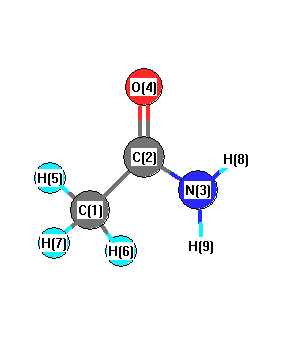
Vibrational Frequencies calculated at BLYP/cc-pVDZ
| Mode Number |
Symmetry |
Frequency
(cm-1) |
Scaled Frequency
(cm-1) |
IR Intensities
(km mol-1) |
Raman Act
(Å4/u) |
Dep P |
Dep U |
|---|
| 1 |
A |
3570 |
3576 |
15.00 |
|
|
|
| 2 |
A |
3435 |
3440 |
9.71 |
|
|
|
| 3 |
A |
3079 |
3084 |
7.53 |
|
|
|
| 4 |
A |
3019 |
3024 |
16.05 |
|
|
|
| 5 |
A |
2957 |
2961 |
9.58 |
|
|
|
| 6 |
A |
1725 |
1728 |
253.27 |
|
|
|
| 7 |
A |
1541 |
1544 |
73.94 |
|
|
|
| 8 |
A |
1417 |
1419 |
6.73 |
|
|
|
| 9 |
A |
1404 |
1406 |
9.04 |
|
|
|
| 10 |
A |
1332 |
1334 |
66.70 |
|
|
|
| 11 |
A |
1282 |
1284 |
83.11 |
|
|
|
| 12 |
A |
1086 |
1088 |
0.62 |
|
|
|
| 13 |
A |
1002 |
1004 |
2.71 |
|
|
|
| 14 |
A |
934 |
936 |
8.48 |
|
|
|
| 15 |
A |
808 |
809 |
4.45 |
|
|
|
| 16 |
A |
623 |
624 |
9.74 |
|
|
|
| 17 |
A |
536 |
537 |
15.34 |
|
|
|
| 18 |
A |
495 |
496 |
7.89 |
|
|
|
| 19 |
A |
404 |
405 |
3.93 |
|
|
|
| 20 |
A |
277 |
278 |
175.31 |
|
|
|
| 21 |
A |
54 |
54 |
0.07 |
|
|
|
Unscaled Zero Point Vibrational Energy (zpe) 15489.0 cm
-1
Scaled (by 1.0016) Zero Point Vibrational Energy (zpe) 15513.8 cm
-1
See section
III.C.1 List or set vibrational scaling factors
to change the scale factors used here.
See section
III.C.2
Calculate a vibrational scaling factor for a given set of molecules
to determine the least squares best scaling factor.
Charges, Dipole, Quadrupole and Polarizability
Charges from optimized geometry at BLYP/cc-pVDZ
Charges (e)
| Number |
Element |
Mulliken |
CHELPG |
AIM |
ESP |
| 1 |
C |
0.022 |
|
|
|
| 2 |
C |
-0.002 |
|
|
|
| 3 |
N |
-0.038 |
|
|
|
| 4 |
O |
-0.220 |
|
|
|
| 5 |
H |
0.029 |
|
|
|
| 6 |
H |
0.020 |
|
|
|
| 7 |
H |
0.032 |
|
|
|
| 8 |
H |
0.084 |
|
|
|
| 9 |
H |
0.074 |
|
|
|
Electric dipole moments
Electric dipole components in Debye
(What's a Debye? See section
VII.A.3)
| |
x |
y |
z |
Total |
| |
-0.129 |
-3.466 |
0.532 |
3.509 |
| CHELPG |
|
|
|
|
| AIM |
|
|
|
|
| ESP |
|
|
|
|
Electric Quadrupole moment
Quadrupole components in D Å
| Primitive |
|---|
| | x | y | z |
|---|
| x |
-21.091 |
-2.273 |
0.628 |
| y |
-2.273 |
-25.275 |
-0.800 |
| z |
0.628 |
-0.800 |
-24.611 |
|
| Traceless |
|---|
| | x | y | z |
|---|
| x |
3.852 |
-2.273 |
0.628 |
| y |
-2.273 |
-2.424 |
-0.800 |
| z |
0.628 |
-0.800 |
-1.428 |
|
| Polar |
|---|
| 3z2-r2 | -2.856 |
|---|
| x2-y2 | 4.184 |
|---|
| xy | -2.273 |
|---|
| xz | 0.628 |
|---|
| yz | -0.800 |
|---|
|
Polarizabilities
Components of the polarizability tensor.
Units are
Å
3 (Angstrom cubed)
Change units.
| |
x |
y |
z |
| x |
5.701 |
-0.142 |
0.041 |
| y |
-0.142 |
5.751 |
-0.032 |
| z |
0.041 |
-0.032 |
3.248 |
<r2> (average value of r
2) Å
2
| <r2> |
0.000 |
| (<r2>)1/2 |
0.000 |