return to home page Computational Chemistry Comparison and Benchmark DataBase Release 22 (May 2022) Standard Reference Database 101 National Institute of Standards and Technology
You are here: Calculated > Energy > Optimized > Energy

All results from a given calculation for C2H4O3 (1,2,3-trioxolane)

using model chemistry: CCSD(T)=FULL/cc-pVDZ

19 10 17 12 22

States and conformations

State Conformation minimum conformation conformer description state description
1 1 yes CS 1A'
Energy calculated at CCSD(T)=FULL/cc-pVDZ
 hartrees
Energy at 0K-303.360464
Energy at 298.15K-303.366950
HF Energy-302.443242
Nuclear repulsion energy191.798570
The energy at 298.15K was derived from the energy at 0K and an integrated heat capacity that used the calculated vibrational frequencies.
Vibrational Frequencies calculated at CCSD(T)=FULL/cc-pVDZ
Mode Number Symmetry Frequency
(cm-1)
Scaled Frequency
(cm-1)
IR Intensities
(km mol-1)
Raman Act
(Å4/u)
Dep P Dep U
1 A' 3159 3042        
2 A' 3075 2962        
3 A' 1508 1452        
4 A' 1342 1293        
5 A' 1239 1194        
6 A' 1024 987        
7 A' 947 912        
8 A' 860 828        
9 A' 839 809        
10 A' 693 667        
11 A' 408 393        
12 A" 3142 3026        
13 A" 3063 2950        
14 A" 1491 1436        
15 A" 1341 1291        
16 A" 1216 1172        
17 A" 1152 1110        
18 A" 1036 998        
19 A" 743 716        
20 A" 645 622        
21 A" 123 118        

Unscaled Zero Point Vibrational Energy (zpe) 14522.3 cm-1
Scaled (by 0.9632) Zero Point Vibrational Energy (zpe) 13987.9 cm-1
See section III.C.1 List or set vibrational scaling factors to change the scale factors used here.
See section III.C.2 Calculate a vibrational scaling factor for a given set of molecules to determine the least squares best scaling factor.
Rotational Constants (cm-1) from geometry optimized at CCSD(T)=FULL/cc-pVDZ
ABC
0.27155 0.24822 0.14608

See section I.F.4 to change rotational constant units
Geometric Data calculated at CCSD(T)=FULL/cc-pVDZ

Point Group is Cs

Cartesians (Å)
Atom x (Å) y (Å) z (Å)
O1 -0.595 -1.051 0.000
O2 0.148 -0.489 1.121
O3 0.148 -0.489 -1.121
C4 0.148 0.897 0.780
C5 0.148 0.897 -0.780
H6 1.062 1.327 1.221
H7 1.062 1.327 -1.221
H8 -0.750 1.408 1.174
H9 -0.750 1.408 -1.174

Atom - Atom Distances (Å)
  O1 O2 O3 C4 C5 H6 H7 H8 H9
O11.45801.45802.22612.22613.14523.14522.72942.7294
O21.45802.24281.42732.35302.03543.10152.09943.1101
O31.45802.24282.35301.42733.10152.03543.11012.0994
C42.22611.42732.35301.56031.10222.24161.10552.2102
C52.22612.35301.42731.56032.24161.10222.21021.1055
H63.14522.03543.10151.10222.24162.44181.81443.0040
H73.14523.10152.03542.24161.10222.44183.00401.8144
H82.72942.09943.11011.10552.21021.81443.00402.3475
H92.72943.11012.09942.21021.10553.00401.81442.3475

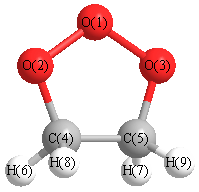
picture of 1,2,3-trioxolane state 1 conformation 1
More geometry information
Calculated Bond Angles
atom1 atom2 atom3 angle atom1 atom2 atom3 angle
O1 O2 C4 100.982 O1 O3 C5 100.982
O2 O1 O3 100.555 O2 C4 C5 103.834
O2 C4 H6 106.451 O2 C4 H8 111.337
O3 C5 C4 103.834 O3 C5 H7 106.451
O3 C5 H9 111.337 C4 C5 H7 113.569
C4 C5 H9 110.856 C5 C4 H6 113.569
C5 C4 H8 110.856 H6 C4 H8 110.535
H7 C5 H9 110.535
Electronic energy levels
Charges, Dipole, Quadrupole and Polarizability