return to home page Computational Chemistry Comparison and Benchmark DataBase Release 22 (May 2022) Standard Reference Database 101 National Institute of Standards and Technology
You are here: Calculated > Energy > Optimized > Energy

All results from a given calculation for C3H4O2 (Methyl glyoxal)

using model chemistry: CCSD(T)=FULL/cc-pVDZ

19 10 17 12 22

States and conformations

State Conformation minimum conformation conformer description state description
1 1 yes CS 1A'
Energy calculated at CCSD(T)=FULL/cc-pVDZ
 hartrees
Energy at 0K-266.489882
Energy at 298.15K-266.494006
HF Energy-265.659080
Nuclear repulsion energy158.778654
The energy at 298.15K was derived from the energy at 0K and an integrated heat capacity that used the calculated vibrational frequencies.
Vibrational Frequencies calculated at CCSD(T)=FULL/cc-pVDZ
Mode Number Symmetry Frequency
(cm-1)
Scaled Frequency
(cm-1)
IR Intensities
(km mol-1)
Raman Act
(Å4/u)
Dep P Dep U
1 A' 3190 3073        
2 A' 3067 2954        
3 A' 2974 2865        
4 A' 1792 1726        
5 A' 1773 1708        
6 A' 1451 1398        
7 A' 1391 1340        
8 A' 1355 1305        
9 A' 1266 1220        
10 A' 1009 972        
11 A' 798 769        
12 A' 575 554        
13 A' 478 460        
14 A' 246 237        
15 A" 3150 3034        
16 A" 1461 1408        
17 A" 1068 1029        
18 A" 906 873        
19 A" 469 452        
20 A" 149 143        
21 A" 103 99        

Unscaled Zero Point Vibrational Energy (zpe) 14335.6 cm-1
Scaled (by 0.9632) Zero Point Vibrational Energy (zpe) 13808.1 cm-1
See section III.C.1 List or set vibrational scaling factors to change the scale factors used here.
See section III.C.2 Calculate a vibrational scaling factor for a given set of molecules to determine the least squares best scaling factor.
Rotational Constants (cm-1) from geometry optimized at CCSD(T)=FULL/cc-pVDZ
ABC
0.29992 0.14634 0.10020

See section I.F.4 to change rotational constant units
Geometric Data calculated at CCSD(T)=FULL/cc-pVDZ

Point Group is Cs

Cartesians (Å)
Atom x (Å) y (Å) z (Å)
C1 -0.852 -0.722 0.000
C2 0.000 0.557 0.000
C3 1.502 0.370 0.000
O4 -0.369 -1.839 0.000
O5 -0.576 1.635 0.000
H6 -1.953 -0.521 0.000
H7 1.999 1.353 0.000
H8 1.806 -0.215 0.887
H9 1.806 -0.215 -0.887

Atom - Atom Distances (Å)
  C1 C2 C3 O4 O5 H6 H7 H8 H9
C11.53672.59511.21732.37271.11923.52572.84692.8469
C21.53671.51412.42491.22192.23042.15152.15472.1547
C32.59511.51412.89572.43313.56821.10081.10461.1046
O41.21732.42492.89573.48032.06083.97462.85562.8556
O52.37271.22192.43313.48032.55752.59063.14333.1433
H61.11922.23043.56822.06082.55754.37333.87363.8736
H73.52572.15151.10083.97462.59064.37331.81121.8112
H82.84692.15471.10462.85563.14333.87361.81121.7731
H92.84692.15471.10462.85563.14333.87361.81121.7731

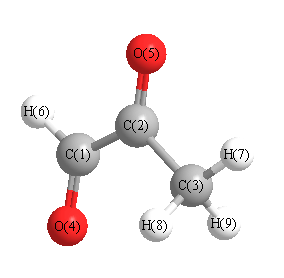
picture of Methyl glyoxal state 1 conformation 1
More geometry information
Calculated Bond Angles
atom1 atom2 atom3 angle atom1 atom2 atom3 angle
C1 C2 C3 116.562 C1 C2 O5 118.211
C2 C1 O4 122.983 C2 C1 H6 113.303
C2 C3 H7 109.718 C2 C3 H8 109.743
C2 C3 H9 109.743 C3 C2 O5 125.227
O4 C1 H6 123.713 H7 C3 H8 110.419
H7 C3 H9 110.419 H8 C3 H9 106.754
Electronic energy levels
Charges, Dipole, Quadrupole and Polarizability