Jump to
S1C2
Energy calculated at CCSD(T)=FULL/cc-pVDZ
| | hartrees |
|---|
| Energy at 0K | -1071.554115 |
| Energy at 298.15K | -1071.556624 |
| HF Energy | -1070.755157 |
| Nuclear repulsion energy | 261.584368 |
The energy at 298.15K was derived from the energy at 0K
and an integrated heat capacity that used the calculated vibrational frequencies.
Vibrational Frequencies calculated at CCSD(T)=FULL/cc-pVDZ
| Mode Number |
Symmetry |
Frequency
(cm-1) |
Scaled Frequency
(cm-1) |
IR Intensities
(km mol-1) |
Raman Act
(Å4/u) |
Dep P |
Dep U |
|---|
| 1 |
A' |
3174 |
3057 |
|
|
|
|
| 2 |
A' |
2991 |
2880 |
|
|
|
|
| 3 |
A' |
1804 |
1738 |
|
|
|
|
| 4 |
A' |
1395 |
1344 |
|
|
|
|
| 5 |
A' |
1212 |
1168 |
|
|
|
|
| 6 |
A' |
1084 |
1045 |
|
|
|
|
| 7 |
A' |
789 |
760 |
|
|
|
|
| 8 |
A' |
437 |
421 |
|
|
|
|
| 9 |
A' |
323 |
311 |
|
|
|
|
| 10 |
A' |
256 |
247 |
|
|
|
|
| 11 |
A" |
1238 |
1193 |
|
|
|
|
| 12 |
A" |
1004 |
967 |
|
|
|
|
| 13 |
A" |
749 |
721 |
|
|
|
|
| 14 |
A" |
286 |
276 |
|
|
|
|
| 15 |
A" |
83 |
80 |
|
|
|
|
Unscaled Zero Point Vibrational Energy (zpe) 8413.1 cm
-1
Scaled (by 0.9632) Zero Point Vibrational Energy (zpe) 8103.5 cm
-1
See section
III.C.1 List or set vibrational scaling factors
to change the scale factors used here.
See section
III.C.2
Calculate a vibrational scaling factor for a given set of molecules
to determine the least squares best scaling factor.
Geometric Data calculated at CCSD(T)=FULL/cc-pVDZ
Point Group is Cs
Cartesians (Å)
| Atom |
x (Å) |
y (Å) |
z (Å) |
|---|
| C1 |
0.392 |
-0.018 |
0.000 |
| C2 |
-0.173 |
1.405 |
0.000 |
| H3 |
1.491 |
0.001 |
0.000 |
| Cl4 |
-0.173 |
-0.848 |
1.484 |
| Cl5 |
-0.173 |
-0.848 |
-1.484 |
| O6 |
0.543 |
2.383 |
0.000 |
| H7 |
-1.289 |
1.450 |
0.000 |
Atom - Atom Distances (Å)
| |
C1 |
C2 |
H3 |
Cl4 |
Cl5 |
O6 |
H7 |
| C1 | | 1.5316 | 1.0989 | 1.7913 | 1.7913 | 2.4062 | 2.2330 |
C2 | 1.5316 | | 2.1773 | 2.6979 | 2.6979 | 1.2118 | 1.1178 | H3 | 1.0989 | 2.1773 | | 2.3852 | 2.3852 | 2.5642 | 3.1359 | Cl4 | 1.7913 | 2.6979 | 2.3852 | | 2.9673 | 3.6268 | 2.9550 | Cl5 | 1.7913 | 2.6979 | 2.3852 | 2.9673 | | 3.6268 | 2.9550 | O6 | 2.4062 | 1.2118 | 2.5642 | 3.6268 | 3.6268 | | 2.0562 | H7 | 2.2330 | 1.1178 | 3.1359 | 2.9550 | 2.9550 | 2.0562 | |
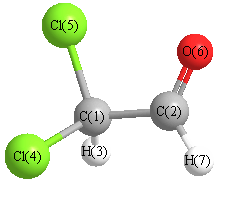 More geometry information
Calculated Bond Angles
| atom1 |
atom2 |
atom3 |
angle |
|
atom1 |
atom2 |
atom3 |
angle |
| C1 |
C2 |
O6 |
122.160 |
|
C1 |
C2 |
H7 |
113.967 |
| C2 |
C1 |
H3 |
110.654 |
|
C2 |
C1 |
Cl4 |
108.310 |
| C2 |
C1 |
Cl5 |
108.310 |
|
H3 |
C1 |
Cl4 |
108.866 |
| H3 |
C1 |
Cl5 |
108.866 |
|
Cl4 |
C1 |
Cl5 |
111.841 |
| O6 |
C2 |
H7 |
123.873 |
|
Electronic energy levels
Charges, Dipole, Quadrupole and Polarizability
Jump to
S1C1
Energy calculated at CCSD(T)=FULL/cc-pVDZ
| | hartrees |
|---|
| Energy at 0K | -1071.551660 |
| Energy at 298.15K | |
| HF Energy | -1070.752226 |
| Nuclear repulsion energy | 264.341462 |
The energy at 298.15K was derived from the energy at 0K
and an integrated heat capacity that used the calculated vibrational frequencies.
Vibrational Frequencies calculated at CCSD(T)=FULL/cc-pVDZ
| Mode Number |
Symmetry |
Frequency
(cm-1) |
Scaled Frequency
(cm-1) |
IR Intensities
(km mol-1) |
Raman Act
(Å4/u) |
Dep P |
Dep U |
|---|
| 1 |
A |
3124 |
3009 |
|
|
|
|
| 2 |
A |
2976 |
2866 |
|
|
|
|
| 3 |
A |
1816 |
1749 |
|
|
|
|
| 4 |
A |
1394 |
1342 |
|
|
|
|
| 5 |
A |
1267 |
1220 |
|
|
|
|
| 6 |
A |
1222 |
1177 |
|
|
|
|
| 7 |
A |
1034 |
996 |
|
|
|
|
| 8 |
A |
939 |
905 |
|
|
|
|
| 9 |
A |
828 |
797 |
|
|
|
|
| 10 |
A |
648 |
624 |
|
|
|
|
| 11 |
A |
617 |
594 |
|
|
|
|
| 12 |
A |
346 |
333 |
|
|
|
|
| 13 |
A |
276 |
265 |
|
|
|
|
| 14 |
A |
222 |
213 |
|
|
|
|
| 15 |
A |
88 |
85 |
|
|
|
|
Unscaled Zero Point Vibrational Energy (zpe) 8397.0 cm
-1
Scaled (by 0.9632) Zero Point Vibrational Energy (zpe) 8088.0 cm
-1
See section
III.C.1 List or set vibrational scaling factors
to change the scale factors used here.
See section
III.C.2
Calculate a vibrational scaling factor for a given set of molecules
to determine the least squares best scaling factor.
Geometric Data calculated at CCSD(T)=FULL/cc-pVDZ
Point Group is C1
Cartesians (Å)
| Atom |
x (Å) |
y (Å) |
z (Å) |
|---|
| C1 |
0.103 |
-0.026 |
0.525 |
| C2 |
-0.716 |
-1.289 |
0.195 |
| H3 |
0.232 |
0.057 |
1.617 |
| Cl4 |
1.747 |
-0.258 |
-0.170 |
| Cl5 |
-0.682 |
1.454 |
-0.058 |
| O6 |
-1.809 |
-1.283 |
-0.319 |
| H7 |
-0.183 |
-2.227 |
0.493 |
Atom - Atom Distances (Å)
| |
C1 |
C2 |
H3 |
Cl4 |
Cl5 |
O6 |
H7 |
| C1 | | 1.5408 | 1.1026 | 1.8001 | 1.7734 | 2.4390 | 2.2194 |
C2 | 1.5408 | | 2.1752 | 2.6948 | 2.7547 | 1.2085 | 1.1186 | H3 | 1.1026 | 2.1752 | | 2.3640 | 2.3642 | 3.1163 | 2.5792 | Cl4 | 1.8001 | 2.6948 | 2.3640 | | 2.9735 | 3.7040 | 2.8357 | Cl5 | 1.7734 | 2.7547 | 2.3642 | 2.9735 | | 2.9713 | 3.7546 | O6 | 2.4390 | 1.2085 | 3.1163 | 3.7040 | 2.9713 | | 2.0480 | H7 | 2.2194 | 1.1186 | 2.5792 | 2.8357 | 3.7546 | 2.0480 | |
More geometry information
Calculated Bond Angles
| atom1 |
atom2 |
atom3 |
angle |
|
atom1 |
atom2 |
atom3 |
angle |
| C1 |
C2 |
O6 |
124.587 |
|
C1 |
C2 |
H7 |
112.160 |
| C2 |
C1 |
H3 |
109.633 |
|
C2 |
C1 |
Cl4 |
107.278 |
| C2 |
C1 |
Cl5 |
112.248 |
|
H3 |
C1 |
Cl4 |
106.573 |
| H3 |
C1 |
Cl5 |
108.308 |
|
Cl4 |
C1 |
Cl5 |
112.630 |
| O6 |
C2 |
H7 |
123.252 |
|
Electronic energy levels
Charges, Dipole, Quadrupole and Polarizability
