Jump to
S1C2
Energy calculated at CCSD(T)/cc-pVTZ
| | hartrees |
|---|
| Energy at 0K | -191.597058 |
| Energy at 298.15K | |
| HF Energy | -190.832528 |
| Nuclear repulsion energy | 102.878072 |
The energy at 298.15K was derived from the energy at 0K
and an integrated heat capacity that used the calculated vibrational frequencies.
Vibrational Frequencies calculated at CCSD(T)/cc-pVTZ
| Mode Number |
Symmetry |
Frequency
(cm-1) |
Scaled Frequency
(cm-1) |
IR Intensities
(km mol-1) |
Raman Act
(Å4/u) |
Dep P |
Dep U |
|---|
| 1 |
A' |
3242 |
3161 |
|
|
|
|
| 2 |
A' |
3196 |
3116 |
|
|
|
|
| 3 |
A' |
3145 |
3066 |
|
|
|
|
| 4 |
A' |
2922 |
2848 |
|
|
|
|
| 5 |
A' |
1765 |
1720 |
|
|
|
|
| 6 |
A' |
1663 |
1621 |
|
|
|
|
| 7 |
A' |
1458 |
1421 |
|
|
|
|
| 8 |
A' |
1391 |
1356 |
|
|
|
|
| 9 |
A' |
1293 |
1260 |
|
|
|
|
| 10 |
A' |
1171 |
1141 |
|
|
|
|
| 11 |
A' |
920 |
897 |
|
|
|
|
| 12 |
A' |
568 |
554 |
|
|
|
|
| 13 |
A' |
315 |
307 |
|
|
|
|
| 14 |
A" |
1025 |
999 |
|
|
|
|
| 15 |
A" |
1010 |
985 |
|
|
|
|
| 16 |
A" |
975 |
950 |
|
|
|
|
| 17 |
A" |
608 |
592 |
|
|
|
|
| 18 |
A" |
165 |
161 |
|
|
|
|
Unscaled Zero Point Vibrational Energy (zpe) 13414.8 cm
-1
Scaled (by 0.9748) Zero Point Vibrational Energy (zpe) 13076.8 cm
-1
See section
III.C.1 List or set vibrational scaling factors
to change the scale factors used here.
See section
III.C.2
Calculate a vibrational scaling factor for a given set of molecules
to determine the least squares best scaling factor.
Geometric Data calculated at CCSD(T)/cc-pVTZ
Point Group is Cs
Cartesians (Å)
| Atom |
x (Å) |
y (Å) |
z (Å) |
|---|
| C1 |
-0.153 |
-0.744 |
0.000 |
| C2 |
0.000 |
0.725 |
0.000 |
| C3 |
1.222 |
1.277 |
0.000 |
| O4 |
-1.223 |
-1.320 |
0.000 |
| H5 |
0.801 |
-1.307 |
0.000 |
| H6 |
-0.908 |
1.316 |
0.000 |
| H7 |
1.370 |
2.349 |
0.000 |
| H8 |
2.109 |
0.652 |
0.000 |
Atom - Atom Distances (Å)
| |
C1 |
C2 |
C3 |
O4 |
H5 |
H6 |
H7 |
H8 |
| C1 | | 1.4776 | 2.4455 | 1.2147 | 1.1078 | 2.1944 | 3.4487 | 2.6586 |
C2 | 1.4776 | | 1.3413 | 2.3828 | 2.1844 | 1.0835 | 2.1251 | 2.1103 | C3 | 2.4455 | 1.3413 | | 3.5673 | 2.6187 | 2.1308 | 1.0820 | 1.0851 | O4 | 1.2147 | 2.3828 | 3.5673 | | 2.0240 | 2.6546 | 4.4931 | 3.8718 | H5 | 1.1078 | 2.1844 | 2.6187 | 2.0240 | | 3.1308 | 3.7005 | 2.3556 | H6 | 2.1944 | 1.0835 | 2.1308 | 2.6546 | 3.1308 | | 2.5019 | 3.0894 | H7 | 3.4487 | 2.1251 | 1.0820 | 4.4931 | 3.7005 | 2.5019 | | 1.8511 | H8 | 2.6586 | 2.1103 | 1.0851 | 3.8718 | 2.3556 | 3.0894 | 1.8511 | |
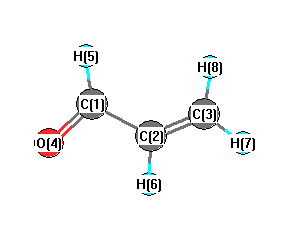 More geometry information
Calculated Bond Angles
| atom1 |
atom2 |
atom3 |
angle |
|
atom1 |
atom2 |
atom3 |
angle |
| C1 |
C2 |
C3 |
120.274 |
|
C1 |
C2 |
H6 |
117.094 |
| C2 |
C1 |
O4 |
124.227 |
|
C2 |
C1 |
H5 |
114.569 |
| C2 |
C3 |
H7 |
122.185 |
|
C2 |
C3 |
H8 |
120.481 |
| C3 |
C2 |
H6 |
122.632 |
|
O4 |
C1 |
H5 |
121.205 |
| H7 |
C3 |
H8 |
117.335 |
|
Electronic energy levels
Charges, Dipole, Quadrupole and Polarizability
Jump to
S1C1
Energy calculated at CCSD(T)/cc-pVTZ
| | hartrees |
|---|
| Energy at 0K | -191.594181 |
| Energy at 298.15K | |
| HF Energy | -190.828856 |
| Nuclear repulsion energy | 104.444005 |
The energy at 298.15K was derived from the energy at 0K
and an integrated heat capacity that used the calculated vibrational frequencies.
Vibrational Frequencies calculated at CCSD(T)/cc-pVTZ
| Mode Number |
Symmetry |
Frequency
(cm-1) |
Scaled Frequency
(cm-1) |
IR Intensities
(km mol-1) |
Raman Act
(Å4/u) |
Dep P |
Dep U |
|---|
| 1 |
A' |
3252 |
3170 |
|
|
|
|
| 2 |
A' |
3183 |
3103 |
|
|
|
|
| 3 |
A' |
3153 |
3073 |
|
|
|
|
| 4 |
A' |
2948 |
2874 |
|
|
|
|
| 5 |
A' |
1761 |
1716 |
|
|
|
|
| 6 |
A' |
1658 |
1617 |
|
|
|
|
| 7 |
A' |
1439 |
1403 |
|
|
|
|
| 8 |
A' |
1430 |
1394 |
|
|
|
|
| 9 |
A' |
1306 |
1273 |
|
|
|
|
| 10 |
A' |
1065 |
1038 |
|
|
|
|
| 11 |
A' |
933 |
910 |
|
|
|
|
| 12 |
A' |
677 |
660 |
|
|
|
|
| 13 |
A' |
285 |
278 |
|
|
|
|
| 14 |
A" |
1023 |
997 |
|
|
|
|
| 15 |
A" |
1012 |
986 |
|
|
|
|
| 16 |
A" |
984 |
959 |
|
|
|
|
| 17 |
A" |
558 |
543 |
|
|
|
|
| 18 |
A" |
153 |
149 |
|
|
|
|
Unscaled Zero Point Vibrational Energy (zpe) 13408.8 cm
-1
Scaled (by 0.9748) Zero Point Vibrational Energy (zpe) 13070.9 cm
-1
See section
III.C.1 List or set vibrational scaling factors
to change the scale factors used here.
See section
III.C.2
Calculate a vibrational scaling factor for a given set of molecules
to determine the least squares best scaling factor.
Geometric Data calculated at CCSD(T)/cc-pVTZ
Point Group is Cs
Cartesians (Å)
| Atom |
x (Å) |
y (Å) |
z (Å) |
|---|
| C1 |
-0.893 |
-0.288 |
0.000 |
| C2 |
0.000 |
0.903 |
0.000 |
| C3 |
1.334 |
0.767 |
0.000 |
| O4 |
-0.495 |
-1.437 |
0.000 |
| H5 |
-1.977 |
-0.072 |
0.000 |
| H6 |
-0.472 |
1.879 |
0.000 |
| H7 |
1.993 |
1.626 |
0.000 |
| H8 |
1.773 |
-0.224 |
0.000 |
Atom - Atom Distances (Å)
| |
C1 |
C2 |
C3 |
O4 |
H5 |
H6 |
H7 |
H8 |
| C1 | | 1.4889 | 2.4650 | 1.2156 | 1.1049 | 2.2078 | 3.4633 | 2.6677 |
C2 | 1.4889 | | 1.3411 | 2.3914 | 2.2040 | 1.0843 | 2.1199 | 2.1009 | C3 | 2.4650 | 1.3411 | | 2.8641 | 3.4156 | 2.1211 | 1.0823 | 1.0837 | O4 | 1.2156 | 2.3914 | 2.8641 | | 2.0148 | 3.3158 | 3.9458 | 2.5725 | H5 | 1.1049 | 2.2040 | 3.4156 | 2.0148 | | 2.4635 | 4.3173 | 3.7534 | H6 | 2.2078 | 1.0843 | 2.1211 | 3.3158 | 2.4635 | | 2.4778 | 3.0762 | H7 | 3.4633 | 2.1199 | 1.0823 | 3.9458 | 4.3173 | 2.4778 | | 1.8625 | H8 | 2.6677 | 2.1009 | 1.0837 | 2.5725 | 3.7534 | 3.0762 | 1.8625 | |
More geometry information
Calculated Bond Angles
| atom1 |
atom2 |
atom3 |
angle |
|
atom1 |
atom2 |
atom3 |
angle |
| C1 |
C2 |
C3 |
121.065 |
|
C1 |
C2 |
H6 |
117.315 |
| C2 |
C1 |
O4 |
123.997 |
|
C2 |
C1 |
H5 |
115.565 |
| C2 |
C3 |
H7 |
121.670 |
|
C2 |
C3 |
H8 |
119.720 |
| C3 |
C2 |
H6 |
121.620 |
|
O4 |
C1 |
H5 |
120.438 |
| H7 |
C3 |
H8 |
118.610 |
|
Electronic energy levels
Charges, Dipole, Quadrupole and Polarizability
