Jump to
S1C2
Energy calculated at CCSD(T)/cc-pVTZ
| | hartrees |
|---|
| Energy at 0K | -3110.916492 |
| Energy at 298.15K | |
| HF Energy | -3110.078920 |
| Nuclear repulsion energy | 289.074018 |
The energy at 298.15K was derived from the energy at 0K
and an integrated heat capacity that used the calculated vibrational frequencies.
Vibrational Frequencies calculated at CCSD(T)/cc-pVTZ
| Mode Number |
Symmetry |
Frequency
(cm-1) |
Scaled Frequency
(cm-1) |
IR Intensities
(km mol-1) |
Raman Act
(Å4/u) |
Dep P |
Dep U |
|---|
| 1 |
A' |
194 |
189 |
|
|
|
|
| 2 |
A' |
251 |
244 |
|
|
|
|
| 3 |
A' |
664 |
648 |
|
|
|
|
| 4 |
A' |
759 |
740 |
|
|
|
|
| 5 |
A' |
1080 |
1053 |
|
|
|
|
| 6 |
A' |
1230 |
1199 |
|
|
|
|
| 7 |
A' |
1320 |
1287 |
|
|
|
|
| 8 |
A' |
1487 |
1449 |
|
|
|
|
| 9 |
A' |
1495 |
1457 |
|
|
|
|
| 10 |
A' |
3106 |
3028 |
|
|
|
|
| 11 |
A' |
3118 |
3039 |
|
|
|
|
| 12 |
A" |
114 |
112 |
|
|
|
|
| 13 |
A" |
764 |
745 |
|
|
|
|
| 14 |
A" |
979 |
954 |
|
|
|
|
| 15 |
A" |
1130 |
1101 |
|
|
|
|
| 16 |
A" |
1297 |
1264 |
|
|
|
|
| 17 |
A" |
3164 |
3084 |
|
|
|
|
| 18 |
A" |
3189 |
3109 |
|
|
|
|
Unscaled Zero Point Vibrational Energy (zpe) 12669.5 cm
-1
Scaled (by 0.9748) Zero Point Vibrational Energy (zpe) 12350.2 cm
-1
See section
III.C.1 List or set vibrational scaling factors
to change the scale factors used here.
See section
III.C.2
Calculate a vibrational scaling factor for a given set of molecules
to determine the least squares best scaling factor.
Geometric Data calculated at CCSD(T)/cc-pVTZ
Point Group is Cs
Cartesians (Å)
| Atom |
x (Å) |
y (Å) |
z (Å) |
|---|
| C1 |
0.000 |
0.644 |
0.000 |
| C2 |
1.228 |
-0.239 |
0.000 |
| Br3 |
-1.590 |
-0.481 |
0.000 |
| Cl4 |
2.697 |
0.801 |
0.000 |
| H5 |
-0.048 |
1.265 |
0.890 |
| H6 |
-0.048 |
1.265 |
-0.890 |
| H7 |
1.270 |
-0.863 |
0.889 |
| H8 |
1.270 |
-0.863 |
-0.889 |
Atom - Atom Distances (Å)
| |
C1 |
C2 |
Br3 |
Cl4 |
H5 |
H6 |
H7 |
H8 |
| C1 | | 1.5129 | 1.9483 | 2.7011 | 1.0861 | 1.0861 | 2.1623 | 2.1623 |
C2 | 1.5129 | | 2.8284 | 1.7997 | 2.1642 | 2.1642 | 1.0869 | 1.0869 | Br3 | 1.9483 | 2.8284 | | 4.4743 | 2.4939 | 2.4939 | 3.0190 | 3.0190 | Cl4 | 2.7011 | 1.7997 | 4.4743 | | 2.9226 | 2.9226 | 2.3656 | 2.3656 | H5 | 1.0861 | 2.1642 | 2.4939 | 2.9226 | | 1.7802 | 2.5033 | 3.0711 | H6 | 1.0861 | 2.1642 | 2.4939 | 2.9226 | 1.7802 | | 3.0711 | 2.5033 | H7 | 2.1623 | 1.0869 | 3.0190 | 2.3656 | 2.5033 | 3.0711 | | 1.7778 | H8 | 2.1623 | 1.0869 | 3.0190 | 2.3656 | 3.0711 | 2.5033 | 1.7778 | |
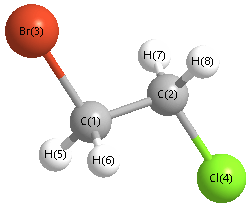 More geometry information
Calculated Bond Angles
| atom1 |
atom2 |
atom3 |
angle |
|
atom1 |
atom2 |
atom3 |
angle |
| C1 |
C2 |
Cl4 |
108.951 |
|
C1 |
C2 |
H7 |
111.504 |
| C1 |
C2 |
H8 |
111.504 |
|
C2 |
C1 |
Br3 |
108.959 |
| C2 |
C1 |
Cl4 |
39.062 |
|
C2 |
C1 |
H6 |
111.701 |
| Br3 |
C1 |
H5 |
107.092 |
|
Br3 |
C1 |
H6 |
107.092 |
| Cl4 |
C2 |
H7 |
107.488 |
|
Cl4 |
C2 |
H8 |
107.488 |
| H5 |
C1 |
H6 |
110.075 |
|
H7 |
C2 |
H8 |
109.737 |
Electronic energy levels
Charges, Dipole, Quadrupole and Polarizability
Jump to
S1C1
Energy calculated at CCSD(T)/cc-pVTZ
| | hartrees |
|---|
| Energy at 0K | -3110.913820 |
| Energy at 298.15K | |
| HF Energy | -3110.075379 |
| Nuclear repulsion energy | 305.453758 |
The energy at 298.15K was derived from the energy at 0K
and an integrated heat capacity that used the calculated vibrational frequencies.
Vibrational Frequencies calculated at CCSD(T)/cc-pVTZ
| Mode Number |
Symmetry |
Frequency
(cm-1) |
Scaled Frequency
(cm-1) |
IR Intensities
(km mol-1) |
Raman Act
(Å4/u) |
Dep P |
Dep U |
|---|
| 1 |
A |
3166 |
3086 |
|
|
|
|
| 2 |
A |
3148 |
3069 |
|
|
|
|
| 3 |
A |
3098 |
3020 |
|
|
|
|
| 4 |
A |
3084 |
3006 |
|
|
|
|
| 5 |
A |
1479 |
1441 |
|
|
|
|
| 6 |
A |
1468 |
1431 |
|
|
|
|
| 7 |
A |
1337 |
1303 |
|
|
|
|
| 8 |
A |
1301 |
1268 |
|
|
|
|
| 9 |
A |
1215 |
1184 |
|
|
|
|
| 10 |
A |
1149 |
1120 |
|
|
|
|
| 11 |
A |
1054 |
1027 |
|
|
|
|
| 12 |
A |
942 |
918 |
|
|
|
|
| 13 |
A |
880 |
858 |
|
|
|
|
| 14 |
A |
690 |
673 |
|
|
|
|
| 15 |
A |
594 |
579 |
|
|
|
|
| 16 |
A |
386 |
377 |
|
|
|
|
| 17 |
A |
244 |
238 |
|
|
|
|
| 18 |
A |
100 |
97 |
|
|
|
|
Unscaled Zero Point Vibrational Energy (zpe) 12666.7 cm
-1
Scaled (by 0.9748) Zero Point Vibrational Energy (zpe) 12347.5 cm
-1
See section
III.C.1 List or set vibrational scaling factors
to change the scale factors used here.
See section
III.C.2
Calculate a vibrational scaling factor for a given set of molecules
to determine the least squares best scaling factor.
Geometric Data calculated at CCSD(T)/cc-pVTZ
Point Group is C1
Cartesians (Å)
| Atom |
x (Å) |
y (Å) |
z (Å) |
|---|
| C1 |
0.006 |
1.100 |
-0.389 |
| C2 |
1.276 |
0.901 |
0.408 |
| Br3 |
-1.349 |
-0.225 |
0.036 |
| Cl4 |
2.161 |
-0.575 |
-0.087 |
| H5 |
-0.430 |
2.069 |
-0.151 |
| H6 |
0.192 |
1.031 |
-1.458 |
| H7 |
1.946 |
1.743 |
0.236 |
| H8 |
1.067 |
0.814 |
1.472 |
Atom - Atom Distances (Å)
| |
C1 |
C2 |
Br3 |
Cl4 |
H5 |
H6 |
H7 |
H8 |
| C1 | | 1.5132 | 1.9424 | 2.7465 | 1.0888 | 1.0869 | 2.1378 | 2.1617 |
C2 | 1.5132 | | 2.8806 | 1.7911 | 2.1419 | 2.1622 | 1.0898 | 1.0875 | Br3 | 1.9424 | 2.8806 | | 3.5299 | 2.4784 | 2.4870 | 3.8434 | 2.9963 | Cl4 | 2.7465 | 1.7911 | 3.5299 | | 3.7026 | 2.8870 | 2.3504 | 2.3575 | H5 | 1.0888 | 2.1419 | 2.4784 | 3.7026 | | 1.7812 | 2.4295 | 2.5398 | H6 | 1.0869 | 2.1622 | 2.4870 | 2.8870 | 1.7812 | | 2.5406 | 3.0655 | H7 | 2.1378 | 1.0898 | 3.8434 | 2.3504 | 2.4295 | 2.5406 | | 1.7786 | H8 | 2.1617 | 1.0875 | 2.9963 | 2.3575 | 2.5398 | 3.0655 | 1.7786 | |
More geometry information
Calculated Bond Angles
| atom1 |
atom2 |
atom3 |
angle |
|
atom1 |
atom2 |
atom3 |
angle |
| C1 |
C2 |
Cl4 |
112.174 |
|
C1 |
C2 |
H7 |
109.347 |
| C1 |
C2 |
H8 |
111.396 |
|
C2 |
C1 |
Br3 |
112.348 |
| C2 |
C1 |
Cl4 |
37.149 |
|
C2 |
C1 |
H6 |
111.468 |
| Br3 |
C1 |
H5 |
106.258 |
|
Br3 |
C1 |
H6 |
106.953 |
| Cl4 |
C2 |
H7 |
106.807 |
|
Cl4 |
C2 |
H8 |
107.437 |
| H5 |
C1 |
H6 |
109.913 |
|
H7 |
C2 |
H8 |
109.544 |
Electronic energy levels
Charges, Dipole, Quadrupole and Polarizability
