return to home page Computational Chemistry Comparison and Benchmark DataBase Release 22 (May 2022) Standard Reference Database 101 National Institute of Standards and Technology
You are here: Calculated > Energy > Optimized > Energy

All results from a given calculation for CH2ClCH2OH (2-Chloroethanol)

using model chemistry: QCISD(T)/cc-pVTZ

19 10 17 12 22

States and conformations

State Conformation minimum conformation conformer description state description
1 1 yes CS 1A'
Energy calculated at QCISD(T)/cc-pVTZ
 hartrees
Energy at 0K-613.928913
Energy at 298.15K-613.934794
HF Energy-613.080296
Nuclear repulsion energy159.180016
The energy at 298.15K was derived from the energy at 0K and an integrated heat capacity that used the calculated vibrational frequencies.
Vibrational Frequencies calculated at QCISD(T)/cc-pVTZ
Mode Number Symmetry Frequency
(cm-1)
Scaled Frequency
(cm-1)
IR Intensities
(km mol-1)
Raman Act
(Å4/u)
Dep P Dep U
1 A' 3858 3660        
2 A' 3103 2944        
3 A' 3021 2866        
4 A' 1534 1456        
5 A' 1501 1424        
6 A' 1462 1387        
7 A' 1305 1238        
8 A' 1240 1176        
9 A' 1082 1026        
10 A' 1039 986        
11 A' 786 745        
12 A' 390 370        
13 A' 246 233        
14 A" 3167 3004        
15 A" 3064 2906        
16 A" 1309 1242        
17 A" 1213 1151        
18 A" 1064 1009        
19 A" 801 760        
20 A" 209 198        
21 A" 125 119        

Unscaled Zero Point Vibrational Energy (zpe) 15759.2 cm-1
Scaled (by 0.9486) Zero Point Vibrational Energy (zpe) 14949.2 cm-1
See section III.C.1 List or set vibrational scaling factors to change the scale factors used here.
See section III.C.2 Calculate a vibrational scaling factor for a given set of molecules to determine the least squares best scaling factor.
Rotational Constants (cm-1) from geometry optimized at QCISD(T)/cc-pVTZ
ABC
0.98003 0.08178 0.07770

See section I.F.4 to change rotational constant units
Geometric Data calculated at QCISD(T)/cc-pVTZ

Point Group is Cs

Cartesians (Å)
Atom x (Å) y (Å) z (Å)
C1 0.965 -0.555 0.000
C2 0.000 0.615 0.000
Cl3 -1.688 0.006 0.000
O4 2.269 0.016 0.000
H5 0.790 -1.171 0.888
H6 0.790 -1.171 -0.888
H7 0.133 1.227 0.889
H8 0.133 1.227 -0.889
H9 2.905 -0.704 0.000

Atom - Atom Distances (Å)
  C1 C2 Cl3 O4 H5 H6 H7 H8 H9
C11.51662.71201.42301.09491.09492.15812.15811.9452
C21.51661.79422.34672.14502.14501.08731.08733.1902
Cl32.71201.79423.95682.88342.88342.36512.36514.6473
O41.42302.34673.95682.09382.09382.61162.61160.9604
H51.09492.14502.88342.09381.77632.48583.05572.3408
H61.09492.14502.88342.09381.77633.05572.48582.3408
H72.15811.08732.36512.61162.48583.05571.77803.4932
H82.15811.08732.36512.61163.05572.48581.77803.4932
H91.94523.19024.64730.96042.34082.34083.49323.4932

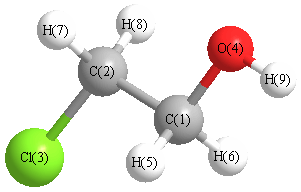
picture of 2-Chloroethanol state 1 conformation 1
More geometry information
Calculated Bond Angles
atom1 atom2 atom3 angle atom1 atom2 atom3 angle
C1 C2 Cl3 109.710 C1 C2 H7 110.872
C1 C2 H8 110.872 C1 O4 H9 107.826
C2 C1 O4 105.896 C2 C1 H5 109.379
C2 C1 H6 109.379 Cl3 C2 H7 107.792
Cl3 C2 H8 107.792 O4 C1 H5 111.857
O4 C1 H6 111.857 H5 C1 H6 108.417
H7 C2 H8 109.701
Electronic energy levels
Charges, Dipole, Quadrupole and Polarizability