Jump to
S1C2
Vibrational Frequencies calculated at CCSD(T)/cc-pVTZ
Geometric Data calculated at CCSD(T)/cc-pVTZ
Electronic energy levels
Charges, Dipole, Quadrupole and Polarizability
Jump to
S1C1
Energy calculated at CCSD(T)/cc-pVTZ
| | hartrees |
|---|
| Energy at 0K | -207.640738 |
| Energy at 298.15K | -207.644060 |
| HF Energy | -206.845793 |
| Nuclear repulsion energy | 101.909020 |
The energy at 298.15K was derived from the energy at 0K
and an integrated heat capacity that used the calculated vibrational frequencies.
Vibrational Frequencies calculated at CCSD(T)/cc-pVTZ
| Mode Number |
Symmetry |
Frequency
(cm-1) |
Scaled Frequency
(cm-1) |
IR Intensities
(km mol-1) |
Raman Act
(Å4/u) |
Dep P |
Dep U |
|---|
| 1 |
A |
3842 |
3746 |
|
|
|
|
| 2 |
A |
3127 |
3048 |
|
|
|
|
| 3 |
A |
3050 |
2973 |
|
|
|
|
| 4 |
A |
2284 |
2226 |
|
|
|
|
| 5 |
A |
1501 |
1464 |
|
|
|
|
| 6 |
A |
1428 |
1392 |
|
|
|
|
| 7 |
A |
1385 |
1350 |
|
|
|
|
| 8 |
A |
1237 |
1206 |
|
|
|
|
| 9 |
A |
1097 |
1069 |
|
|
|
|
| 10 |
A |
994 |
969 |
|
|
|
|
| 11 |
A |
895 |
872 |
|
|
|
|
| 12 |
A |
572 |
557 |
|
|
|
|
| 13 |
A |
370 |
361 |
|
|
|
|
| 14 |
A |
294 |
287 |
|
|
|
|
| 15 |
A |
210 |
204 |
|
|
|
|
Unscaled Zero Point Vibrational Energy (zpe) 11142.3 cm
-1
Scaled (by 0.9748) Zero Point Vibrational Energy (zpe) 10861.5 cm
-1
See section
III.C.1 List or set vibrational scaling factors
to change the scale factors used here.
See section
III.C.2
Calculate a vibrational scaling factor for a given set of molecules
to determine the least squares best scaling factor.
Geometric Data calculated at CCSD(T)/cc-pVTZ
Point Group is C1
Cartesians (Å)
| Atom |
x (Å) |
y (Å) |
z (Å) |
|---|
| C1 |
-0.576 |
0.592 |
0.038 |
| C2 |
0.825 |
0.113 |
-0.006 |
| O3 |
-1.512 |
-0.455 |
-0.110 |
| H4 |
-0.714 |
1.152 |
0.968 |
| H5 |
-0.733 |
1.275 |
-0.795 |
| H6 |
-1.391 |
-1.069 |
0.620 |
| N7 |
1.920 |
-0.279 |
-0.015 |
Atom - Atom Distances (Å)
| |
C1 |
C2 |
O3 |
H4 |
H5 |
H6 |
N7 |
| C1 | | 1.4816 | 1.4113 | 1.0939 | 1.0891 | 1.9387 | 2.6440 |
C2 | 1.4816 | | 2.4074 | 2.0969 | 2.0974 | 2.5888 | 1.1626 | O3 | 1.4113 | 2.4074 | | 2.0927 | 2.0169 | 0.9617 | 3.4374 | H4 | 1.0939 | 2.0969 | 2.0927 | | 1.7671 | 2.3474 | 3.1545 | H5 | 1.0891 | 2.0974 | 2.0169 | 1.7671 | | 2.8158 | 3.1714 | H6 | 1.9387 | 2.5888 | 0.9617 | 2.3474 | 2.8158 | | 3.4626 | N7 | 2.6440 | 1.1626 | 3.4374 | 3.1545 | 3.1714 | 3.4626 | |
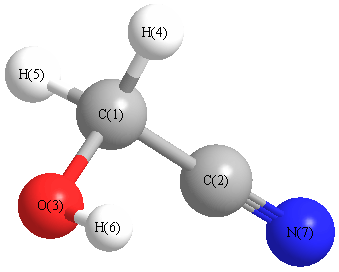 More geometry information
Calculated Bond Angles
| atom1 |
atom2 |
atom3 |
angle |
|
atom1 |
atom2 |
atom3 |
angle |
| C1 |
C2 |
N7 |
178.450 |
|
C1 |
O3 |
H6 |
108.070 |
| C2 |
C1 |
O3 |
112.621 |
|
C2 |
C1 |
H4 |
108.063 |
| C2 |
C1 |
H5 |
108.383 |
|
O3 |
C1 |
H4 |
112.686 |
| O3 |
C1 |
H5 |
106.829 |
|
H4 |
C1 |
H5 |
108.088 |
Electronic energy levels
Charges, Dipole, Quadrupole and Polarizability
