Jump to
S2C1
Energy calculated at QCISD(T)=FULL/cc-pVTZ
| | hartrees |
|---|
| Energy at 0K | -151.057795 |
| Energy at 298.15K | -151.056188 |
| HF Energy | -150.518103 |
| Nuclear repulsion energy | 45.871540 |
The energy at 298.15K was derived from the energy at 0K
and an integrated heat capacity that used the calculated vibrational frequencies.
Geometric Data calculated at QCISD(T)=FULL/cc-pVTZ
Point Group is C∞v
Cartesians (Å)
| Atom |
x (Å) |
y (Å) |
z (Å) |
|---|
| C1 |
0.000 |
0.000 |
-1.419 |
| C2 |
0.000 |
0.000 |
-0.056 |
| O3 |
0.000 |
0.000 |
1.107 |
Atom - Atom Distances (Å)
| |
C1 |
C2 |
O3 |
| C1 | | 1.3631 | 2.5258 |
C2 | 1.3631 | | 1.1628 | O3 | 2.5258 | 1.1628 | |
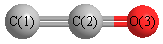 More geometry information
Calculated Bond Angles
| atom1 |
atom2 |
atom3 |
angle |
|
atom1 |
atom2 |
atom3 |
angle |
| C1 |
C2 |
O3 |
180.000 |
|
Electronic energy levels
Charges, Dipole, Quadrupole and Polarizability
Jump to
S1C1
Energy calculated at QCISD(T)=FULL/cc-pVTZ
| | hartrees |
|---|
| Energy at 0K | -151.026582 |
| Energy at 298.15K | -151.024982 |
| HF Energy | -150.456528 |
| Nuclear repulsion energy | 45.662161 |
The energy at 298.15K was derived from the energy at 0K
and an integrated heat capacity that used the calculated vibrational frequencies.
Geometric Data calculated at QCISD(T)=FULL/cc-pVTZ
Point Group is C∞v
Cartesians (Å)
| Atom |
x (Å) |
y (Å) |
z (Å) |
|---|
| C1 |
0.000 |
0.000 |
-1.422 |
| C2 |
0.000 |
0.000 |
-0.061 |
| O3 |
0.000 |
0.000 |
1.112 |
Atom - Atom Distances (Å)
| |
C1 |
C2 |
O3 |
| C1 | | 1.3602 | 2.5340 |
C2 | 1.3602 | | 1.1738 | O3 | 2.5340 | 1.1738 | |
More geometry information
Calculated Bond Angles
| atom1 |
atom2 |
atom3 |
angle |
|
atom1 |
atom2 |
atom3 |
angle |
| C1 |
C2 |
O3 |
180.000 |
|
Electronic energy levels
Charges, Dipole, Quadrupole and Polarizability
