Jump to
S2C1
Energy calculated at B2PLYP=FULL/cc-pVTZ
| | hartrees |
|---|
| Energy at 0K | -152.020989 |
| Energy at 298.15K | |
| HF Energy | -151.834954 |
| Nuclear repulsion energy | 63.553430 |
The energy at 298.15K was derived from the energy at 0K
and an integrated heat capacity that used the calculated vibrational frequencies.
Vibrational Frequencies calculated at B2PLYP=FULL/cc-pVTZ
| Mode Number |
Symmetry |
Frequency
(cm-1) |
Scaled Frequency
(cm-1) |
IR Intensities
(km mol-1) |
Raman Act
(Å4/u) |
Dep P |
Dep U |
|---|
| 1 |
Σg |
2131 |
2037 |
0.00 |
50.15 |
0.53 |
0.69 |
| 2 |
Σg |
937 |
896 |
0.00 |
73.58 |
0.38 |
0.55 |
| 3 |
Σu |
1588 |
1518 |
341.00 |
0.00 |
0.33 |
0.50 |
| 4 |
Πg |
405 |
387 |
0.00 |
5.00 |
0.75 |
0.86 |
| 4 |
Πg |
405 |
387 |
0.00 |
5.00 |
0.75 |
0.86 |
| 5 |
Πu |
179 |
171 |
25.26 |
0.00 |
0.75 |
0.86 |
| 5 |
Πu |
179 |
171 |
25.26 |
0.00 |
0.00 |
0.00 |
Unscaled Zero Point Vibrational Energy (zpe) 2911.7 cm
-1
Scaled (by 0.9558) Zero Point Vibrational Energy (zpe) 2783.0 cm
-1
See section
III.C.1 List or set vibrational scaling factors
to change the scale factors used here.
See section
III.C.2
Calculate a vibrational scaling factor for a given set of molecules
to determine the least squares best scaling factor.
Geometric Data calculated at B2PLYP=FULL/cc-pVTZ
Point Group is D∞h
Cartesians (Å)
| Atom |
x (Å) |
y (Å) |
z (Å) |
|---|
| C1 |
0.000 |
0.000 |
0.644 |
| C2 |
0.000 |
0.000 |
-0.644 |
| C3 |
0.000 |
0.000 |
1.949 |
| C4 |
0.000 |
0.000 |
-1.949 |
Atom - Atom Distances (Å)
| |
C1 |
C2 |
C3 |
C4 |
| C1 | | 1.2878 | 1.3056 | 2.5934 |
C2 | 1.2878 | | 2.5934 | 1.3056 | C3 | 1.3056 | 2.5934 | | 3.8990 | C4 | 2.5934 | 1.3056 | 3.8990 | |
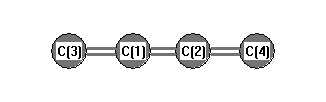 More geometry information
Calculated Bond Angles
| atom1 |
atom2 |
atom3 |
angle |
|
atom1 |
atom2 |
atom3 |
angle |
| C1 |
C2 |
C4 |
180.000 |
|
C2 |
C1 |
C3 |
180.000 |
Electronic energy levels
Charges, Dipole, Quadrupole and Polarizability
Jump to
S1C1
Energy calculated at B2PLYP=FULL/cc-pVTZ
| | hartrees |
|---|
| Energy at 0K | -151.998006 |
| Energy at 298.15K | |
| HF Energy | -151.799946 |
| Nuclear repulsion energy | 63.368785 |
The energy at 298.15K was derived from the energy at 0K
and an integrated heat capacity that used the calculated vibrational frequencies.
Vibrational Frequencies calculated at B2PLYP=FULL/cc-pVTZ
| Mode Number |
Symmetry |
Frequency
(cm-1) |
Scaled Frequency
(cm-1) |
IR Intensities
(km mol-1) |
Raman Act
(Å4/u) |
Dep P |
Dep U |
|---|
| 1 |
Σg |
2110 |
2017 |
0.00 |
65.26 |
0.37 |
0.54 |
| 2 |
Σg |
926 |
885 |
0.00 |
73.05 |
0.32 |
0.48 |
| 3 |
Σu |
1591 |
1521 |
372.39 |
0.00 |
0.75 |
0.86 |
| 4 |
Πg |
489 |
468 |
0.00 |
4.05 |
0.75 |
0.86 |
| 4 |
Πg |
340 |
325 |
0.00 |
8.94 |
0.75 |
0.86 |
| 5 |
Πu |
213 |
204 |
8.30 |
0.00 |
0.75 |
0.86 |
| 5 |
Πu |
154 |
147 |
39.70 |
0.00 |
0.75 |
0.86 |
Unscaled Zero Point Vibrational Energy (zpe) 2911.5 cm
-1
Scaled (by 0.9558) Zero Point Vibrational Energy (zpe) 2782.8 cm
-1
See section
III.C.1 List or set vibrational scaling factors
to change the scale factors used here.
See section
III.C.2
Calculate a vibrational scaling factor for a given set of molecules
to determine the least squares best scaling factor.
Geometric Data calculated at B2PLYP=FULL/cc-pVTZ
Point Group is D∞h
Cartesians (Å)
| Atom |
x (Å) |
y (Å) |
z (Å) |
|---|
| C1 |
0.000 |
0.000 |
0.646 |
| C2 |
0.000 |
0.000 |
-0.646 |
| C3 |
0.000 |
0.000 |
1.955 |
| C4 |
0.000 |
0.000 |
-1.955 |
Atom - Atom Distances (Å)
| |
C1 |
C2 |
C3 |
C4 |
| C1 | | 1.2929 | 1.3086 | 2.6015 |
C2 | 1.2929 | | 2.6015 | 1.3086 | C3 | 1.3086 | 2.6015 | | 3.9101 | C4 | 2.6015 | 1.3086 | 3.9101 | |
More geometry information
Electronic energy levels
Charges, Dipole, Quadrupole and Polarizability
