Jump to
S1C2
Energy calculated at QCISD(T)=FULL/cc-pVTZ
| | hartrees |
|---|
| Energy at 0K | -166.319338 |
| Energy at 298.15K | |
| HF Energy | -165.720308 |
| Nuclear repulsion energy | 49.013807 |
The energy at 298.15K was derived from the energy at 0K
and an integrated heat capacity that used the calculated vibrational frequencies.
Vibrational Frequencies calculated at QCISD(T)=FULL/cc-pVTZ
| Mode Number |
Symmetry |
Frequency
(cm-1) |
Scaled Frequency
(cm-1) |
IR Intensities
(km mol-1) |
Raman Act
(Å4/u) |
Dep P |
Dep U |
|---|
| 1 |
A1 |
4025 |
3851 |
|
|
|
|
| 2 |
A1 |
754 |
721 |
|
|
|
|
| 3 |
A1 |
573 |
548 |
|
|
|
|
| 4 |
A1 |
317 |
303 |
|
|
|
|
| 5 |
A2 |
210i |
201i |
|
|
|
|
| 6 |
B1 |
373 |
357 |
|
|
|
|
| 7 |
B2 |
4023 |
3849 |
|
|
|
|
| 8 |
B2 |
1552 |
1485 |
|
|
|
|
| 9 |
B2 |
451 |
432 |
|
|
|
|
Unscaled Zero Point Vibrational Energy (zpe) 5928.8 cm
-1
Scaled (by 0.9569) Zero Point Vibrational Energy (zpe) 5673.2 cm
-1
See section
III.C.1 List or set vibrational scaling factors
to change the scale factors used here.
See section
III.C.2
Calculate a vibrational scaling factor for a given set of molecules
to determine the least squares best scaling factor.
Geometric Data calculated at QCISD(T)=FULL/cc-pVTZ
Point Group is C2v
Cartesians (Å)
| Atom |
x (Å) |
y (Å) |
z (Å) |
|---|
| Be1 |
0.000 |
0.000 |
-0.001 |
| O2 |
0.000 |
1.425 |
0.079 |
| O3 |
0.000 |
-1.425 |
0.079 |
| H4 |
0.000 |
2.058 |
-0.629 |
| H5 |
0.000 |
-2.058 |
-0.629 |
Atom - Atom Distances (Å)
| |
Be1 |
O2 |
O3 |
H4 |
H5 |
| Be1 | | 1.4267 | 1.4267 | 2.1520 | 2.1520 |
O2 | 1.4267 | | 2.8490 | 0.9502 | 3.5540 | O3 | 1.4267 | 2.8490 | | 3.5540 | 0.9502 | H4 | 2.1520 | 0.9502 | 3.5540 | | 4.1164 | H5 | 2.1520 | 3.5540 | 0.9502 | 4.1164 | |
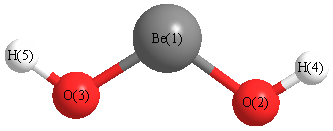 More geometry information
Calculated Bond Angles
| atom1 |
atom2 |
atom3 |
angle |
|
atom1 |
atom2 |
atom3 |
angle |
| Be1 |
O2 |
H4 |
128.621 |
|
Be1 |
O3 |
H5 |
128.621 |
| O2 |
Be1 |
O3 |
173.590 |
|
Electronic energy levels
Charges, Dipole, Quadrupole and Polarizability
Jump to
S1C1
Energy calculated at QCISD(T)=FULL/cc-pVTZ
| | hartrees |
|---|
| Energy at 0K | -166.320053 |
| Energy at 298.15K | -166.321589 |
| HF Energy | -165.720766 |
| Nuclear repulsion energy | 48.980379 |
The energy at 298.15K was derived from the energy at 0K
and an integrated heat capacity that used the calculated vibrational frequencies.
Vibrational Frequencies calculated at QCISD(T)=FULL/cc-pVTZ
| Mode Number |
Symmetry |
Frequency
(cm-1) |
Scaled Frequency
(cm-1) |
IR Intensities
(km mol-1) |
Raman Act
(Å4/u) |
Dep P |
Dep U |
|---|
| 1 |
A |
4005 |
3833 |
|
|
|
|
| 2 |
A |
747 |
715 |
|
|
|
|
| 3 |
A |
577 |
552 |
|
|
|
|
| 4 |
A |
328 |
314 |
|
|
|
|
| 5 |
A |
221 |
212 |
|
|
|
|
| 6 |
B |
4004 |
3831 |
|
|
|
|
| 7 |
B |
1550 |
1483 |
|
|
|
|
| 8 |
B |
558 |
534 |
|
|
|
|
| 9 |
B |
322 |
308 |
|
|
|
|
Unscaled Zero Point Vibrational Energy (zpe) 6156.3 cm
-1
Scaled (by 0.9569) Zero Point Vibrational Energy (zpe) 5891.0 cm
-1
See section
III.C.1 List or set vibrational scaling factors
to change the scale factors used here.
See section
III.C.2
Calculate a vibrational scaling factor for a given set of molecules
to determine the least squares best scaling factor.
Geometric Data calculated at QCISD(T)=FULL/cc-pVTZ
Point Group is C2
Cartesians (Å)
| Atom |
x (Å) |
y (Å) |
z (Å) |
|---|
| Be1 |
0.000 |
0.000 |
-0.009 |
| O2 |
0.000 |
1.428 |
-0.059 |
| O3 |
0.000 |
-1.428 |
-0.059 |
| H4 |
0.521 |
2.006 |
0.489 |
| H5 |
-0.521 |
-2.006 |
0.489 |
Atom - Atom Distances (Å)
| |
Be1 |
O2 |
O3 |
H4 |
H5 |
| Be1 | | 1.4288 | 1.4288 | 2.1317 | 2.1317 |
O2 | 1.4288 | | 2.8559 | 0.9516 | 3.5165 | O3 | 1.4288 | 2.8559 | | 3.5165 | 0.9516 | H4 | 2.1317 | 0.9516 | 3.5165 | | 4.1458 | H5 | 2.1317 | 3.5165 | 0.9516 | 4.1458 | |
More geometry information
Calculated Bond Angles
| atom1 |
atom2 |
atom3 |
angle |
|
atom1 |
atom2 |
atom3 |
angle |
| Be1 |
O2 |
H4 |
125.968 |
|
Be1 |
O3 |
H5 |
125.968 |
| O2 |
Be1 |
O3 |
175.981 |
|
Electronic energy levels
Charges, Dipole, Quadrupole and Polarizability
