return to home page Computational Chemistry Comparison and Benchmark DataBase Release 22 (May 2022) Standard Reference Database 101 National Institute of Standards and Technology
You are here: Calculated > Energy > Optimized > Energy

All results from a given calculation for SiF2 (Silicon difluoride)

using model chemistry: QCISD/cc-pVTZ

19 10 17 12 22

States and conformations

State Conformation minimum conformation conformer description state description
1 1 yes C2V 1A1
2 1 yes C2V 3B1

State 1 (1A1)

Jump to S2C1
Energy calculated at QCISD/cc-pVTZ
 hartrees
Energy at 0K-488.608331
Energy at 298.15K-488.488664
HF Energy-487.998011
Nuclear repulsion energy100.427999
The energy at 298.15K was derived from the energy at 0K and an integrated heat capacity that used the calculated vibrational frequencies.
Vibrational Frequencies calculated at QCISD/cc-pVTZ
Mode Number Symmetry Frequency
(cm-1)
Scaled Frequency
(cm-1)
IR Intensities
(km mol-1)
Raman Act
4/u)
Dep P Dep U
1 A1 869 830 128.75      
2 A1 348 333 19.17      
3 B2 885 845 168.70      

Unscaled Zero Point Vibrational Energy (zpe) 1050.9 cm-1
Scaled (by 0.9555) Zero Point Vibrational Energy (zpe) 1004.1 cm-1
See section III.C.1 List or set vibrational scaling factors to change the scale factors used here.
See section III.C.2 Calculate a vibrational scaling factor for a given set of molecules to determine the least squares best scaling factor.
Rotational Constants (cm-1) from geometry optimized at QCISD/cc-pVTZ
ABC
0.99208 0.29131 0.22519

See section I.F.4 to change rotational constant units
Geometric Data calculated at QCISD/cc-pVTZ

Point Group is C2v

Cartesians (Å)
Atom x (Å) y (Å) z (Å)
Si1 0.000 0.000 0.574
F2 0.000 1.234 -0.447
F3 0.000 -1.234 -0.447

Atom - Atom Distances (Å)
  Si1 F2 F3
Si11.60171.6017
F21.60172.4688
F31.60172.4688

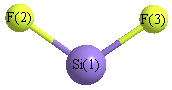
picture of Silicon difluoride state 1 conformation 1
More geometry information
Calculated Bond Angles
atom1 atom2 atom3 angle atom1 atom2 atom3 angle
F2 Si1 F3 100.827
Electronic energy levels
Charges, Dipole, Quadrupole and Polarizability

State 2 (3B1)

Jump to S1C1
Energy calculated at QCISD/cc-pVTZ
 hartrees
Energy at 0K-488.492743
Energy at 298.15K-488.373001
HF Energy-487.915823
Nuclear repulsion energy99.224264
The energy at 298.15K was derived from the energy at 0K and an integrated heat capacity that used the calculated vibrational frequencies.
Vibrational Frequencies calculated at QCISD/cc-pVTZ
Mode Number Symmetry Frequency
(cm-1)
Scaled Frequency
(cm-1)
IR Intensities
(km mol-1)
Raman Act
4/u)
Dep P Dep U
1 A1 841 804 73.69      
2 A1 278 265 15.13      
3 B2 955 913 152.32      

Unscaled Zero Point Vibrational Energy (zpe) 1037.3 cm-1
Scaled (by 0.9555) Zero Point Vibrational Energy (zpe) 991.1 cm-1
See section III.C.1 List or set vibrational scaling factors to change the scale factors used here.
See section III.C.2 Calculate a vibrational scaling factor for a given set of molecules to determine the least squares best scaling factor.
Rotational Constants (cm-1) from geometry optimized at QCISD/cc-pVTZ
ABC
1.33778 0.24823 0.20938

See section I.F.4 to change rotational constant units
Geometric Data calculated at QCISD/cc-pVTZ

Point Group is C2v

Electronic energy levels
Charges, Dipole, Quadrupole and Polarizability