Jump to
S1C2
Energy calculated at QCISD(T)=FULL/cc-pVTZ
| | hartrees |
|---|
| Energy at 0K | -454.237199 |
| Energy at 298.15K | -454.240951 |
| HF Energy | -453.744357 |
| Nuclear repulsion energy | 57.619319 |
The energy at 298.15K was derived from the energy at 0K
and an integrated heat capacity that used the calculated vibrational frequencies.
Vibrational Frequencies calculated at QCISD(T)=FULL/cc-pVTZ
| Mode Number |
Symmetry |
Frequency
(cm-1) |
Scaled Frequency
(cm-1) |
IR Intensities
(km mol-1) |
Raman Act
(Å4/u) |
Dep P |
Dep U |
|---|
| 1 |
A' |
3542 |
3390 |
|
|
|
|
| 2 |
A' |
2674 |
2559 |
|
|
|
|
| 3 |
A' |
1636 |
1566 |
|
|
|
|
| 4 |
A' |
1045 |
1000 |
|
|
|
|
| 5 |
A' |
902 |
864 |
|
|
|
|
| 6 |
A' |
668 |
639 |
|
|
|
|
| 7 |
A" |
3633 |
3476 |
|
|
|
|
| 8 |
A" |
1138 |
1089 |
|
|
|
|
| 9 |
A" |
416 |
398 |
|
|
|
|
Unscaled Zero Point Vibrational Energy (zpe) 7827.1 cm
-1
Scaled (by 0.9569) Zero Point Vibrational Energy (zpe) 7489.7 cm
-1
See section
III.C.1 List or set vibrational scaling factors
to change the scale factors used here.
See section
III.C.2
Calculate a vibrational scaling factor for a given set of molecules
to determine the least squares best scaling factor.
Geometric Data calculated at QCISD(T)=FULL/cc-pVTZ
Point Group is Cs
Cartesians (Å)
| Atom |
x (Å) |
y (Å) |
z (Å) |
|---|
| N1 |
0.013 |
1.114 |
0.000 |
| S2 |
0.013 |
-0.619 |
0.000 |
| H3 |
-1.318 |
-0.773 |
0.000 |
| H4 |
0.507 |
1.437 |
0.819 |
| H5 |
0.507 |
1.437 |
-0.819 |
Atom - Atom Distances (Å)
| |
N1 |
S2 |
H3 |
H4 |
H5 |
| N1 | | 1.7325 | 2.3089 | 1.0092 | 1.0092 |
S2 | 1.7325 | | 1.3403 | 2.2673 | 2.2673 | H3 | 2.3089 | 1.3403 | | 2.9808 | 2.9808 | H4 | 1.0092 | 2.2673 | 2.9808 | | 1.6371 | H5 | 1.0092 | 2.2673 | 2.9808 | 1.6371 | |
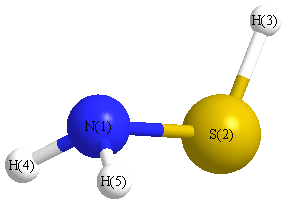 More geometry information
Calculated Bond Angles
| atom1 |
atom2 |
atom3 |
angle |
|
atom1 |
atom2 |
atom3 |
angle |
| N1 |
S2 |
H3 |
96.592 |
|
S2 |
N1 |
H4 |
108.690 |
| S2 |
N1 |
H5 |
108.690 |
|
H4 |
N1 |
H5 |
108.394 |
Electronic energy levels
Charges, Dipole, Quadrupole and Polarizability
Jump to
S1C1
Energy calculated at QCISD(T)=FULL/cc-pVTZ
| | hartrees |
|---|
| Energy at 0K | -454.236809 |
| Energy at 298.15K | -454.240631 |
| HF Energy | -453.744775 |
| Nuclear repulsion energy | 57.854278 |
The energy at 298.15K was derived from the energy at 0K
and an integrated heat capacity that used the calculated vibrational frequencies.
Vibrational Frequencies calculated at QCISD(T)=FULL/cc-pVTZ
| Mode Number |
Symmetry |
Frequency
(cm-1) |
Scaled Frequency
(cm-1) |
IR Intensities
(km mol-1) |
Raman Act
(Å4/u) |
Dep P |
Dep U |
|---|
| 1 |
A' |
3548 |
3395 |
|
|
|
|
| 2 |
A' |
2603 |
2491 |
|
|
|
|
| 3 |
A' |
1625 |
1555 |
|
|
|
|
| 4 |
A' |
1036 |
991 |
|
|
|
|
| 5 |
A' |
894 |
856 |
|
|
|
|
| 6 |
A' |
647 |
619 |
|
|
|
|
| 7 |
A" |
3647 |
3490 |
|
|
|
|
| 8 |
A" |
1122 |
1073 |
|
|
|
|
| 9 |
A" |
520 |
498 |
|
|
|
|
Unscaled Zero Point Vibrational Energy (zpe) 7820.4 cm
-1
Scaled (by 0.9569) Zero Point Vibrational Energy (zpe) 7483.3 cm
-1
See section
III.C.1 List or set vibrational scaling factors
to change the scale factors used here.
See section
III.C.2
Calculate a vibrational scaling factor for a given set of molecules
to determine the least squares best scaling factor.
Geometric Data calculated at QCISD(T)=FULL/cc-pVTZ
Point Group is Cs
Electronic energy levels
Charges, Dipole, Quadrupole and Polarizability
