Jump to
S1C2
S1C3
Energy calculated at HF/cc-pVTZ
| | hartrees |
|---|
| Energy at 0K | -254.214135 |
| Energy at 298.15K | -254.213525 |
| HF Energy | -254.214135 |
| Nuclear repulsion energy | 46.725792 |
The energy at 298.15K was derived from the energy at 0K
and an integrated heat capacity that used the calculated vibrational frequencies.
Geometric Data calculated at HF/cc-pVTZ
Point Group is C∞v
Cartesians (Å)
| Atom |
x (Å) |
y (Å) |
z (Å) |
|---|
| C1 |
0.000 |
0.000 |
-0.711 |
| N2 |
0.000 |
0.000 |
-1.852 |
| Na3 |
0.000 |
0.000 |
1.567 |
Atom - Atom Distances (Å)
| |
C1 |
N2 |
Na3 |
| C1 | | 1.1414 | 2.2775 |
N2 | 1.1414 | | 3.4189 | Na3 | 2.2775 | 3.4189 | |
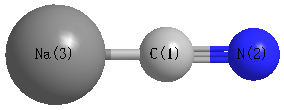 More geometry information
Calculated Bond Angles
| atom1 |
atom2 |
atom3 |
angle |
|
atom1 |
atom2 |
atom3 |
angle |
| C1 |
N2 |
Na3 |
0.000 |
|
C1 |
Na3 |
N2 |
0.000 |
| N2 |
C1 |
Na3 |
180.000 |
|
Electronic energy levels
Charges, Dipole, Quadrupole and Polarizability
Charges from optimized geometry at HF/cc-pVTZ
Charges (e)
| Number |
Element |
Mulliken |
CHELPG |
AIM |
ESP |
| 1 |
C |
-0.340 |
|
|
|
| 2 |
N |
-0.183 |
|
|
|
| 3 |
Na |
0.523 |
|
|
|
Electric dipole moments
Electric dipole components in Debye
(What's a Debye? See section
VII.A.3)
| |
x |
y |
z |
Total |
| |
0.000 |
0.000 |
11.380 |
11.380 |
| CHELPG |
|
|
|
|
| AIM |
|
|
|
|
| ESP |
|
|
|
|
Electric Quadrupole moment
Quadrupole components in D Å
| Primitive |
|---|
| | x | y | z |
|---|
| x |
-17.006 |
0.000 |
0.000 |
| y |
0.000 |
-17.006 |
0.000 |
| z |
0.000 |
0.000 |
-13.332 |
|
| Traceless |
|---|
| | x | y | z |
|---|
| x |
-1.837 |
0.000 |
0.000 |
| y |
0.000 |
-1.837 |
0.000 |
| z |
0.000 |
0.000 |
3.674 |
|
| Polar |
|---|
| 3z2-r2 | 7.348 |
|---|
| x2-y2 | 0.000 |
|---|
| xy | 0.000 |
|---|
| xz | 0.000 |
|---|
| yz | 0.000 |
|---|
|
Polarizabilities
Components of the polarizability tensor.
Units are
Å
3 (Angstrom cubed)
Change units.
| |
x |
y |
z |
| x |
2.630 |
0.000 |
0.000 |
| y |
0.000 |
2.630 |
0.000 |
| z |
0.000 |
0.000 |
4.341 |
<r2> (average value of r
2) Å
2
| <r2> |
63.902 |
| (<r2>)1/2 |
7.994 |
Jump to
S1C1
S1C3
Energy calculated at HF/cc-pVTZ
| | hartrees |
|---|
| Energy at 0K | -254.221413 |
| Energy at 298.15K | -254.221116 |
| HF Energy | -254.221413 |
| Nuclear repulsion energy | 51.640972 |
The energy at 298.15K was derived from the energy at 0K
and an integrated heat capacity that used the calculated vibrational frequencies.
Geometric Data calculated at HF/cc-pVTZ
Point Group is Cs
Cartesians (Å)
| Atom |
x (Å) |
y (Å) |
z (Å) |
|---|
| C1 |
1.115 |
0.751 |
0.000 |
| N2 |
0.000 |
1.046 |
0.000 |
| Na3 |
-0.608 |
-1.075 |
0.000 |
Atom - Atom Distances (Å)
| |
C1 |
N2 |
Na3 |
| C1 | | 1.1535 | 2.5113 |
N2 | 1.1535 | | 2.2066 | Na3 | 2.5113 | 2.2066 | |
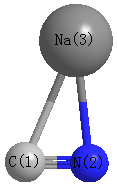 More geometry information
Calculated Bond Angles
| atom1 |
atom2 |
atom3 |
angle |
|
atom1 |
atom2 |
atom3 |
angle |
| C1 |
N2 |
Na3 |
91.200 |
|
C1 |
Na3 |
N2 |
27.337 |
| N2 |
C1 |
Na3 |
61.463 |
|
Electronic energy levels
Charges, Dipole, Quadrupole and Polarizability
Charges from optimized geometry at HF/cc-pVTZ
Charges (e)
| Number |
Element |
Mulliken |
CHELPG |
AIM |
ESP |
| 1 |
C |
-0.216 |
|
|
|
| 2 |
N |
-0.265 |
|
|
|
| 3 |
Na |
0.481 |
|
|
|
Electric dipole moments
Electric dipole components in Debye
(What's a Debye? See section
VII.A.3)
| |
x |
y |
z |
Total |
| |
-4.745 |
-7.989 |
0.000 |
9.292 |
| CHELPG |
|
|
|
|
| AIM |
|
|
|
|
| ESP |
|
|
|
|
Electric Quadrupole moment
Quadrupole components in D Å
| Primitive |
|---|
| | x | y | z |
|---|
| x |
-19.694 |
3.019 |
0.000 |
| y |
3.019 |
-13.584 |
0.000 |
| z |
0.000 |
0.000 |
-17.096 |
|
| Traceless |
|---|
| | x | y | z |
|---|
| x |
-4.354 |
3.019 |
0.000 |
| y |
3.019 |
4.811 |
0.000 |
| z |
0.000 |
0.000 |
-0.457 |
|
| Polar |
|---|
| 3z2-r2 | -0.914 |
|---|
| x2-y2 | -6.110 |
|---|
| xy | 3.019 |
|---|
| xz | 0.000 |
|---|
| yz | 0.000 |
|---|
|
Polarizabilities
Components of the polarizability tensor.
Units are
Å
3 (Angstrom cubed)
Change units.
| |
x |
y |
z |
| x |
3.829 |
-0.117 |
0.000 |
| y |
-0.117 |
3.041 |
0.000 |
| z |
0.000 |
0.000 |
2.777 |
<r2> (average value of r
2) Å
2
| <r2> |
45.781 |
| (<r2>)1/2 |
6.766 |
Jump to
S1C1
S1C2
Energy calculated at HF/cc-pVTZ
| | hartrees |
|---|
| Energy at 0K | -254.219926 |
| Energy at 298.15K | -254.219079 |
| HF Energy | -254.219926 |
| Nuclear repulsion energy | 49.094171 |
The energy at 298.15K was derived from the energy at 0K
and an integrated heat capacity that used the calculated vibrational frequencies.
Geometric Data calculated at HF/cc-pVTZ
Point Group is C∞v
Cartesians (Å)
| Atom |
x (Å) |
y (Å) |
z (Å) |
|---|
| C1 |
0.000 |
0.000 |
-1.839 |
| N2 |
0.000 |
0.000 |
-0.685 |
| Na3 |
0.000 |
0.000 |
1.439 |
Atom - Atom Distances (Å)
| |
C1 |
N2 |
Na3 |
| C1 | | 1.1537 | 3.2785 |
N2 | 1.1537 | | 2.1248 | Na3 | 3.2785 | 2.1248 | |
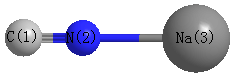 More geometry information
Calculated Bond Angles
| atom1 |
atom2 |
atom3 |
angle |
|
atom1 |
atom2 |
atom3 |
angle |
| C1 |
N2 |
Na3 |
180.000 |
|
C1 |
Na3 |
N2 |
0.000 |
| N2 |
C1 |
Na3 |
0.000 |
|
Electronic energy levels
Charges, Dipole, Quadrupole and Polarizability
Charges from optimized geometry at HF/cc-pVTZ
Charges (e)
| Number |
Element |
Mulliken |
CHELPG |
AIM |
ESP |
| 1 |
C |
-0.363 |
|
|
|
| 2 |
N |
-0.326 |
|
|
|
| 3 |
Na |
0.689 |
|
|
|
Electric dipole moments
Electric dipole components in Debye
(What's a Debye? See section
VII.A.3)
| |
x |
y |
z |
Total |
| |
0.000 |
0.000 |
11.046 |
11.046 |
| CHELPG |
|
|
|
|
| AIM |
|
|
|
|
| ESP |
|
|
|
|
Electric Quadrupole moment
Quadrupole components in D Å
| Primitive |
|---|
| | x | y | z |
|---|
| x |
-16.974 |
0.000 |
0.000 |
| y |
0.000 |
-16.974 |
0.000 |
| z |
0.000 |
0.000 |
-15.389 |
|
| Traceless |
|---|
| | x | y | z |
|---|
| x |
-0.792 |
0.000 |
0.000 |
| y |
0.000 |
-0.792 |
0.000 |
| z |
0.000 |
0.000 |
1.585 |
|
| Polar |
|---|
| 3z2-r2 | 3.170 |
|---|
| x2-y2 | 0.000 |
|---|
| xy | 0.000 |
|---|
| xz | 0.000 |
|---|
| yz | 0.000 |
|---|
|
Polarizabilities
Components of the polarizability tensor.
Units are
Å
3 (Angstrom cubed)
Change units.
| |
x |
y |
z |
| x |
2.647 |
0.000 |
0.000 |
| y |
0.000 |
2.647 |
0.000 |
| z |
0.000 |
0.000 |
4.156 |
<r2> (average value of r
2) Å
2
| <r2> |
56.644 |
| (<r2>)1/2 |
7.526 |
