return to home page Computational Chemistry Comparison and Benchmark DataBase Release 22 (May 2022) Standard Reference Database 101 National Institute of Standards and Technology
You are here: Calculated > Energy > Optimized > Energy

All results from a given calculation for C3H5OH (Cyclopropanol)

using model chemistry: QCISD(T)/cc-pVTZ

19 10 17 12 22

States and conformations

State Conformation minimum conformation conformer description state description
1 1 yes C1 1A
Energy calculated at QCISD(T)/cc-pVTZ
 hartrees
Energy at 0K-192.793586
Energy at 298.15K-192.800562
HF Energy-191.984102
Nuclear repulsion energy124.301889
The energy at 298.15K was derived from the energy at 0K and an integrated heat capacity that used the calculated vibrational frequencies.
Vibrational Frequencies calculated at QCISD(T)/cc-pVTZ
Mode Number Symmetry Frequency
(cm-1)
Scaled Frequency
(cm-1)
IR Intensities
(km mol-1)
Raman Act
(Å4/u)
Dep P Dep U
1 A 3832 3635        
2 A 3250 3083        
3 A 3234 3068        
4 A 3156 2994        
5 A 3146 2984        
6 A 3136 2975        
7 A 1515 1437        
8 A 1459 1384        
9 A 1422 1349        
10 A 1315 1247        
11 A 1238 1174        
12 A 1198 1137        
13 A 1194 1133        
14 A 1134 1076        
15 A 1069 1014        
16 A 1048 994        
17 A 994 943        
18 A 939 890        
19 A 837 794        
20 A 819 777        
21 A 755 716        
22 A 408 387        
23 A 403 383        
24 A 317 301        

Unscaled Zero Point Vibrational Energy (zpe) 18907.6 cm-1
Scaled (by 0.9486) Zero Point Vibrational Energy (zpe) 17935.8 cm-1
See section III.C.1 List or set vibrational scaling factors to change the scale factors used here.
See section III.C.2 Calculate a vibrational scaling factor for a given set of molecules to determine the least squares best scaling factor.
Rotational Constants (cm-1) from geometry optimized at QCISD(T)/cc-pVTZ
ABC
0.55679 0.23090 0.19891

See section I.F.4 to change rotational constant units
Geometric Data calculated at QCISD(T)/cc-pVTZ

Point Group is C1

Cartesians (Å)
Atom x (Å) y (Å) z (Å)
C1 -0.236 -0.017 0.486
C2 0.910 -0.744 -0.140
C3 0.882 0.777 -0.136
O4 -1.460 -0.113 -0.195
H5 -0.309 -0.023 1.569
H6 1.615 -1.250 0.505
H7 0.699 -1.231 -1.082
H8 1.567 1.304 0.514
H9 0.665 1.259 -1.080
H10 -1.894 0.742 -0.121

Atom - Atom Distances (Å)
  C1 C2 C3 O4 H5 H6 H7 H8 H9 H10
C11.49431.50611.40371.08542.22462.19192.23562.21161.9213
C21.49431.52122.45292.21881.08121.08122.24832.22633.1732
C31.50611.52122.50642.22862.24882.22671.08171.08182.7766
O41.40372.45292.50642.10803.35252.58763.41692.67950.9617
H51.08542.21882.22862.10802.51803.08192.52853.09962.4393
H62.22461.08122.24883.35252.51801.83212.55483.11624.0833
H72.19191.08122.22672.58763.08191.83213.11882.49003.3968
H82.23562.24831.08173.41692.52852.55483.11881.83253.5635
H92.21162.22631.08182.67953.09963.11622.49001.83252.7813
H101.92133.17322.77660.96172.43934.08333.39683.56352.7813

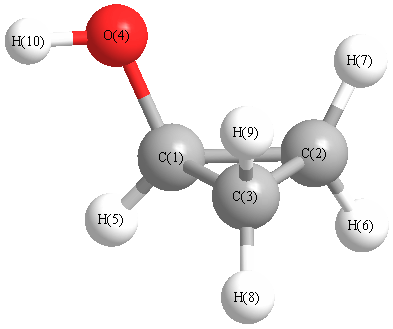
picture of Cyclopropanol state 1 conformation 1
More geometry information
Calculated Bond Angles
atom1 atom2 atom3 angle atom1 atom2 atom3 angle
C1 C2 C3 59.921 C1 C2 H6 118.608
C1 C2 H7 115.726 C1 C3 C2 59.153
C1 C3 H8 118.594 C1 C3 H9 116.472
C1 O4 H10 107.149 C2 C1 C3 60.926
C2 C1 O4 115.613 C2 C1 H5 117.784
C2 C3 H8 118.501 C2 C3 H9 116.568
C3 C1 O4 118.896 C3 C1 H5 117.707
C3 C2 H6 118.593 C3 C2 H7 116.648
O4 C1 H5 115.156 H6 C2 H7 115.832
H8 C3 H9 115.777
Electronic energy levels
Charges, Dipole, Quadrupole and Polarizability