Jump to
S1C2
S1C3
Energy calculated at HF/cc-pVTZ
| | hartrees |
|---|
| Energy at 0K | -1590.148736 |
| Energy at 298.15K | |
| HF Energy | -1590.148736 |
| Nuclear repulsion energy | 352.643638 |
The energy at 298.15K was derived from the energy at 0K
and an integrated heat capacity that used the calculated vibrational frequencies.
Vibrational Frequencies calculated at HF/cc-pVTZ
| Mode Number |
Symmetry |
Frequency
(cm-1) |
Scaled Frequency
(cm-1) |
IR Intensities
(km mol-1) |
Raman Act
(Å4/u) |
Dep P |
Dep U |
|---|
| 1 |
A1 |
573 |
522 |
0.00 |
57.66 |
0.06 |
0.11 |
| 2 |
A1 |
201 |
183 |
0.00 |
2.09 |
0.75 |
0.86 |
| 3 |
B1 |
542 |
493 |
0.00 |
24.21 |
0.75 |
0.86 |
| 4 |
B2 |
354 |
323 |
0.05 |
7.28 |
0.75 |
0.86 |
| 5 |
E |
516 |
469 |
0.17 |
5.56 |
0.75 |
0.86 |
| 5 |
E |
516 |
469 |
0.17 |
5.56 |
0.75 |
0.86 |
Unscaled Zero Point Vibrational Energy (zpe) 1350.6 cm
-1
Scaled (by 0.9101) Zero Point Vibrational Energy (zpe) 1229.2 cm
-1
See section
III.C.1 List or set vibrational scaling factors
to change the scale factors used here.
See section
III.C.2
Calculate a vibrational scaling factor for a given set of molecules
to determine the least squares best scaling factor.
Geometric Data calculated at HF/cc-pVTZ
Point Group is D2d
Cartesians (Å)
| Atom |
x (Å) |
y (Å) |
z (Å) |
|---|
| S1 |
0.000 |
1.430 |
0.286 |
| S2 |
0.000 |
-1.430 |
0.286 |
| S3 |
-1.430 |
0.000 |
-0.286 |
| S4 |
1.430 |
0.000 |
-0.286 |
Atom - Atom Distances (Å)
| |
S1 |
S2 |
S3 |
S4 |
| S1 | | 2.8595 | 2.1012 | 2.1012 |
S2 | 2.8595 | | 2.1012 | 2.1012 | S3 | 2.1012 | 2.1012 | | 2.8595 | S4 | 2.1012 | 2.1012 | 2.8595 | |
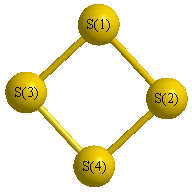 More geometry information
Calculated Bond Angles
| atom1 |
atom2 |
atom3 |
angle |
|
atom1 |
atom2 |
atom3 |
angle |
| S1 |
S2 |
S4 |
47.120 |
|
S1 |
S3 |
S4 |
47.120 |
| S2 |
S1 |
S3 |
47.120 |
|
S2 |
S4 |
S3 |
47.120 |
Electronic energy levels
Charges, Dipole, Quadrupole and Polarizability
Charges from optimized geometry at HF/cc-pVTZ
Charges (e)
| Number |
Element |
Mulliken |
CHELPG |
AIM |
ESP |
| 1 |
S |
0.000 |
|
|
|
| 2 |
S |
0.000 |
|
|
|
| 3 |
S |
0.000 |
|
|
|
| 4 |
S |
0.000 |
|
|
|
Electric dipole moments
Electric dipole components in Debye
(What's a Debye? See section
VII.A.3)
| |
x |
y |
z |
Total |
| |
0.000 |
0.000 |
0.000 |
0.000 |
| CHELPG |
|
|
|
|
| AIM |
|
|
|
|
| ESP |
|
|
|
|
Electric Quadrupole moment
Quadrupole components in D Å
| Primitive |
|---|
| | x | y | z |
|---|
| x |
-49.408 |
0.000 |
0.000 |
| y |
0.000 |
-49.408 |
0.000 |
| z |
0.000 |
0.000 |
-55.219 |
|
| Traceless |
|---|
| | x | y | z |
|---|
| x |
2.906 |
0.000 |
0.000 |
| y |
0.000 |
2.906 |
0.000 |
| z |
0.000 |
0.000 |
-5.812 |
|
| Polar |
|---|
| 3z2-r2 | -11.623 |
|---|
| x2-y2 | 0.000 |
|---|
| xy | 0.000 |
|---|
| xz | 0.000 |
|---|
| yz | 0.000 |
|---|
|
Polarizabilities
Components of the polarizability tensor.
Units are
Å
3 (Angstrom cubed)
Change units.
| |
x |
y |
z |
| x |
11.200 |
0.000 |
0.000 |
| y |
0.000 |
11.200 |
0.000 |
| z |
0.000 |
0.000 |
6.317 |
<r2> (average value of r
2) Å
2
| <r2> |
168.122 |
| (<r2>)1/2 |
12.966 |
Jump to
S1C1
S1C3
Energy calculated at HF/cc-pVTZ
| | hartrees |
|---|
| Energy at 0K | -1590.126798 |
| Energy at 298.15K | |
| HF Energy | -1590.126798 |
| Nuclear repulsion energy | 334.840863 |
The energy at 298.15K was derived from the energy at 0K
and an integrated heat capacity that used the calculated vibrational frequencies.
Vibrational Frequencies calculated at HF/cc-pVTZ
| Mode Number |
Symmetry |
Frequency
(cm-1) |
Scaled Frequency
(cm-1) |
IR Intensities
(km mol-1) |
Raman Act
(Å4/u) |
Dep P |
Dep U |
|---|
| 1 |
A1 |
731 |
665 |
19.19 |
26.23 |
0.73 |
0.84 |
| 2 |
A1 |
570 |
519 |
1.47 |
395.90 |
0.24 |
0.39 |
| 3 |
A1 |
138 |
126 |
0.03 |
22.03 |
0.43 |
0.61 |
| 4 |
A2 |
224 |
204 |
0.00 |
0.59 |
0.75 |
0.86 |
| 5 |
B2 |
637 |
580 |
467.17 |
0.30 |
0.75 |
0.86 |
| 6 |
B2 |
368 |
335 |
1.58 |
11.50 |
0.75 |
0.86 |
Unscaled Zero Point Vibrational Energy (zpe) 1334.3 cm
-1
Scaled (by 0.9101) Zero Point Vibrational Energy (zpe) 1214.4 cm
-1
See section
III.C.1 List or set vibrational scaling factors
to change the scale factors used here.
See section
III.C.2
Calculate a vibrational scaling factor for a given set of molecules
to determine the least squares best scaling factor.
Geometric Data calculated at HF/cc-pVTZ
Point Group is C2v
Cartesians (Å)
| Atom |
x (Å) |
y (Å) |
z (Å) |
|---|
| S1 |
0.000 |
0.985 |
0.880 |
| S2 |
0.000 |
-0.985 |
0.880 |
| S3 |
0.000 |
1.710 |
-0.880 |
| S4 |
0.000 |
-1.710 |
-0.880 |
Atom - Atom Distances (Å)
| |
S1 |
S2 |
S3 |
S4 |
| S1 | | 1.9690 | 1.9044 | 3.2190 |
S2 | 1.9690 | | 3.2190 | 1.9044 | S3 | 1.9044 | 3.2190 | | 3.4205 | S4 | 3.2190 | 1.9044 | 3.4205 | |
More geometry information
Calculated Bond Angles
| atom1 |
atom2 |
atom3 |
angle |
|
atom1 |
atom2 |
atom3 |
angle |
| S1 |
S2 |
S4 |
112.400 |
|
S1 |
S3 |
S4 |
67.600 |
| S2 |
S1 |
S3 |
112.400 |
|
S2 |
S4 |
S3 |
67.600 |
Electronic energy levels
Charges, Dipole, Quadrupole and Polarizability
Charges from optimized geometry at HF/cc-pVTZ
Charges (e)
| Number |
Element |
Mulliken |
CHELPG |
AIM |
ESP |
| 1 |
S |
0.217 |
|
|
|
| 2 |
S |
0.217 |
|
|
|
| 3 |
S |
-0.217 |
|
|
|
| 4 |
S |
-0.217 |
|
|
|
Electric dipole moments
Electric dipole components in Debye
(What's a Debye? See section
VII.A.3)
| |
x |
y |
z |
Total |
| |
0.000 |
0.000 |
2.228 |
2.228 |
| CHELPG |
|
|
|
|
| AIM |
|
|
|
|
| ESP |
|
|
|
|
Electric Quadrupole moment
Quadrupole components in D Å
| Primitive |
|---|
| | x | y | z |
|---|
| x |
-51.753 |
0.000 |
0.000 |
| y |
0.000 |
-54.998 |
0.000 |
| z |
0.000 |
0.000 |
-49.762 |
|
| Traceless |
|---|
| | x | y | z |
|---|
| x |
0.627 |
0.000 |
0.000 |
| y |
0.000 |
-4.240 |
0.000 |
| z |
0.000 |
0.000 |
3.614 |
|
| Polar |
|---|
| 3z2-r2 | 7.227 |
|---|
| x2-y2 | 3.245 |
|---|
| xy | 0.000 |
|---|
| xz | 0.000 |
|---|
| yz | 0.000 |
|---|
|
Polarizabilities
Components of the polarizability tensor.
Units are
Å
3 (Angstrom cubed)
Change units.
| |
x |
y |
z |
| x |
5.761 |
0.000 |
0.000 |
| y |
0.000 |
22.996 |
0.000 |
| z |
0.000 |
0.000 |
11.171 |
<r2> (average value of r
2) Å
2
| <r2> |
206.804 |
| (<r2>)1/2 |
14.381 |
Jump to
S1C1
S1C2
Energy calculated at HF/cc-pVTZ
| | hartrees |
|---|
| Energy at 0K | -1590.089454 |
| Energy at 298.15K | |
| HF Energy | -1590.089454 |
| Nuclear repulsion energy | 342.481058 |
The energy at 298.15K was derived from the energy at 0K
and an integrated heat capacity that used the calculated vibrational frequencies.
Vibrational Frequencies calculated at HF/cc-pVTZ
| Mode Number |
Symmetry |
Frequency
(cm-1) |
Scaled Frequency
(cm-1) |
IR Intensities
(km mol-1) |
Raman Act
(Å4/u) |
Dep P |
Dep U |
|---|
| 1 |
Ag |
827 |
753 |
0.00 |
40.73 |
0.26 |
0.41 |
| 2 |
Ag |
343 |
312 |
0.00 |
1220.90 |
0.32 |
0.48 |
| 3 |
Au |
285 |
260 |
0.00 |
0.00 |
0.00 |
0.00 |
| 4 |
B1u |
683 |
621 |
646.05 |
0.00 |
0.00 |
0.00 |
| 5 |
B2u |
352i |
320i |
50.54 |
0.00 |
0.00 |
0.00 |
| 6 |
B3g |
382 |
348 |
0.00 |
16.89 |
0.75 |
0.86 |
Unscaled Zero Point Vibrational Energy (zpe) 1084.2 cm
-1
Scaled (by 0.9101) Zero Point Vibrational Energy (zpe) 986.7 cm
-1
See section
III.C.1 List or set vibrational scaling factors
to change the scale factors used here.
See section
III.C.2
Calculate a vibrational scaling factor for a given set of molecules
to determine the least squares best scaling factor.
Geometric Data calculated at HF/cc-pVTZ
Point Group is D2h
Cartesians (Å)
| Atom |
x (Å) |
y (Å) |
z (Å) |
|---|
| S1 |
0.000 |
0.931 |
1.238 |
| S2 |
0.000 |
0.931 |
-1.238 |
| S3 |
0.000 |
-0.931 |
1.238 |
| S4 |
0.000 |
-0.931 |
-1.238 |
Atom - Atom Distances (Å)
| |
S1 |
S2 |
S3 |
S4 |
| S1 | | 2.4757 | 1.8613 | 3.0973 |
S2 | 2.4757 | | 3.0973 | 1.8613 | S3 | 1.8613 | 3.0973 | | 2.4757 | S4 | 3.0973 | 1.8613 | 2.4757 | |
More geometry information
Calculated Bond Angles
| atom1 |
atom2 |
atom3 |
angle |
|
atom1 |
atom2 |
atom3 |
angle |
| S1 |
S2 |
S4 |
90.000 |
|
S1 |
S3 |
S4 |
90.000 |
| S2 |
S1 |
S3 |
90.000 |
|
S2 |
S4 |
S3 |
90.000 |
Electronic energy levels
Charges, Dipole, Quadrupole and Polarizability
Charges from optimized geometry at HF/cc-pVTZ
Charges (e)
| Number |
Element |
Mulliken |
CHELPG |
AIM |
ESP |
| 1 |
S |
0.000 |
|
|
|
| 2 |
S |
0.000 |
|
|
|
| 3 |
S |
0.000 |
|
|
|
| 4 |
S |
0.000 |
|
|
|
Electric dipole moments
Electric dipole components in Debye
(What's a Debye? See section
VII.A.3)
| |
x |
y |
z |
Total |
| |
0.000 |
0.000 |
0.000 |
0.000 |
| CHELPG |
|
|
|
|
| AIM |
|
|
|
|
| ESP |
|
|
|
|
Electric Quadrupole moment
Quadrupole components in D Å
| Primitive |
|---|
| | x | y | z |
|---|
| x |
-52.353 |
0.000 |
0.000 |
| y |
0.000 |
-48.607 |
0.000 |
| z |
0.000 |
0.000 |
-53.712 |
|
| Traceless |
|---|
| | x | y | z |
|---|
| x |
-1.193 |
0.000 |
0.000 |
| y |
0.000 |
4.425 |
0.000 |
| z |
0.000 |
0.000 |
-3.232 |
|
| Polar |
|---|
| 3z2-r2 | -6.465 |
|---|
| x2-y2 | -3.745 |
|---|
| xy | 0.000 |
|---|
| xz | 0.000 |
|---|
| yz | 0.000 |
|---|
|
Polarizabilities
Components of the polarizability tensor.
Units are
Å
3 (Angstrom cubed)
Change units.
| |
x |
y |
z |
| x |
5.715 |
0.000 |
0.000 |
| y |
0.000 |
12.075 |
0.000 |
| z |
0.000 |
0.000 |
22.946 |
<r2> (average value of r
2) Å
2
| <r2> |
185.697 |
| (<r2>)1/2 |
13.627 |
