Jump to
S1C2
S1C3
Energy calculated at QCISD(T)=FULL/cc-pVTZ
| | hartrees |
|---|
| Energy at 0K | -1591.055068 |
| Energy at 298.15K | |
| HF Energy | -1590.147566 |
| Nuclear repulsion energy | 349.241109 |
The energy at 298.15K was derived from the energy at 0K
and an integrated heat capacity that used the calculated vibrational frequencies.
Vibrational Frequencies calculated at QCISD(T)=FULL/cc-pVTZ
| Mode Number |
Symmetry |
Frequency
(cm-1) |
Scaled Frequency
(cm-1) |
IR Intensities
(km mol-1) |
Raman Act
(Å4/u) |
Dep P |
Dep U |
|---|
| 1 |
A1 |
521 |
499 |
|
|
|
|
| 2 |
A1 |
203 |
194 |
|
|
|
|
| 3 |
B1 |
461 |
441 |
|
|
|
|
| 4 |
B2 |
304 |
291 |
|
|
|
|
| 5 |
E |
436 |
417 |
|
|
|
|
| 5 |
E |
436 |
417 |
|
|
|
|
Unscaled Zero Point Vibrational Energy (zpe) 1181.0 cm
-1
Scaled (by 0.9569) Zero Point Vibrational Energy (zpe) 1130.1 cm
-1
See section
III.C.1 List or set vibrational scaling factors
to change the scale factors used here.
See section
III.C.2
Calculate a vibrational scaling factor for a given set of molecules
to determine the least squares best scaling factor.
Geometric Data calculated at QCISD(T)=FULL/cc-pVTZ
Point Group is D2d
Cartesians (Å)
| Atom |
x (Å) |
y (Å) |
z (Å) |
|---|
| S1 |
0.000 |
1.435 |
0.319 |
| S2 |
0.000 |
-1.435 |
0.319 |
| S3 |
-1.435 |
0.000 |
-0.319 |
| S4 |
1.435 |
0.000 |
-0.319 |
Atom - Atom Distances (Å)
| |
S1 |
S2 |
S3 |
S4 |
| S1 | | 2.8691 | 2.1267 | 2.1267 |
S2 | 2.8691 | | 2.1267 | 2.1267 | S3 | 2.1267 | 2.1267 | | 2.8691 | S4 | 2.1267 | 2.1267 | 2.8691 | |
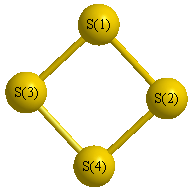 More geometry information
Calculated Bond Angles
| atom1 |
atom2 |
atom3 |
angle |
|
atom1 |
atom2 |
atom3 |
angle |
| S1 |
S2 |
S4 |
47.581 |
|
S1 |
S3 |
S4 |
47.581 |
| S2 |
S1 |
S3 |
47.581 |
|
S2 |
S4 |
S3 |
47.581 |
Electronic energy levels
Charges, Dipole, Quadrupole and Polarizability
Jump to
S1C1
S1C3
Energy calculated at QCISD(T)=FULL/cc-pVTZ
| | hartrees |
|---|
| Energy at 0K | -1591.078384 |
| Energy at 298.15K | |
| HF Energy | -1590.113394 |
| Nuclear repulsion energy | 330.976074 |
The energy at 298.15K was derived from the energy at 0K
and an integrated heat capacity that used the calculated vibrational frequencies.
Vibrational Frequencies calculated at QCISD(T)=FULL/cc-pVTZ
| Mode Number |
Symmetry |
Frequency
(cm-1) |
Scaled Frequency
(cm-1) |
IR Intensities
(km mol-1) |
Raman Act
(Å4/u) |
Dep P |
Dep U |
|---|
| 1 |
A1 |
681 |
651 |
0.00 |
|
|
|
| 2 |
A1 |
337 |
323 |
0.00 |
|
|
|
| 3 |
A1 |
134 |
128 |
0.00 |
|
|
|
| 4 |
A2 |
210 |
201 |
0.00 |
|
|
|
| 5 |
B2 |
630 |
602 |
0.00 |
|
|
|
| 6 |
B2 |
326 |
312 |
0.00 |
|
|
|
Unscaled Zero Point Vibrational Energy (zpe) 1158.6 cm
-1
Scaled (by 0.9569) Zero Point Vibrational Energy (zpe) 1108.7 cm
-1
See section
III.C.1 List or set vibrational scaling factors
to change the scale factors used here.
See section
III.C.2
Calculate a vibrational scaling factor for a given set of molecules
to determine the least squares best scaling factor.
Geometric Data calculated at QCISD(T)=FULL/cc-pVTZ
Point Group is C2v
Cartesians (Å)
| Atom |
x (Å) |
y (Å) |
z (Å) |
|---|
| S1 |
0.000 |
1.088 |
0.934 |
| S2 |
0.000 |
-1.088 |
0.934 |
| S3 |
0.000 |
1.544 |
-0.934 |
| S4 |
0.000 |
-1.544 |
-0.934 |
Atom - Atom Distances (Å)
| |
S1 |
S2 |
S3 |
S4 |
| S1 | | 2.1765 | 1.9227 | 3.2278 |
S2 | 2.1765 | | 3.2278 | 1.9227 | S3 | 1.9227 | 3.2278 | | 3.0883 | S4 | 3.2278 | 1.9227 | 3.0883 | |
More geometry information
Calculated Bond Angles
| atom1 |
atom2 |
atom3 |
angle |
|
atom1 |
atom2 |
atom3 |
angle |
| S1 |
S2 |
S4 |
103.717 |
|
S1 |
S3 |
S4 |
76.283 |
| S2 |
S1 |
S3 |
103.717 |
|
S2 |
S4 |
S3 |
76.283 |
Electronic energy levels
Charges, Dipole, Quadrupole and Polarizability
Jump to
S1C1
S1C2
Energy calculated at QCISD(T)=FULL/cc-pVTZ
| | hartrees |
|---|
| Energy at 0K | -1591.074971 |
| Energy at 298.15K | |
| HF Energy | -1590.085049 |
| Nuclear repulsion energy | 332.923780 |
The energy at 298.15K was derived from the energy at 0K
and an integrated heat capacity that used the calculated vibrational frequencies.
Vibrational Frequencies calculated at QCISD(T)=FULL/cc-pVTZ
| Mode Number |
Symmetry |
Frequency
(cm-1) |
Scaled Frequency
(cm-1) |
IR Intensities
(km mol-1) |
Raman Act
(Å4/u) |
Dep P |
Dep U |
|---|
| 1 |
Ag |
715 |
684 |
|
|
|
|
| 2 |
Ag |
279 |
267 |
|
|
|
|
| 3 |
Au |
236 |
226 |
|
|
|
|
| 4 |
B1u |
249 |
238 |
|
|
|
|
| 5 |
B2u |
137i |
131i |
|
|
|
|
| 6 |
B3g |
313 |
299 |
|
|
|
|
Unscaled Zero Point Vibrational Energy (zpe) 827.5 cm
-1
Scaled (by 0.9569) Zero Point Vibrational Energy (zpe) 791.8 cm
-1
See section
III.C.1 List or set vibrational scaling factors
to change the scale factors used here.
See section
III.C.2
Calculate a vibrational scaling factor for a given set of molecules
to determine the least squares best scaling factor.
Geometric Data calculated at QCISD(T)=FULL/cc-pVTZ
Point Group is D2h
Cartesians (Å)
| Atom |
x (Å) |
y (Å) |
z (Å) |
|---|
| S1 |
0.000 |
0.954 |
1.278 |
| S2 |
0.000 |
0.954 |
-1.278 |
| S3 |
0.000 |
-0.954 |
1.278 |
| S4 |
0.000 |
-0.954 |
-1.278 |
Atom - Atom Distances (Å)
| |
S1 |
S2 |
S3 |
S4 |
| S1 | | 2.5563 | 1.9080 | 3.1898 |
S2 | 2.5563 | | 3.1898 | 1.9080 | S3 | 1.9080 | 3.1898 | | 2.5563 | S4 | 3.1898 | 1.9080 | 2.5563 | |
More geometry information
Calculated Bond Angles
| atom1 |
atom2 |
atom3 |
angle |
|
atom1 |
atom2 |
atom3 |
angle |
| S1 |
S2 |
S4 |
90.000 |
|
S1 |
S3 |
S4 |
90.000 |
| S2 |
S1 |
S3 |
90.000 |
|
S2 |
S4 |
S3 |
90.000 |
Electronic energy levels
Charges, Dipole, Quadrupole and Polarizability
