Jump to
S1C2
Energy calculated at B1B95/cc-pVTZ
| | hartrees |
|---|
| Energy at 0K | -114.413952 |
| Energy at 298.15K | -114.415370 |
| HF Energy | -114.413952 |
| Nuclear repulsion energy | 30.890862 |
The energy at 298.15K was derived from the energy at 0K
and an integrated heat capacity that used the calculated vibrational frequencies.
Vibrational Frequencies calculated at B1B95/cc-pVTZ
| Mode Number |
Symmetry |
Frequency
(cm-1) |
Scaled Frequency
(cm-1) |
IR Intensities
(km mol-1) |
Raman Act
(Å4/u) |
Dep P |
Dep U |
|---|
| 1 |
A' |
3755 |
3594 |
76.06 |
|
|
|
| 2 |
A' |
2853 |
2731 |
153.16 |
|
|
|
| 3 |
A' |
1512 |
1447 |
20.74 |
|
|
|
| 4 |
A' |
1364 |
1305 |
78.44 |
|
|
|
| 5 |
A' |
1219 |
1167 |
132.97 |
|
|
|
| 6 |
A" |
1104 |
1057 |
117.12 |
|
|
|
Unscaled Zero Point Vibrational Energy (zpe) 5903.5 cm
-1
Scaled (by 0.9571) Zero Point Vibrational Energy (zpe) 5650.3 cm
-1
See section
III.C.1 List or set vibrational scaling factors
to change the scale factors used here.
See section
III.C.2
Calculate a vibrational scaling factor for a given set of molecules
to determine the least squares best scaling factor.
Geometric Data calculated at B1B95/cc-pVTZ
Point Group is Cs
Cartesians (Å)
| Atom |
x (Å) |
y (Å) |
z (Å) |
|---|
| C1 |
0.011 |
0.738 |
0.000 |
| O2 |
0.011 |
-0.566 |
0.000 |
| H3 |
-1.078 |
0.972 |
0.000 |
| H4 |
0.925 |
-0.872 |
0.000 |
Atom - Atom Distances (Å)
| |
C1 |
O2 |
H3 |
H4 |
| C1 | | 1.3031 | 1.1134 | 1.8510 |
O2 | 1.3031 | | 1.8835 | 0.9644 | H3 | 1.1134 | 1.8835 | | 2.7221 | H4 | 1.8510 | 0.9644 | 2.7221 | |
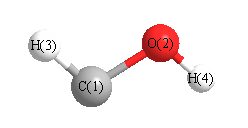 More geometry information
Calculated Bond Angles
| atom1 |
atom2 |
atom3 |
angle |
|
atom1 |
atom2 |
atom3 |
angle |
| C1 |
O2 |
H4 |
108.512 |
|
O2 |
C1 |
H3 |
102.132 |
Electronic energy levels
Charges, Dipole, Quadrupole and Polarizability
Charges from optimized geometry at B1B95/cc-pVTZ
Charges (e)
| Number |
Element |
Mulliken |
CHELPG |
AIM |
ESP |
| 1 |
C |
-0.200 |
|
|
|
| 2 |
O |
-0.134 |
|
|
|
| 3 |
H |
0.085 |
|
|
|
| 4 |
H |
0.249 |
|
|
|
Electric dipole moments
Electric dipole components in Debye
(What's a Debye? See section
VII.A.3)
| |
x |
y |
z |
Total |
| |
0.201 |
-1.656 |
0.000 |
1.668 |
| CHELPG |
|
|
|
|
| AIM |
|
|
|
|
| ESP |
|
|
|
|
Electric Quadrupole moment
Quadrupole components in D Å
| Primitive |
|---|
| | x | y | z |
|---|
| x |
-11.099 |
-3.624 |
0.000 |
| y |
-3.624 |
-13.580 |
0.000 |
| z |
0.000 |
0.000 |
-11.969 |
|
| Traceless |
|---|
| | x | y | z |
|---|
| x |
1.675 |
-3.624 |
0.000 |
| y |
-3.624 |
-2.045 |
0.000 |
| z |
0.000 |
0.000 |
0.371 |
|
| Polar |
|---|
| 3z2-r2 | 0.741 |
|---|
| x2-y2 | 2.480 |
|---|
| xy | -3.624 |
|---|
| xz | 0.000 |
|---|
| yz | 0.000 |
|---|
|
Polarizabilities
Components of the polarizability tensor.
Units are
Å
3 (Angstrom cubed)
Change units.
| |
x |
y |
z |
| x |
2.820 |
-0.458 |
0.000 |
| y |
-0.458 |
2.791 |
0.000 |
| z |
0.000 |
0.000 |
1.880 |
<r2> (average value of r
2) Å
2
| <r2> |
17.176 |
| (<r2>)1/2 |
4.144 |
Jump to
S1C1
Energy calculated at B1B95/cc-pVTZ
| | hartrees |
|---|
| Energy at 0K | -114.406684 |
| Energy at 298.15K | -114.408093 |
| HF Energy | -114.406684 |
| Nuclear repulsion energy | 30.816852 |
The energy at 298.15K was derived from the energy at 0K
and an integrated heat capacity that used the calculated vibrational frequencies.
Vibrational Frequencies calculated at B1B95/cc-pVTZ
| Mode Number |
Symmetry |
Frequency
(cm-1) |
Scaled Frequency
(cm-1) |
IR Intensities
(km mol-1) |
Raman Act
(Å4/u) |
Dep P |
Dep U |
|---|
| 1 |
A' |
3610 |
3455 |
18.72 |
|
|
|
| 2 |
A' |
2766 |
2647 |
216.51 |
|
|
|
| 3 |
A' |
1479 |
1416 |
50.82 |
|
|
|
| 4 |
A' |
1367 |
1309 |
70.63 |
|
|
|
| 5 |
A' |
1228 |
1176 |
31.11 |
|
|
|
| 6 |
A" |
1031 |
987 |
29.25 |
|
|
|
Unscaled Zero Point Vibrational Energy (zpe) 5741.1 cm
-1
Scaled (by 0.9571) Zero Point Vibrational Energy (zpe) 5494.8 cm
-1
See section
III.C.1 List or set vibrational scaling factors
to change the scale factors used here.
See section
III.C.2
Calculate a vibrational scaling factor for a given set of molecules
to determine the least squares best scaling factor.
Geometric Data calculated at B1B95/cc-pVTZ
Point Group is Cs
Cartesians (Å)
| Atom |
x (Å) |
y (Å) |
z (Å) |
|---|
| C1 |
0.122 |
0.737 |
0.000 |
| O2 |
0.122 |
-0.563 |
0.000 |
| H3 |
-0.950 |
1.063 |
0.000 |
| H4 |
-0.753 |
-0.983 |
0.000 |
Atom - Atom Distances (Å)
| |
C1 |
O2 |
H3 |
H4 |
| C1 | | 1.2998 | 1.1197 | 1.9298 |
O2 | 1.2998 | | 1.9468 | 0.9706 | H3 | 1.1197 | 1.9468 | | 2.0553 | H4 | 1.9298 | 0.9706 | 2.0553 | |
More geometry information
Calculated Bond Angles
| atom1 |
atom2 |
atom3 |
angle |
|
atom1 |
atom2 |
atom3 |
angle |
| C1 |
O2 |
H4 |
115.656 |
|
O2 |
C1 |
H3 |
106.920 |
Electronic energy levels
Charges, Dipole, Quadrupole and Polarizability
Charges from optimized geometry at B1B95/cc-pVTZ
Charges (e)
| Number |
Element |
Mulliken |
CHELPG |
AIM |
ESP |
| 1 |
C |
-0.138 |
|
|
|
| 2 |
O |
-0.128 |
|
|
|
| 3 |
H |
0.050 |
|
|
|
| 4 |
H |
0.217 |
|
|
|
Electric dipole moments
Electric dipole components in Debye
(What's a Debye? See section
VII.A.3)
| |
x |
y |
z |
Total |
| |
-2.897 |
-1.689 |
0.000 |
3.354 |
| CHELPG |
|
|
|
|
| AIM |
|
|
|
|
| ESP |
|
|
|
|
Electric Quadrupole moment
Quadrupole components in D Å
| Primitive |
|---|
| | x | y | z |
|---|
| x |
-12.311 |
-0.167 |
0.000 |
| y |
-0.167 |
-13.091 |
0.000 |
| z |
0.000 |
0.000 |
-11.926 |
|
| Traceless |
|---|
| | x | y | z |
|---|
| x |
0.198 |
-0.167 |
0.000 |
| y |
-0.167 |
-0.973 |
0.000 |
| z |
0.000 |
0.000 |
0.775 |
|
| Polar |
|---|
| 3z2-r2 | 1.550 |
|---|
| x2-y2 | 0.780 |
|---|
| xy | -0.167 |
|---|
| xz | 0.000 |
|---|
| yz | 0.000 |
|---|
|
Polarizabilities
Components of the polarizability tensor.
Units are
Å
3 (Angstrom cubed)
Change units.
| |
x |
y |
z |
| x |
2.777 |
-0.004 |
0.000 |
| y |
-0.004 |
3.191 |
0.000 |
| z |
0.000 |
0.000 |
1.879 |
<r2> (average value of r
2) Å
2
| <r2> |
17.336 |
| (<r2>)1/2 |
4.164 |
