Jump to
S1C2
Energy calculated at wB97X-D/cc-pVTZ
| | hartrees |
|---|
| Energy at 0K | -114.423410 |
| Energy at 298.15K | -114.424829 |
| HF Energy | -114.423410 |
| Nuclear repulsion energy | 30.873466 |
The energy at 298.15K was derived from the energy at 0K
and an integrated heat capacity that used the calculated vibrational frequencies.
Vibrational Frequencies calculated at wB97X-D/cc-pVTZ
| Mode Number |
Symmetry |
Frequency
(cm-1) |
Scaled Frequency
(cm-1) |
IR Intensities
(km mol-1) |
Raman Act
(Å4/u) |
Dep P |
Dep U |
|---|
| 1 |
A' |
3791 |
3624 |
78.62 |
|
|
|
| 2 |
A' |
2867 |
2741 |
143.66 |
|
|
|
| 3 |
A' |
1518 |
1451 |
21.59 |
|
|
|
| 4 |
A' |
1370 |
1309 |
81.09 |
|
|
|
| 5 |
A' |
1231 |
1177 |
136.14 |
|
|
|
| 6 |
A" |
1094 |
1046 |
120.19 |
|
|
|
Unscaled Zero Point Vibrational Energy (zpe) 5935.5 cm
-1
Scaled (by 0.956) Zero Point Vibrational Energy (zpe) 5674.3 cm
-1
See section
III.C.1 List or set vibrational scaling factors
to change the scale factors used here.
See section
III.C.2
Calculate a vibrational scaling factor for a given set of molecules
to determine the least squares best scaling factor.
Geometric Data calculated at wB97X-D/cc-pVTZ
Point Group is Cs
Cartesians (Å)
| Atom |
x (Å) |
y (Å) |
z (Å) |
|---|
| C1 |
-0.004 |
0.726 |
0.000 |
| O2 |
-0.004 |
-0.577 |
0.000 |
| H3 |
0.968 |
1.125 |
0.000 |
| H4 |
-0.915 |
-0.862 |
0.000 |
Atom - Atom Distances (Å)
| |
C1 |
O2 |
H3 |
H4 |
| C1 | | 1.3026 | 1.0510 | 1.8302 |
O2 | 1.3026 | | 1.9601 | 0.9546 | H3 | 1.0510 | 1.9601 | | 2.7375 | H4 | 1.8302 | 0.9546 | 2.7375 | |
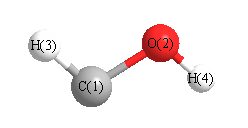 More geometry information
Calculated Bond Angles
| atom1 |
atom2 |
atom3 |
angle |
|
atom1 |
atom2 |
atom3 |
angle |
| C1 |
O2 |
H4 |
107.353 |
|
O2 |
C1 |
H3 |
112.338 |
Electronic energy levels
Charges, Dipole, Quadrupole and Polarizability
Charges from optimized geometry at wB97X-D/cc-pVTZ
Charges (e)
| Number |
Element |
Mulliken |
CHELPG |
AIM |
ESP |
| 1 |
C |
-0.178 |
|
|
|
| 2 |
O |
-0.122 |
|
|
|
| 3 |
H |
0.068 |
|
|
|
| 4 |
H |
0.233 |
|
|
|
Electric dipole moments
Electric dipole components in Debye
(What's a Debye? See section
VII.A.3)
| |
x |
y |
z |
Total |
| |
-0.157 |
-1.651 |
0.000 |
1.658 |
| CHELPG |
|
|
|
|
| AIM |
|
|
|
|
| ESP |
|
|
|
|
Electric Quadrupole moment
Quadrupole components in D Å
| Primitive |
|---|
| | x | y | z |
|---|
| x |
-11.084 |
3.706 |
0.000 |
| y |
3.706 |
-13.606 |
0.000 |
| z |
0.000 |
0.000 |
-11.968 |
|
| Traceless |
|---|
| | x | y | z |
|---|
| x |
1.702 |
3.706 |
0.000 |
| y |
3.706 |
-2.080 |
0.000 |
| z |
0.000 |
0.000 |
0.377 |
|
| Polar |
|---|
| 3z2-r2 | 0.754 |
|---|
| x2-y2 | 2.521 |
|---|
| xy | 3.706 |
|---|
| xz | 0.000 |
|---|
| yz | 0.000 |
|---|
|
Polarizabilities
Components of the polarizability tensor.
Units are
Å
3 (Angstrom cubed)
Change units.
| |
x |
y |
z |
| x |
2.803 |
0.447 |
0.000 |
| y |
0.447 |
2.806 |
0.000 |
| z |
0.000 |
0.000 |
1.908 |
<r2> (average value of r
2) Å
2
| <r2> |
17.195 |
| (<r2>)1/2 |
4.147 |
Jump to
S1C1
Energy calculated at wB97X-D/cc-pVTZ
| | hartrees |
|---|
| Energy at 0K | -114.415750 |
| Energy at 298.15K | -114.417159 |
| HF Energy | -114.415750 |
| Nuclear repulsion energy | 30.792339 |
The energy at 298.15K was derived from the energy at 0K
and an integrated heat capacity that used the calculated vibrational frequencies.
Vibrational Frequencies calculated at wB97X-D/cc-pVTZ
| Mode Number |
Symmetry |
Frequency
(cm-1) |
Scaled Frequency
(cm-1) |
IR Intensities
(km mol-1) |
Raman Act
(Å4/u) |
Dep P |
Dep U |
|---|
| 1 |
A' |
3668 |
3507 |
17.87 |
|
|
|
| 2 |
A' |
2772 |
2650 |
204.84 |
|
|
|
| 3 |
A' |
1480 |
1415 |
50.21 |
|
|
|
| 4 |
A' |
1371 |
1310 |
83.40 |
|
|
|
| 5 |
A' |
1249 |
1194 |
33.02 |
|
|
|
| 6 |
A" |
1020 |
975 |
28.21 |
|
|
|
Unscaled Zero Point Vibrational Energy (zpe) 5779.6 cm
-1
Scaled (by 0.956) Zero Point Vibrational Energy (zpe) 5525.3 cm
-1
See section
III.C.1 List or set vibrational scaling factors
to change the scale factors used here.
See section
III.C.2
Calculate a vibrational scaling factor for a given set of molecules
to determine the least squares best scaling factor.
Geometric Data calculated at wB97X-D/cc-pVTZ
Point Group is Cs
Cartesians (Å)
| Atom |
x (Å) |
y (Å) |
z (Å) |
|---|
| C1 |
0.116 |
0.732 |
0.000 |
| O2 |
0.116 |
-0.572 |
0.000 |
| H3 |
-0.860 |
1.142 |
0.000 |
| H4 |
-0.768 |
-0.958 |
0.000 |
Atom - Atom Distances (Å)
| |
C1 |
O2 |
H3 |
H4 |
| C1 | | 1.3045 | 1.0590 | 1.9077 |
O2 | 1.3045 | | 1.9728 | 0.9646 | H3 | 1.0590 | 1.9728 | | 2.1022 | H4 | 1.9077 | 0.9646 | 2.1022 | |
More geometry information
Calculated Bond Angles
| atom1 |
atom2 |
atom3 |
angle |
|
atom1 |
atom2 |
atom3 |
angle |
| C1 |
O2 |
H4 |
113.587 |
|
O2 |
C1 |
H3 |
112.760 |
Electronic energy levels
Charges, Dipole, Quadrupole and Polarizability
Charges from optimized geometry at wB97X-D/cc-pVTZ
Charges (e)
| Number |
Element |
Mulliken |
CHELPG |
AIM |
ESP |
| 1 |
C |
-0.121 |
|
|
|
| 2 |
O |
-0.116 |
|
|
|
| 3 |
H |
0.035 |
|
|
|
| 4 |
H |
0.202 |
|
|
|
Electric dipole moments
Electric dipole components in Debye
(What's a Debye? See section
VII.A.3)
| |
x |
y |
z |
Total |
| |
-2.966 |
-1.697 |
0.000 |
3.417 |
| CHELPG |
|
|
|
|
| AIM |
|
|
|
|
| ESP |
|
|
|
|
Electric Quadrupole moment
Quadrupole components in D Å
| Primitive |
|---|
| | x | y | z |
|---|
| x |
-12.300 |
-0.206 |
0.000 |
| y |
-0.206 |
-13.118 |
0.000 |
| z |
0.000 |
0.000 |
-11.922 |
|
| Traceless |
|---|
| | x | y | z |
|---|
| x |
0.220 |
-0.206 |
0.000 |
| y |
-0.206 |
-1.008 |
0.000 |
| z |
0.000 |
0.000 |
0.787 |
|
| Polar |
|---|
| 3z2-r2 | 1.575 |
|---|
| x2-y2 | 0.819 |
|---|
| xy | -0.206 |
|---|
| xz | 0.000 |
|---|
| yz | 0.000 |
|---|
|
Polarizabilities
Components of the polarizability tensor.
Units are
Å
3 (Angstrom cubed)
Change units.
| |
x |
y |
z |
| x |
2.769 |
-0.035 |
0.000 |
| y |
-0.035 |
3.142 |
0.000 |
| z |
0.000 |
0.000 |
1.909 |
<r2> (average value of r
2) Å
2
| <r2> |
17.356 |
| (<r2>)1/2 |
4.166 |
