Jump to
S1C2
Energy calculated at QCISD(T)/cc-pVTZ
| | hartrees |
|---|
| Energy at 0K | -117.032946 |
| Energy at 298.15K | -117.037136 |
| HF Energy | -116.511489 |
| Nuclear repulsion energy | 64.889136 |
The energy at 298.15K was derived from the energy at 0K
and an integrated heat capacity that used the calculated vibrational frequencies.
Vibrational Frequencies calculated at QCISD(T)/cc-pVTZ
| Mode Number |
Symmetry |
Frequency
(cm-1) |
Scaled Frequency
(cm-1) |
IR Intensities
(km mol-1) |
Raman Act
(Å4/u) |
Dep P |
Dep U |
|---|
| 1 |
A1 |
3253 |
3086 |
|
|
|
|
| 2 |
A1 |
3157 |
2995 |
|
|
|
|
| 3 |
A1 |
3148 |
2986 |
|
|
|
|
| 4 |
A1 |
1517 |
1439 |
|
|
|
|
| 5 |
A1 |
1270 |
1204 |
|
|
|
|
| 6 |
A1 |
1032 |
979 |
|
|
|
|
| 7 |
A1 |
412 |
391 |
|
|
|
|
| 8 |
A2 |
760 |
721 |
|
|
|
|
| 9 |
A2 |
516 |
490 |
|
|
|
|
| 10 |
B1 |
997 |
946 |
|
|
|
|
| 11 |
B1 |
799 |
758 |
|
|
|
|
| 12 |
B1 |
509 |
483 |
|
|
|
|
| 13 |
B2 |
3252 |
3084 |
|
|
|
|
| 14 |
B2 |
3144 |
2982 |
|
|
|
|
| 15 |
B2 |
1512 |
1434 |
|
|
|
|
| 16 |
B2 |
1414 |
1342 |
|
|
|
|
| 17 |
B2 |
1179 |
1118 |
|
|
|
|
| 18 |
B2 |
916 |
869 |
|
|
|
|
Unscaled Zero Point Vibrational Energy (zpe) 14393.4 cm
-1
Scaled (by 0.9486) Zero Point Vibrational Energy (zpe) 13653.6 cm
-1
See section
III.C.1 List or set vibrational scaling factors
to change the scale factors used here.
See section
III.C.2
Calculate a vibrational scaling factor for a given set of molecules
to determine the least squares best scaling factor.
Geometric Data calculated at QCISD(T)/cc-pVTZ
Point Group is C2v
Cartesians (Å)
| Atom |
x (Å) |
y (Å) |
z (Å) |
|---|
| C1 |
0.000 |
0.000 |
0.451 |
| H2 |
0.000 |
0.000 |
1.536 |
| C3 |
0.000 |
1.227 |
-0.199 |
| C4 |
0.000 |
-1.227 |
-0.199 |
| H5 |
0.000 |
2.156 |
0.353 |
| H6 |
0.000 |
-2.156 |
0.353 |
| H7 |
0.000 |
1.278 |
-1.281 |
| H8 |
0.000 |
-1.278 |
-1.281 |
Atom - Atom Distances (Å)
| |
C1 |
H2 |
C3 |
C4 |
H5 |
H6 |
H7 |
H8 |
| C1 | | 1.0858 | 1.3878 | 1.3878 | 2.1586 | 2.1586 | 2.1522 | 2.1522 |
H2 | 1.0858 | | 2.1249 | 2.1249 | 2.4598 | 2.4598 | 3.0937 | 3.0937 | C3 | 1.3878 | 2.1249 | | 2.4531 | 1.0812 | 3.4276 | 1.0834 | 2.7285 | C4 | 1.3878 | 2.1249 | 2.4531 | | 3.4276 | 1.0812 | 2.7285 | 1.0834 | H5 | 2.1586 | 2.4598 | 1.0812 | 3.4276 | | 4.3127 | 1.8550 | 3.8034 | H6 | 2.1586 | 2.4598 | 3.4276 | 1.0812 | 4.3127 | | 3.8034 | 1.8550 | H7 | 2.1522 | 3.0937 | 1.0834 | 2.7285 | 1.8550 | 3.8034 | | 2.5563 | H8 | 2.1522 | 3.0937 | 2.7285 | 1.0834 | 3.8034 | 1.8550 | 2.5563 | |
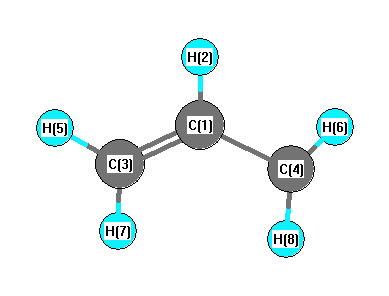 More geometry information
Calculated Bond Angles
| atom1 |
atom2 |
atom3 |
angle |
|
atom1 |
atom2 |
atom3 |
angle |
| C1 |
C3 |
H5 |
121.421 |
|
C1 |
C3 |
H7 |
120.627 |
| C1 |
C4 |
H6 |
121.421 |
|
C1 |
C4 |
H8 |
120.627 |
| H2 |
C1 |
C3 |
117.896 |
|
H2 |
C1 |
C4 |
117.896 |
| C3 |
C1 |
C4 |
124.208 |
|
H5 |
C3 |
H7 |
117.952 |
| H6 |
C4 |
H8 |
117.952 |
|
Electronic energy levels
Charges, Dipole, Quadrupole and Polarizability
Jump to
S1C1
Energy calculated at QCISD(T)/cc-pVTZ
| | hartrees |
|---|
| Energy at 0K | -117.032946 |
| Energy at 298.15K | -117.037173 |
| HF Energy | -116.511477 |
| Nuclear repulsion energy | 64.890429 |
The energy at 298.15K was derived from the energy at 0K
and an integrated heat capacity that used the calculated vibrational frequencies.
Vibrational Frequencies calculated at QCISD(T)/cc-pVTZ
| Mode Number |
Symmetry |
Frequency
(cm-1) |
Scaled Frequency
(cm-1) |
IR Intensities
(km mol-1) |
Raman Act
(Å4/u) |
Dep P |
Dep U |
|---|
| 1 |
A' |
3252 |
3085 |
|
|
|
|
| 2 |
A' |
3248 |
3081 |
|
|
|
|
| 3 |
A' |
3157 |
2995 |
|
|
|
|
| 4 |
A' |
3148 |
2987 |
|
|
|
|
| 5 |
A' |
3145 |
2983 |
|
|
|
|
| 6 |
A' |
1525 |
1446 |
|
|
|
|
| 7 |
A' |
1514 |
1436 |
|
|
|
|
| 8 |
A' |
1418 |
1345 |
|
|
|
|
| 9 |
A' |
1271 |
1206 |
|
|
|
|
| 10 |
A' |
1180 |
1120 |
|
|
|
|
| 11 |
A' |
1033 |
980 |
|
|
|
|
| 12 |
A' |
926 |
878 |
|
|
|
|
| 13 |
A' |
414 |
393 |
|
|
|
|
| 14 |
A" |
998 |
947 |
|
|
|
|
| 15 |
A" |
795 |
754 |
|
|
|
|
| 16 |
A" |
773 |
733 |
|
|
|
|
| 17 |
A" |
543 |
515 |
|
|
|
|
| 18 |
A" |
523 |
496 |
|
|
|
|
Unscaled Zero Point Vibrational Energy (zpe) 14430.4 cm
-1
Scaled (by 0.9486) Zero Point Vibrational Energy (zpe) 13688.7 cm
-1
See section
III.C.1 List or set vibrational scaling factors
to change the scale factors used here.
See section
III.C.2
Calculate a vibrational scaling factor for a given set of molecules
to determine the least squares best scaling factor.
Geometric Data calculated at QCISD(T)/cc-pVTZ
Point Group is Cs
Cartesians (Å)
| Atom |
x (Å) |
y (Å) |
z (Å) |
|---|
| C1 |
0.000 |
0.451 |
0.000 |
| H2 |
-0.000 |
1.537 |
0.000 |
| C3 |
-1.226 |
-0.199 |
0.000 |
| C4 |
1.226 |
-0.199 |
0.000 |
| H5 |
-2.157 |
0.351 |
0.000 |
| H6 |
2.157 |
0.352 |
0.000 |
| H7 |
-1.277 |
-1.281 |
0.000 |
| H8 |
1.277 |
-1.281 |
0.000 |
Atom - Atom Distances (Å)
| |
C1 |
H2 |
C3 |
C4 |
H5 |
H6 |
H7 |
H8 |
| C1 | | 1.0860 | 1.3877 | 1.3878 | 2.1593 | 2.1589 | 2.1526 | 2.1523 |
H2 | 1.0860 | | 2.1252 | 2.1255 | 2.4613 | 2.4611 | 3.0944 | 3.0944 | C3 | 1.3877 | 2.1252 | | 2.4522 | 1.0813 | 3.4273 | 1.0836 | 2.7271 | C4 | 1.3878 | 2.1255 | 2.4522 | | 3.4275 | 1.0812 | 2.7277 | 1.0837 | H5 | 2.1593 | 2.4613 | 1.0813 | 3.4275 | | 4.3136 | 1.8543 | 3.8023 | H6 | 2.1589 | 2.4611 | 3.4273 | 1.0812 | 4.3136 | | 3.8027 | 1.8551 | H7 | 2.1526 | 3.0944 | 1.0836 | 2.7277 | 1.8543 | 3.8027 | | 2.5545 | H8 | 2.1523 | 3.0944 | 2.7271 | 1.0837 | 3.8023 | 1.8551 | 2.5545 | |
More geometry information
Calculated Bond Angles
| atom1 |
atom2 |
atom3 |
angle |
|
atom1 |
atom2 |
atom3 |
angle |
| C1 |
C3 |
H5 |
121.487 |
|
C1 |
C3 |
H7 |
120.652 |
| C1 |
C4 |
H6 |
121.452 |
|
C1 |
C4 |
H8 |
120.616 |
| H2 |
C1 |
C3 |
117.919 |
|
H2 |
C1 |
C4 |
117.940 |
| C3 |
C1 |
C4 |
124.141 |
|
H5 |
C3 |
H7 |
117.860 |
| H6 |
C4 |
H8 |
117.932 |
|
Electronic energy levels
Charges, Dipole, Quadrupole and Polarizability
