Jump to
S1C2
Energy calculated at B1B95/cc-pVTZ
| | hartrees |
|---|
| Energy at 0K | -90.571137 |
| Energy at 298.15K | -90.570953 |
| HF Energy | -90.571137 |
| Nuclear repulsion energy | 17.554225 |
The energy at 298.15K was derived from the energy at 0K
and an integrated heat capacity that used the calculated vibrational frequencies.
Geometric Data calculated at B1B95/cc-pVTZ
Point Group is Cs
Cartesians (Å)
| Atom |
x (Å) |
y (Å) |
z (Å) |
|---|
| O1 |
0.047 |
-0.374 |
0.000 |
| Be2 |
0.047 |
1.022 |
0.000 |
| H3 |
-0.561 |
-1.101 |
0.000 |
Atom - Atom Distances (Å)
| |
O1 |
Be2 |
H3 |
| O1 | | 1.3960 | 0.9480 |
Be2 | 1.3960 | | 2.2086 | H3 | 0.9480 | 2.2086 | |
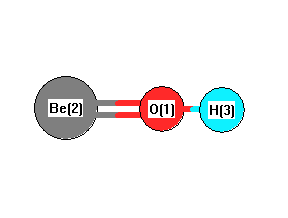 More geometry information
Calculated Bond Angles
| atom1 |
atom2 |
atom3 |
angle |
|
atom1 |
atom2 |
atom3 |
angle |
| Be2 |
O1 |
H3 |
140.091 |
|
Electronic energy levels
Charges, Dipole, Quadrupole and Polarizability
Charges from optimized geometry at B1B95/cc-pVTZ
Charges (e)
| Number |
Element |
Mulliken |
CHELPG |
AIM |
ESP |
| 1 |
O |
-0.284 |
|
|
|
| 2 |
Be |
0.074 |
|
|
|
| 3 |
H |
0.210 |
|
|
|
Electric dipole moments
Electric dipole components in Debye
(What's a Debye? See section
VII.A.3)
| |
x |
y |
z |
Total |
| |
-1.018 |
-0.701 |
0.000 |
1.236 |
| CHELPG |
|
|
|
|
| AIM |
|
|
|
|
| ESP |
|
|
|
|
Electric Quadrupole moment
Quadrupole components in D Å
| Primitive |
|---|
| | x | y | z |
|---|
| x |
-11.081 |
1.502 |
0.000 |
| y |
1.502 |
-12.220 |
0.000 |
| z |
0.000 |
0.000 |
-12.009 |
|
| Traceless |
|---|
| | x | y | z |
|---|
| x |
1.033 |
1.502 |
0.000 |
| y |
1.502 |
-0.675 |
0.000 |
| z |
0.000 |
0.000 |
-0.358 |
|
| Polar |
|---|
| 3z2-r2 | -0.716 |
|---|
| x2-y2 | 1.138 |
|---|
| xy | 1.502 |
|---|
| xz | 0.000 |
|---|
| yz | 0.000 |
|---|
|
Polarizabilities
Components of the polarizability tensor.
Units are
Å
3 (Angstrom cubed)
Change units.
| |
x |
y |
z |
| x |
4.951 |
0.156 |
0.000 |
| y |
0.156 |
4.178 |
0.000 |
| z |
0.000 |
0.000 |
4.692 |
<r2> (average value of r
2) Å
2
| <r2> |
14.202 |
| (<r2>)1/2 |
3.769 |
Jump to
S1C1
Energy calculated at B1B95/cc-pVTZ
| | hartrees |
|---|
| Energy at 0K | -90.569524 |
| Energy at 298.15K | |
| HF Energy | -90.569524 |
| Nuclear repulsion energy | 17.347977 |
The energy at 298.15K was derived from the energy at 0K
and an integrated heat capacity that used the calculated vibrational frequencies.
Vibrational Frequencies calculated at B1B95/cc-pVTZ
Geometric Data calculated at B1B95/cc-pVTZ
Point Group is C∞v
Electronic energy levels
Charges, Dipole, Quadrupole and Polarizability
