Jump to
S1C2
S2C1
S2C2
Energy calculated at QCISD(T)/cc-pVTZ
| | hartrees |
|---|
| Energy at 0K | -39.077895 |
| Energy at 298.15K | -39.077707 |
| HF Energy | -38.937707 |
| Nuclear repulsion energy | 6.155024 |
The energy at 298.15K was derived from the energy at 0K
and an integrated heat capacity that used the calculated vibrational frequencies.
Geometric Data calculated at QCISD(T)/cc-pVTZ
Point Group is C2v
Cartesians (Å)
| Atom |
x (Å) |
y (Å) |
z (Å) |
|---|
| C1 |
0.000 |
0.000 |
0.106 |
| H2 |
0.000 |
0.991 |
-0.319 |
| H3 |
0.000 |
-0.991 |
-0.319 |
Atom - Atom Distances (Å)
| |
C1 |
H2 |
H3 |
| C1 | | 1.0785 | 1.0785 |
H2 | 1.0785 | | 1.9819 | H3 | 1.0785 | 1.9819 | |
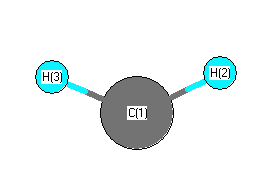 More geometry information
Calculated Bond Angles
| atom1 |
atom2 |
atom3 |
angle |
|
atom1 |
atom2 |
atom3 |
angle |
| H2 |
C1 |
H3 |
133.513 |
|
Electronic energy levels
Electronic state
Charges, Dipole, Quadrupole and Polarizability
Jump to
S1C1
S2C1
S2C2
Energy calculated at QCISD(T)/cc-pVTZ
| | hartrees |
|---|
| Energy at 0K | -39.068491 |
| Energy at 298.15K | |
| HF Energy | -38.925790 |
| Nuclear repulsion energy | 6.192343 |
The energy at 298.15K was derived from the energy at 0K
and an integrated heat capacity that used the calculated vibrational frequencies.
Geometric Data calculated at QCISD(T)/cc-pVTZ
Point Group is D∞h
Cartesians (Å)
| Atom |
x (Å) |
y (Å) |
z (Å) |
|---|
| C1 |
0.000 |
0.000 |
0.000 |
| H2 |
0.000 |
0.000 |
1.068 |
| H3 |
0.000 |
0.000 |
-1.068 |
Atom - Atom Distances (Å)
| |
C1 |
H2 |
H3 |
| C1 | | 1.0677 | 1.0677 |
H2 | 1.0677 | | 2.1353 | H3 | 1.0677 | 2.1353 | |
More geometry information
Calculated Bond Angles
| atom1 |
atom2 |
atom3 |
angle |
|
atom1 |
atom2 |
atom3 |
angle |
| H2 |
C1 |
H3 |
180.000 |
|
Electronic energy levels
Charges, Dipole, Quadrupole and Polarizability
Jump to
S1C1
S1C2
S2C2
Energy calculated at QCISD(T)/cc-pVTZ
| | hartrees |
|---|
| Energy at 0K | -39.061433 |
| Energy at 298.15K | -39.061270 |
| HF Energy | -38.892228 |
| Nuclear repulsion energy | 6.025438 |
The energy at 298.15K was derived from the energy at 0K
and an integrated heat capacity that used the calculated vibrational frequencies.
Geometric Data calculated at QCISD(T)/cc-pVTZ
Point Group is C2v
Cartesians (Å)
| Atom |
x (Å) |
y (Å) |
z (Å) |
|---|
| C1 |
0.000 |
0.000 |
0.176 |
| H2 |
0.000 |
0.860 |
-0.527 |
| H3 |
0.000 |
-0.860 |
-0.527 |
Atom - Atom Distances (Å)
| |
C1 |
H2 |
H3 |
| C1 | | 1.1106 | 1.1106 |
H2 | 1.1106 | | 1.7201 | H3 | 1.1106 | 1.7201 | |
More geometry information
Electronic energy levels
Electronic state
Charges, Dipole, Quadrupole and Polarizability
Jump to
S1C1
S1C2
S2C1
Energy calculated at QCISD(T)/cc-pVTZ
| | hartrees |
|---|
| Energy at 0K | -39.061433 |
| Energy at 298.15K | -39.061270 |
| HF Energy | -38.892228 |
| Nuclear repulsion energy | 6.025438 |
The energy at 298.15K was derived from the energy at 0K
and an integrated heat capacity that used the calculated vibrational frequencies.
Vibrational Frequencies calculated at QCISD(T)/cc-pVTZ
Geometric Data calculated at QCISD(T)/cc-pVTZ
Point Group is C2v
Electronic energy levels
Charges, Dipole, Quadrupole and Polarizability
