Jump to
S1C2
Energy calculated at QCISD(T)/cc-pVTZ
| | hartrees |
|---|
| Energy at 0K | -417.835563 |
| Energy at 298.15K | -417.839691 |
| HF Energy | -417.394160 |
| Nuclear repulsion energy | 61.567270 |
The energy at 298.15K was derived from the energy at 0K
and an integrated heat capacity that used the calculated vibrational frequencies.
Vibrational Frequencies calculated at QCISD(T)/cc-pVTZ
| Mode Number |
Symmetry |
Frequency
(cm-1) |
Scaled Frequency
(cm-1) |
IR Intensities
(km mol-1) |
Raman Act
(Å4/u) |
Dep P |
Dep U |
|---|
| 1 |
A' |
3858 |
3660 |
|
|
|
|
| 2 |
A' |
2349 |
2228 |
|
|
|
|
| 3 |
A' |
1152 |
1093 |
|
|
|
|
| 4 |
A' |
1126 |
1068 |
|
|
|
|
| 5 |
A' |
922 |
875 |
|
|
|
|
| 6 |
A' |
815 |
773 |
|
|
|
|
| 7 |
A" |
2350 |
2230 |
|
|
|
|
| 8 |
A" |
924 |
876 |
|
|
|
|
| 9 |
A" |
416 |
394 |
|
|
|
|
Unscaled Zero Point Vibrational Energy (zpe) 6955.5 cm
-1
Scaled (by 0.9486) Zero Point Vibrational Energy (zpe) 6598.0 cm
-1
See section
III.C.1 List or set vibrational scaling factors
to change the scale factors used here.
See section
III.C.2
Calculate a vibrational scaling factor for a given set of molecules
to determine the least squares best scaling factor.
Geometric Data calculated at QCISD(T)/cc-pVTZ
Point Group is Cs
Cartesians (Å)
| Atom |
x (Å) |
y (Å) |
z (Å) |
|---|
| P1 |
-0.107 |
-0.568 |
0.000 |
| O2 |
-0.107 |
1.093 |
0.000 |
| H3 |
0.779 |
1.463 |
0.000 |
| H4 |
0.844 |
-0.845 |
1.026 |
| H5 |
0.844 |
-0.845 |
-1.026 |
Atom - Atom Distances (Å)
| |
P1 |
O2 |
H3 |
H4 |
H5 |
| P1 | | 1.6610 | 2.2162 | 1.4265 | 1.4265 |
O2 | 1.6610 | | 0.9607 | 2.3905 | 2.3905 | H3 | 2.2162 | 0.9607 | | 2.5269 | 2.5269 | H4 | 1.4265 | 2.3905 | 2.5269 | | 2.0516 | H5 | 1.4265 | 2.3905 | 2.5269 | 2.0516 | |
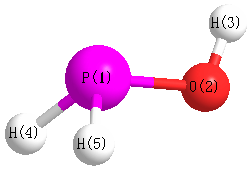 More geometry information
Calculated Bond Angles
| atom1 |
atom2 |
atom3 |
angle |
|
atom1 |
atom2 |
atom3 |
angle |
| P1 |
O2 |
H3 |
112.668 |
|
O2 |
P1 |
H4 |
101.205 |
| O2 |
P1 |
H5 |
101.205 |
|
H4 |
P1 |
H5 |
91.960 |
Electronic energy levels
Charges, Dipole, Quadrupole and Polarizability
Jump to
S1C1
Energy calculated at QCISD(T)/cc-pVTZ
| | hartrees |
|---|
| Energy at 0K | -417.835627 |
| Energy at 298.15K | -417.839597 |
| HF Energy | -417.393552 |
| Nuclear repulsion energy | 61.481693 |
The energy at 298.15K was derived from the energy at 0K
and an integrated heat capacity that used the calculated vibrational frequencies.
Vibrational Frequencies calculated at QCISD(T)/cc-pVTZ
| Mode Number |
Symmetry |
Frequency
(cm-1) |
Scaled Frequency
(cm-1) |
IR Intensities
(km mol-1) |
Raman Act
(Å4/u) |
Dep P |
Dep U |
|---|
| 1 |
A' |
3880 |
3681 |
|
|
|
|
| 2 |
A' |
2387 |
2265 |
|
|
|
|
| 3 |
A' |
1168 |
1108 |
|
|
|
|
| 4 |
A' |
1154 |
1095 |
|
|
|
|
| 5 |
A' |
920 |
873 |
|
|
|
|
| 6 |
A' |
808 |
766 |
|
|
|
|
| 7 |
A" |
2387 |
2264 |
|
|
|
|
| 8 |
A" |
937 |
888 |
|
|
|
|
| 9 |
A" |
269 |
255 |
|
|
|
|
Unscaled Zero Point Vibrational Energy (zpe) 6954.4 cm
-1
Scaled (by 0.9486) Zero Point Vibrational Energy (zpe) 6596.9 cm
-1
See section
III.C.1 List or set vibrational scaling factors
to change the scale factors used here.
See section
III.C.2
Calculate a vibrational scaling factor for a given set of molecules
to determine the least squares best scaling factor.
Geometric Data calculated at QCISD(T)/cc-pVTZ
Point Group is Cs
Cartesians (Å)
| Atom |
x (Å) |
y (Å) |
z (Å) |
|---|
| P1 |
0.039 |
-0.573 |
0.000 |
| O2 |
0.039 |
1.097 |
0.000 |
| H3 |
0.953 |
1.390 |
0.000 |
| H4 |
-0.920 |
-0.784 |
1.027 |
| H5 |
-0.920 |
-0.784 |
-1.027 |
Atom - Atom Distances (Å)
| |
P1 |
O2 |
H3 |
H4 |
H5 |
| P1 | | 1.6702 | 2.1656 | 1.4206 | 1.4206 |
O2 | 1.6702 | | 0.9598 | 2.3478 | 2.3478 | H3 | 2.1656 | 0.9598 | | 3.0477 | 3.0477 | H4 | 1.4206 | 2.3478 | 3.0477 | | 2.0532 | H5 | 1.4206 | 2.3478 | 3.0477 | 2.0532 | |
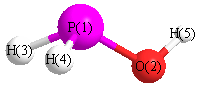 More geometry information
Calculated Bond Angles
| atom1 |
atom2 |
atom3 |
angle |
|
atom1 |
atom2 |
atom3 |
angle |
| P1 |
O2 |
H3 |
107.779 |
|
O2 |
P1 |
H4 |
98.534 |
| O2 |
P1 |
H5 |
98.534 |
|
H4 |
P1 |
H5 |
92.549 |
Electronic energy levels
Charges, Dipole, Quadrupole and Polarizability
