Jump to
S1C2
S2C1
S2C2
Energy calculated at HF/cc-pVTZ
| | hartrees |
|---|
| Energy at 0K | -130.723539 |
| Energy at 298.15K | -130.722927 |
| HF Energy | -130.723539 |
| Nuclear repulsion energy | 47.473616 |
The energy at 298.15K was derived from the energy at 0K
and an integrated heat capacity that used the calculated vibrational frequencies.
Vibrational Frequencies calculated at HF/cc-pVTZ
| Mode Number |
Symmetry |
Frequency
(cm-1) |
Scaled Frequency
(cm-1) |
IR Intensities
(km mol-1) |
Raman Act
(Å4/u) |
Dep P |
Dep U |
|---|
| 1 |
A' |
3469 |
3157 |
19.57 |
|
|
|
| 2 |
A' |
1653 |
1505 |
142.89 |
|
|
|
| 3 |
A' |
1203 |
1095 |
4.77 |
|
|
|
| 4 |
A' |
623 |
567 |
19.64 |
|
|
|
| 5 |
A' |
388 |
353 |
0.47 |
|
|
|
| 6 |
A" |
416 |
378 |
0.13 |
|
|
|
Unscaled Zero Point Vibrational Energy (zpe) 3875.3 cm
-1
Scaled (by 0.9101) Zero Point Vibrational Energy (zpe) 3526.9 cm
-1
See section
III.C.1 List or set vibrational scaling factors
to change the scale factors used here.
See section
III.C.2
Calculate a vibrational scaling factor for a given set of molecules
to determine the least squares best scaling factor.
Geometric Data calculated at HF/cc-pVTZ
Point Group is Cs
Cartesians (Å)
| Atom |
x (Å) |
y (Å) |
z (Å) |
|---|
| C1 |
0.223 |
-1.207 |
0.000 |
| C2 |
0.000 |
0.092 |
0.000 |
| N3 |
-0.331 |
1.235 |
0.000 |
| H4 |
0.976 |
-1.956 |
0.000 |
Atom - Atom Distances (Å)
| |
C1 |
C2 |
N3 |
H4 |
| C1 | | 1.3184 | 2.5040 | 1.0620 |
C2 | 1.3184 | | 1.1895 | 2.2690 | N3 | 2.5040 | 1.1895 | | 3.4481 | H4 | 1.0620 | 2.2690 | 3.4481 | |
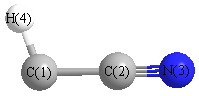 More geometry information
Calculated Bond Angles
| atom1 |
atom2 |
atom3 |
angle |
|
atom1 |
atom2 |
atom3 |
angle |
| C1 |
C2 |
N3 |
173.600 |
|
C2 |
C1 |
H4 |
144.574 |
Electronic energy levels
Charges, Dipole, Quadrupole and Polarizability
Jump to
S1C1
S2C1
S2C2
Energy calculated at HF/cc-pVTZ
| | hartrees |
|---|
| Energy at 0K | -130.721548 |
| Energy at 298.15K | |
| HF Energy | -130.721548 |
| Nuclear repulsion energy | 47.565448 |
The energy at 298.15K was derived from the energy at 0K
and an integrated heat capacity that used the calculated vibrational frequencies.
Vibrational Frequencies calculated at HF/cc-pVTZ
| Mode Number |
Symmetry |
Frequency
(cm-1) |
Scaled Frequency
(cm-1) |
IR Intensities
(km mol-1) |
Raman Act
(Å4/u) |
Dep P |
Dep U |
|---|
| 1 |
Σ |
3543 |
3224 |
58.28 |
|
|
|
| 2 |
Σ |
1565 |
1424 |
131.69 |
|
|
|
| 3 |
Σ |
1254 |
1142 |
0.00 |
|
|
|
| 4 |
Π |
413 |
376 |
0.13 |
|
|
|
| 4 |
Π |
413 |
376 |
0.13 |
|
|
|
| 5 |
Π |
417i |
379i |
44.54 |
|
|
|
| 5 |
Π |
417i |
379i |
44.54 |
|
|
|
Unscaled Zero Point Vibrational Energy (zpe) 3176.9 cm
-1
Scaled (by 0.9101) Zero Point Vibrational Energy (zpe) 2891.3 cm
-1
See section
III.C.1 List or set vibrational scaling factors
to change the scale factors used here.
See section
III.C.2
Calculate a vibrational scaling factor for a given set of molecules
to determine the least squares best scaling factor.
Geometric Data calculated at HF/cc-pVTZ
Point Group is C∞v
Cartesians (Å)
| Atom |
x (Å) |
y (Å) |
z (Å) |
|---|
| C1 |
0.000 |
0.000 |
-1.204 |
| C2 |
0.000 |
0.000 |
0.079 |
| N3 |
0.000 |
0.000 |
1.287 |
| H4 |
0.000 |
0.000 |
-2.260 |
Atom - Atom Distances (Å)
| |
C1 |
C2 |
N3 |
H4 |
| C1 | | 1.2837 | 2.4918 | 1.0558 |
C2 | 1.2837 | | 1.2081 | 2.3395 | N3 | 2.4918 | 1.2081 | | 3.5476 | H4 | 1.0558 | 2.3395 | 3.5476 | |
More geometry information
Calculated Bond Angles
| atom1 |
atom2 |
atom3 |
angle |
|
atom1 |
atom2 |
atom3 |
angle |
| C1 |
C2 |
N3 |
180.000 |
|
C2 |
C1 |
H4 |
180.000 |
Electronic energy levels
Charges, Dipole, Quadrupole and Polarizability
Charges from optimized geometry at HF/cc-pVTZ
Charges (e)
| Number |
Element |
Mulliken |
CHELPG |
AIM |
ESP |
| 1 |
C |
-0.184 |
|
|
|
| 2 |
C |
0.047 |
|
|
|
| 3 |
N |
-0.076 |
|
|
|
| 4 |
H |
0.213 |
|
|
|
Electric dipole moments
Electric dipole components in Debye
(What's a Debye? See section
VII.A.3)
| |
x |
y |
z |
Total |
| |
0.000 |
0.000 |
-3.173 |
3.173 |
| CHELPG |
|
|
|
|
| AIM |
|
|
|
|
| ESP |
|
|
|
|
Electric Quadrupole moment
Quadrupole components in D Å
| Primitive |
|---|
| | x | y | z |
|---|
| x |
-17.393 |
0.000 |
0.000 |
| y |
0.000 |
-17.393 |
0.000 |
| z |
0.000 |
0.000 |
-15.596 |
|
| Traceless |
|---|
| | x | y | z |
|---|
| x |
-0.898 |
0.000 |
0.000 |
| y |
0.000 |
-0.898 |
0.000 |
| z |
0.000 |
0.000 |
1.797 |
|
| Polar |
|---|
| 3z2-r2 | 3.594 |
|---|
| x2-y2 | 0.000 |
|---|
| xy | 0.000 |
|---|
| xz | 0.000 |
|---|
| yz | 0.000 |
|---|
|
Polarizabilities
Components of the polarizability tensor.
Units are
Å
3 (Angstrom cubed)
Change units.
| |
x |
y |
z |
| x |
2.379 |
0.000 |
0.000 |
| y |
0.000 |
2.379 |
0.000 |
| z |
0.000 |
0.000 |
6.001 |
<r2> (average value of r
2) Å
2
| <r2> |
35.940 |
| (<r2>)1/2 |
5.995 |
Jump to
S1C1
S1C2
S2C2
Energy calculated at HF/cc-pVTZ
| | hartrees |
|---|
| Energy at 0K | -130.664862 |
| Energy at 298.15K | -130.664404 |
| HF Energy | -130.664862 |
| Nuclear repulsion energy | 47.515524 |
The energy at 298.15K was derived from the energy at 0K
and an integrated heat capacity that used the calculated vibrational frequencies.
Vibrational Frequencies calculated at HF/cc-pVTZ
| Mode Number |
Symmetry |
Frequency
(cm-1) |
Scaled Frequency
(cm-1) |
IR Intensities
(km mol-1) |
Raman Act
(Å4/u) |
Dep P |
Dep U |
|---|
| 1 |
A' |
3221 |
2931 |
5.17 |
|
|
|
| 2 |
A' |
2341 |
2131 |
38.71 |
|
|
|
| 3 |
A' |
1135 |
1033 |
71.16 |
|
|
|
| 4 |
A' |
1017 |
926 |
18.89 |
|
|
|
| 5 |
A' |
488 |
444 |
27.53 |
|
|
|
| 6 |
A" |
353 |
322 |
16.88 |
|
|
|
Unscaled Zero Point Vibrational Energy (zpe) 4277.5 cm
-1
Scaled (by 0.9101) Zero Point Vibrational Energy (zpe) 3893.0 cm
-1
See section
III.C.1 List or set vibrational scaling factors
to change the scale factors used here.
See section
III.C.2
Calculate a vibrational scaling factor for a given set of molecules
to determine the least squares best scaling factor.
Geometric Data calculated at HF/cc-pVTZ
Point Group is Cs
Cartesians (Å)
| Atom |
x (Å) |
y (Å) |
z (Å) |
|---|
| C1 |
-0.255 |
-1.266 |
0.000 |
| C2 |
0.000 |
0.112 |
0.000 |
| N3 |
0.120 |
1.246 |
0.000 |
| H4 |
0.691 |
-1.801 |
0.000 |
Atom - Atom Distances (Å)
| |
C1 |
C2 |
N3 |
H4 |
| C1 | | 1.4013 | 2.5396 | 1.0867 |
C2 | 1.4013 | | 1.1402 | 2.0344 | N3 | 2.5396 | 1.1402 | | 3.1004 | H4 | 1.0867 | 2.0344 | 3.1004 | |
More geometry information
Electronic energy levels
Charges, Dipole, Quadrupole and Polarizability
Charges from optimized geometry at HF/cc-pVTZ
Charges (e)
| Number |
Element |
Mulliken |
CHELPG |
AIM |
ESP |
| 1 |
C |
-0.129 |
|
|
|
| 2 |
C |
-0.008 |
|
|
|
| 3 |
N |
-0.027 |
|
|
|
| 4 |
H |
0.165 |
|
|
|
Electric dipole moments
Electric dipole components in Debye
(What's a Debye? See section
VII.A.3)
| |
x |
y |
z |
Total |
| |
1.377 |
-2.144 |
0.000 |
2.548 |
| CHELPG |
|
|
|
|
| AIM |
|
|
|
|
| ESP |
|
|
|
|
Electric Quadrupole moment
Quadrupole components in D Å
| Primitive |
|---|
| | x | y | z |
|---|
| x |
-18.599 |
-3.414 |
0.000 |
| y |
-3.414 |
-20.135 |
0.000 |
| z |
0.000 |
0.000 |
-16.053 |
|
| Traceless |
|---|
| | x | y | z |
|---|
| x |
-0.505 |
-3.414 |
0.000 |
| y |
-3.414 |
-2.809 |
0.000 |
| z |
0.000 |
0.000 |
3.314 |
|
| Polar |
|---|
| 3z2-r2 | 6.627 |
|---|
| x2-y2 | 1.536 |
|---|
| xy | -3.414 |
|---|
| xz | 0.000 |
|---|
| yz | 0.000 |
|---|
|
Polarizabilities
Components of the polarizability tensor.
Units are
Å
3 (Angstrom cubed)
Change units.
| |
x |
y |
z |
| x |
2.772 |
0.262 |
0.000 |
| y |
0.262 |
5.909 |
0.000 |
| z |
0.000 |
0.000 |
2.807 |
<r2> (average value of r
2) Å
2
| <r2> |
36.176 |
| (<r2>)1/2 |
6.015 |
Jump to
S1C1
S1C2
S2C1
Energy calculated at HF/cc-pVTZ
| | hartrees |
|---|
| Energy at 0K | -130.664862 |
| Energy at 298.15K | -130.664404 |
| HF Energy | -130.664862 |
| Nuclear repulsion energy | 47.515524 |
The energy at 298.15K was derived from the energy at 0K
and an integrated heat capacity that used the calculated vibrational frequencies.
Vibrational Frequencies calculated at HF/cc-pVTZ
Geometric Data calculated at HF/cc-pVTZ
Point Group is Cs
Electronic energy levels
Charges, Dipole, Quadrupole and Polarizability
