Jump to
S1C2
S2C1
S2C2
Energy calculated at QCISD(T)/cc-pVTZ
| | hartrees |
|---|
| Energy at 0K | -131.190137 |
| Energy at 298.15K | -131.189506 |
| HF Energy | -130.723201 |
| Nuclear repulsion energy | 47.117579 |
The energy at 298.15K was derived from the energy at 0K
and an integrated heat capacity that used the calculated vibrational frequencies.
Vibrational Frequencies calculated at QCISD(T)/cc-pVTZ
| Mode Number |
Symmetry |
Frequency
(cm-1) |
Scaled Frequency
(cm-1) |
IR Intensities
(km mol-1) |
Raman Act
(Å4/u) |
Dep P |
Dep U |
|---|
| 1 |
A' |
3344 |
3172 |
|
|
|
|
| 2 |
A' |
1809 |
1716 |
|
|
|
|
| 3 |
A' |
1158 |
1099 |
|
|
|
|
| 4 |
A' |
581 |
551 |
|
|
|
|
| 5 |
A' |
387 |
367 |
|
|
|
|
| 6 |
A" |
424 |
402 |
|
|
|
|
Unscaled Zero Point Vibrational Energy (zpe) 3851.4 cm
-1
Scaled (by 0.9486) Zero Point Vibrational Energy (zpe) 3653.4 cm
-1
See section
III.C.1 List or set vibrational scaling factors
to change the scale factors used here.
See section
III.C.2
Calculate a vibrational scaling factor for a given set of molecules
to determine the least squares best scaling factor.
Geometric Data calculated at QCISD(T)/cc-pVTZ
Point Group is Cs
Cartesians (Å)
| Atom |
x (Å) |
y (Å) |
z (Å) |
|---|
| C1 |
0.083 |
-1.235 |
0.000 |
| C2 |
0.000 |
0.092 |
0.000 |
| N3 |
-0.178 |
1.276 |
0.000 |
| H4 |
0.747 |
-2.075 |
0.000 |
Atom - Atom Distances (Å)
| |
C1 |
C2 |
N3 |
H4 |
| C1 | | 1.3290 | 2.5239 | 1.0713 |
C2 | 1.3290 | | 1.1973 | 2.2923 | N3 | 2.5239 | 1.1973 | | 3.4764 | H4 | 1.0713 | 2.2923 | 3.4764 | |
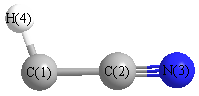 More geometry information
Calculated Bond Angles
| atom1 |
atom2 |
atom3 |
angle |
|
atom1 |
atom2 |
atom3 |
angle |
| C1 |
C2 |
N3 |
175.036 |
|
C2 |
C1 |
H4 |
145.284 |
Electronic energy levels
Charges, Dipole, Quadrupole and Polarizability
Jump to
S1C1
S2C1
S2C2
Energy calculated at QCISD(T)/cc-pVTZ
| | hartrees |
|---|
| Energy at 0K | -131.188398 |
| Energy at 298.15K | |
| HF Energy | -130.721246 |
| Nuclear repulsion energy | 47.243484 |
The energy at 298.15K was derived from the energy at 0K
and an integrated heat capacity that used the calculated vibrational frequencies.
Vibrational Frequencies calculated at QCISD(T)/cc-pVTZ
| Mode Number |
Symmetry |
Frequency
(cm-1) |
Scaled Frequency
(cm-1) |
IR Intensities
(km mol-1) |
Raman Act
(Å4/u) |
Dep P |
Dep U |
|---|
| 1 |
Σ |
3430 |
3253 |
|
|
|
|
| 2 |
Σ |
1677 |
1591 |
|
|
|
|
| 3 |
Σ |
1233 |
1169 |
|
|
|
|
| 4 |
Π |
427 |
405 |
|
|
|
|
| 4 |
Π |
427 |
405 |
|
|
|
|
| 5 |
Π |
403i |
382i |
|
|
|
|
| 5 |
Π |
403i |
382i |
|
|
|
|
Unscaled Zero Point Vibrational Energy (zpe) 3193.1 cm
-1
Scaled (by 0.9486) Zero Point Vibrational Energy (zpe) 3028.9 cm
-1
See section
III.C.1 List or set vibrational scaling factors
to change the scale factors used here.
See section
III.C.2
Calculate a vibrational scaling factor for a given set of molecules
to determine the least squares best scaling factor.
Geometric Data calculated at QCISD(T)/cc-pVTZ
Point Group is C∞v
Cartesians (Å)
| Atom |
x (Å) |
y (Å) |
z (Å) |
|---|
| C1 |
0.000 |
0.000 |
-1.215 |
| C2 |
0.000 |
0.000 |
0.084 |
| N3 |
0.000 |
0.000 |
1.295 |
| H4 |
0.000 |
0.000 |
-2.279 |
Atom - Atom Distances (Å)
| |
C1 |
C2 |
N3 |
H4 |
| C1 | | 1.2982 | 2.5095 | 1.0643 |
C2 | 1.2982 | | 1.2113 | 2.3625 | N3 | 2.5095 | 1.2113 | | 3.5738 | H4 | 1.0643 | 2.3625 | 3.5738 | |
More geometry information
Calculated Bond Angles
| atom1 |
atom2 |
atom3 |
angle |
|
atom1 |
atom2 |
atom3 |
angle |
| C1 |
C2 |
N3 |
180.000 |
|
C2 |
C1 |
H4 |
180.000 |
Electronic energy levels
Charges, Dipole, Quadrupole and Polarizability
Charges from optimized geometry at QCISD(T)/cc-pVTZ
Charges (e)
| Number |
Element |
Mulliken |
CHELPG |
AIM |
ESP |
| 1 |
C |
-0.195 |
|
|
|
| 2 |
C |
0.054 |
|
|
|
| 3 |
N |
-0.072 |
|
|
|
| 4 |
H |
0.213 |
|
|
|
Electric dipole moments
Electric Quadrupole moment
Quadrupole components in D Å
Polarizabilities
Components of the polarizability tensor.
Units are
Å
3 (Angstrom cubed)
Change units.
| |
x |
y |
z |
| x |
0.000 |
0.000 |
0.000 |
| y |
0.000 |
0.000 |
0.000 |
| z |
0.000 |
0.000 |
0.000 |
<r2> (average value of r
2) Å
2
| <r2> |
36.327 |
| (<r2>)1/2 |
6.027 |
Jump to
S1C1
S1C2
S2C2
Energy calculated at QCISD(T)/cc-pVTZ
| | hartrees |
|---|
| Energy at 0K | -131.170777 |
| Energy at 298.15K | -131.170180 |
| HF Energy | -130.660623 |
| Nuclear repulsion energy | 46.693675 |
The energy at 298.15K was derived from the energy at 0K
and an integrated heat capacity that used the calculated vibrational frequencies.
Vibrational Frequencies calculated at QCISD(T)/cc-pVTZ
| Mode Number |
Symmetry |
Frequency
(cm-1) |
Scaled Frequency
(cm-1) |
IR Intensities
(km mol-1) |
Raman Act
(Å4/u) |
Dep P |
Dep U |
|---|
| 1 |
A' |
3049 |
2893 |
|
|
|
|
| 2 |
A' |
2045 |
1940 |
|
|
|
|
| 3 |
A' |
1054 |
1000 |
|
|
|
|
| 4 |
A' |
972 |
922 |
|
|
|
|
| 5 |
A' |
425 |
403 |
|
|
|
|
| 6 |
A" |
296 |
280 |
|
|
|
|
Unscaled Zero Point Vibrational Energy (zpe) 3920.0 cm
-1
Scaled (by 0.9486) Zero Point Vibrational Energy (zpe) 3718.6 cm
-1
See section
III.C.1 List or set vibrational scaling factors
to change the scale factors used here.
See section
III.C.2
Calculate a vibrational scaling factor for a given set of molecules
to determine the least squares best scaling factor.
Geometric Data calculated at QCISD(T)/cc-pVTZ
Point Group is Cs
Cartesians (Å)
| Atom |
x (Å) |
y (Å) |
z (Å) |
|---|
| C1 |
0.083 |
-1.296 |
0.000 |
| C2 |
0.000 |
0.096 |
0.000 |
| N3 |
-0.235 |
1.256 |
0.000 |
| H4 |
1.143 |
-1.593 |
0.000 |
Atom - Atom Distances (Å)
| |
C1 |
C2 |
N3 |
H4 |
| C1 | | 1.3950 | 2.5720 | 1.1000 |
C2 | 1.3950 | | 1.1832 | 2.0394 | N3 | 2.5720 | 1.1832 | | 3.1645 | H4 | 1.1000 | 2.0394 | 3.1645 | |
More geometry information
Electronic energy levels
Charges, Dipole, Quadrupole and Polarizability
Jump to
S1C1
S1C2
S2C1
Energy calculated at QCISD(T)/cc-pVTZ
| | hartrees |
|---|
| Energy at 0K | -131.170777 |
| Energy at 298.15K | -131.170180 |
| HF Energy | -130.660623 |
| Nuclear repulsion energy | 46.693675 |
The energy at 298.15K was derived from the energy at 0K
and an integrated heat capacity that used the calculated vibrational frequencies.
Vibrational Frequencies calculated at QCISD(T)/cc-pVTZ
Geometric Data calculated at QCISD(T)/cc-pVTZ
Point Group is Cs
Electronic energy levels
Charges, Dipole, Quadrupole and Polarizability
