Jump to
S1C2
S2C1
S2C2
Energy calculated at CCSD(T)/cc-pVTZ
| | hartrees |
|---|
| Energy at 0K | -131.188558 |
| Energy at 298.15K | -131.187930 |
| HF Energy | -130.723251 |
| Nuclear repulsion energy | 47.160630 |
The energy at 298.15K was derived from the energy at 0K
and an integrated heat capacity that used the calculated vibrational frequencies.
Vibrational Frequencies calculated at CCSD(T)/cc-pVTZ
| Mode Number |
Symmetry |
Frequency
(cm-1) |
Scaled Frequency
(cm-1) |
IR Intensities
(km mol-1) |
Raman Act
(Å4/u) |
Dep P |
Dep U |
|---|
| 1 |
A' |
3345 |
3261 |
|
|
|
|
| 2 |
A' |
1809 |
1764 |
|
|
|
|
| 3 |
A' |
1161 |
1131 |
|
|
|
|
| 4 |
A' |
579 |
564 |
|
|
|
|
| 5 |
A' |
388 |
378 |
|
|
|
|
| 6 |
A" |
428 |
417 |
|
|
|
|
Unscaled Zero Point Vibrational Energy (zpe) 3854.9 cm
-1
Scaled (by 0.9748) Zero Point Vibrational Energy (zpe) 3757.8 cm
-1
See section
III.C.1 List or set vibrational scaling factors
to change the scale factors used here.
See section
III.C.2
Calculate a vibrational scaling factor for a given set of molecules
to determine the least squares best scaling factor.
Geometric Data calculated at CCSD(T)/cc-pVTZ
Point Group is Cs
Cartesians (Å)
| Atom |
x (Å) |
y (Å) |
z (Å) |
|---|
| C1 |
0.077 |
-1.234 |
0.000 |
| C2 |
0.000 |
0.093 |
0.000 |
| N3 |
-0.171 |
1.275 |
0.000 |
| H4 |
0.735 |
-2.079 |
0.000 |
Atom - Atom Distances (Å)
| |
C1 |
C2 |
N3 |
H4 |
| C1 | | 1.3289 | 2.5217 | 1.0712 |
C2 | 1.3289 | | 1.1952 | 2.2924 | N3 | 2.5217 | 1.1952 | | 3.4744 | H4 | 1.0712 | 2.2924 | 3.4744 | |
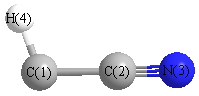 More geometry information
Calculated Bond Angles
| atom1 |
atom2 |
atom3 |
angle |
|
atom1 |
atom2 |
atom3 |
angle |
| C1 |
C2 |
N3 |
175.093 |
|
C2 |
C1 |
H4 |
145.353 |
Electronic energy levels
Charges, Dipole, Quadrupole and Polarizability
Jump to
S1C1
S2C1
S2C2
Energy calculated at CCSD(T)/cc-pVTZ
| | hartrees |
|---|
| Energy at 0K | -131.186854 |
| Energy at 298.15K | |
| HF Energy | -130.721277 |
| Nuclear repulsion energy | 47.281252 |
The energy at 298.15K was derived from the energy at 0K
and an integrated heat capacity that used the calculated vibrational frequencies.
Vibrational Frequencies calculated at CCSD(T)/cc-pVTZ
| Mode Number |
Symmetry |
Frequency
(cm-1) |
Scaled Frequency
(cm-1) |
IR Intensities
(km mol-1) |
Raman Act
(Å4/u) |
Dep P |
Dep U |
|---|
| 1 |
Σ |
3425 |
3339 |
|
|
|
|
| 2 |
Σ |
1671 |
1629 |
|
|
|
|
| 3 |
Σ |
1238 |
1206 |
|
|
|
|
| 4 |
Π |
431 |
420 |
|
|
|
|
| 4 |
Π |
431 |
420 |
|
|
|
|
| 5 |
Π |
389i |
379i |
|
|
|
|
| 5 |
Π |
389i |
379i |
|
|
|
|
Unscaled Zero Point Vibrational Energy (zpe) 3208.5 cm
-1
Scaled (by 0.9748) Zero Point Vibrational Energy (zpe) 3127.6 cm
-1
See section
III.C.1 List or set vibrational scaling factors
to change the scale factors used here.
See section
III.C.2
Calculate a vibrational scaling factor for a given set of molecules
to determine the least squares best scaling factor.
Geometric Data calculated at CCSD(T)/cc-pVTZ
Point Group is C∞v
Cartesians (Å)
| Atom |
x (Å) |
y (Å) |
z (Å) |
|---|
| C1 |
0.000 |
0.000 |
-1.214 |
| C2 |
0.000 |
0.000 |
0.084 |
| N3 |
0.000 |
0.000 |
1.294 |
| H4 |
0.000 |
0.000 |
-2.278 |
Atom - Atom Distances (Å)
| |
C1 |
C2 |
N3 |
H4 |
| C1 | | 1.2976 | 2.5072 | 1.0648 |
C2 | 1.2976 | | 1.2096 | 2.3624 | N3 | 2.5072 | 1.2096 | | 3.5720 | H4 | 1.0648 | 2.3624 | 3.5720 | |
More geometry information
Calculated Bond Angles
| atom1 |
atom2 |
atom3 |
angle |
|
atom1 |
atom2 |
atom3 |
angle |
| C1 |
C2 |
N3 |
180.000 |
|
C2 |
C1 |
H4 |
180.000 |
Electronic energy levels
Charges, Dipole, Quadrupole and Polarizability
Charges from optimized geometry at CCSD(T)/cc-pVTZ
Charges (e)
| Number |
Element |
Mulliken |
CHELPG |
AIM |
ESP |
| 1 |
C |
-0.196 |
|
|
|
| 2 |
C |
0.054 |
|
|
|
| 3 |
N |
-0.072 |
|
|
|
| 4 |
H |
0.213 |
|
|
|
Electric dipole moments
Electric Quadrupole moment
Quadrupole components in D Å
Polarizabilities
Components of the polarizability tensor.
Units are
Å
3 (Angstrom cubed)
Change units.
| |
x |
y |
z |
| x |
0.000 |
0.000 |
0.000 |
| y |
0.000 |
0.000 |
0.000 |
| z |
0.000 |
0.000 |
0.000 |
<r2> (average value of r
2) Å
2
| <r2> |
36.288 |
| (<r2>)1/2 |
6.024 |
Jump to
S1C1
S1C2
S2C2
Energy calculated at CCSD(T)/cc-pVTZ
| | hartrees |
|---|
| Energy at 0K | -131.169801 |
| Energy at 298.15K | -131.169206 |
| HF Energy | -130.660806 |
| Nuclear repulsion energy | 46.712879 |
The energy at 298.15K was derived from the energy at 0K
and an integrated heat capacity that used the calculated vibrational frequencies.
Vibrational Frequencies calculated at CCSD(T)/cc-pVTZ
| Mode Number |
Symmetry |
Frequency
(cm-1) |
Scaled Frequency
(cm-1) |
IR Intensities
(km mol-1) |
Raman Act
(Å4/u) |
Dep P |
Dep U |
|---|
| 1 |
A' |
3050 |
2973 |
|
|
|
|
| 2 |
A' |
2056 |
2004 |
|
|
|
|
| 3 |
A' |
1055 |
1028 |
|
|
|
|
| 4 |
A' |
973 |
949 |
|
|
|
|
| 5 |
A' |
425 |
414 |
|
|
|
|
| 6 |
A" |
297 |
289 |
|
|
|
|
Unscaled Zero Point Vibrational Energy (zpe) 3927.8 cm
-1
Scaled (by 0.9748) Zero Point Vibrational Energy (zpe) 3828.9 cm
-1
See section
III.C.1 List or set vibrational scaling factors
to change the scale factors used here.
See section
III.C.2
Calculate a vibrational scaling factor for a given set of molecules
to determine the least squares best scaling factor.
Geometric Data calculated at CCSD(T)/cc-pVTZ
Point Group is Cs
Cartesians (Å)
| Atom |
x (Å) |
y (Å) |
z (Å) |
|---|
| C1 |
0.071 |
-1.297 |
0.000 |
| C2 |
0.000 |
0.097 |
0.000 |
| N3 |
-0.222 |
1.258 |
0.000 |
| H4 |
1.128 |
-1.602 |
0.000 |
Atom - Atom Distances (Å)
| |
C1 |
C2 |
N3 |
H4 |
| C1 | | 1.3951 | 2.5712 | 1.1000 |
C2 | 1.3951 | | 1.1823 | 2.0390 | N3 | 2.5712 | 1.1823 | | 3.1625 | H4 | 1.1000 | 2.0390 | 3.1625 | |
More geometry information
Electronic energy levels
Charges, Dipole, Quadrupole and Polarizability
Jump to
S1C1
S1C2
S2C1
Energy calculated at CCSD(T)/cc-pVTZ
| | hartrees |
|---|
| Energy at 0K | -131.169801 |
| Energy at 298.15K | -131.169206 |
| HF Energy | -130.660806 |
| Nuclear repulsion energy | 46.712879 |
The energy at 298.15K was derived from the energy at 0K
and an integrated heat capacity that used the calculated vibrational frequencies.
Vibrational Frequencies calculated at CCSD(T)/cc-pVTZ
Geometric Data calculated at CCSD(T)/cc-pVTZ
Point Group is Cs
Electronic energy levels
Charges, Dipole, Quadrupole and Polarizability
