Jump to
S1C2
S2C1
S2C2
Energy calculated at mPW1PW91/cc-pVTZ
| | hartrees |
|---|
| Energy at 0K | -131.428824 |
| Energy at 298.15K | -131.428110 |
| HF Energy | -131.428824 |
| Nuclear repulsion energy | 47.596025 |
The energy at 298.15K was derived from the energy at 0K
and an integrated heat capacity that used the calculated vibrational frequencies.
Vibrational Frequencies calculated at mPW1PW91/cc-pVTZ
| Mode Number |
Symmetry |
Frequency
(cm-1) |
Scaled Frequency
(cm-1) |
IR Intensities
(km mol-1) |
Raman Act
(Å4/u) |
Dep P |
Dep U |
|---|
| 1 |
A' |
3400 |
3261 |
39.64 |
|
|
|
| 2 |
A' |
1794 |
1721 |
43.09 |
|
|
|
| 3 |
A' |
1238 |
1188 |
8.47 |
|
|
|
| 4 |
A' |
464 |
445 |
13.20 |
|
|
|
| 5 |
A' |
363 |
348 |
29.82 |
|
|
|
| 6 |
A" |
445 |
427 |
0.84 |
|
|
|
Unscaled Zero Point Vibrational Energy (zpe) 3852.5 cm
-1
Scaled (by 0.9592) Zero Point Vibrational Energy (zpe) 3695.3 cm
-1
See section
III.C.1 List or set vibrational scaling factors
to change the scale factors used here.
See section
III.C.2
Calculate a vibrational scaling factor for a given set of molecules
to determine the least squares best scaling factor.
Geometric Data calculated at mPW1PW91/cc-pVTZ
Point Group is Cs
Cartesians (Å)
| Atom |
x (Å) |
y (Å) |
z (Å) |
|---|
| C1 |
0.087 |
-1.212 |
0.000 |
| C2 |
0.000 |
0.087 |
0.000 |
| N3 |
-0.163 |
1.269 |
0.000 |
| H4 |
0.618 |
-2.137 |
0.000 |
Atom - Atom Distances (Å)
| |
C1 |
C2 |
N3 |
H4 |
| C1 | | 1.3019 | 2.4929 | 1.0670 |
C2 | 1.3019 | | 1.1926 | 2.3086 | N3 | 2.4929 | 1.1926 | | 3.4941 | H4 | 1.0670 | 2.3086 | 3.4941 | |
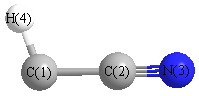 More geometry information
Calculated Bond Angles
| atom1 |
atom2 |
atom3 |
angle |
|
atom1 |
atom2 |
atom3 |
angle |
| C1 |
C2 |
N3 |
175.980 |
|
C2 |
C1 |
H4 |
153.955 |
Electronic energy levels
Charges, Dipole, Quadrupole and Polarizability
Jump to
S1C1
S2C1
S2C2
Energy calculated at mPW1PW91/cc-pVTZ
| | hartrees |
|---|
| Energy at 0K | -131.428386 |
| Energy at 298.15K | |
| HF Energy | -131.428386 |
| Nuclear repulsion energy | 47.648889 |
The energy at 298.15K was derived from the energy at 0K
and an integrated heat capacity that used the calculated vibrational frequencies.
Vibrational Frequencies calculated at mPW1PW91/cc-pVTZ
| Mode Number |
Symmetry |
Frequency
(cm-1) |
Scaled Frequency
(cm-1) |
IR Intensities
(km mol-1) |
Raman Act
(Å4/u) |
Dep P |
Dep U |
|---|
| 1 |
Σ |
3451 |
3311 |
66.12 |
|
|
|
| 2 |
Σ |
1732 |
1662 |
45.87 |
|
|
|
| 3 |
Σ |
1276 |
1224 |
5.65 |
|
|
|
| 4 |
Π |
443 |
425 |
0.17 |
|
|
|
| 4 |
Π |
443 |
425 |
0.17 |
|
|
|
| 5 |
Π |
269i |
258i |
46.46 |
|
|
|
| 5 |
Π |
269i |
258i |
46.46 |
|
|
|
Unscaled Zero Point Vibrational Energy (zpe) 3404.4 cm
-1
Scaled (by 0.9592) Zero Point Vibrational Energy (zpe) 3265.5 cm
-1
See section
III.C.1 List or set vibrational scaling factors
to change the scale factors used here.
See section
III.C.2
Calculate a vibrational scaling factor for a given set of molecules
to determine the least squares best scaling factor.
Geometric Data calculated at mPW1PW91/cc-pVTZ
Point Group is C∞v
Cartesians (Å)
| Atom |
x (Å) |
y (Å) |
z (Å) |
|---|
| C1 |
0.000 |
0.000 |
-1.203 |
| C2 |
0.000 |
0.000 |
0.083 |
| N3 |
0.000 |
0.000 |
1.284 |
| H4 |
0.000 |
0.000 |
-2.266 |
Atom - Atom Distances (Å)
| |
C1 |
C2 |
N3 |
H4 |
| C1 | | 1.2859 | 2.4864 | 1.0629 |
C2 | 1.2859 | | 1.2005 | 2.3488 | N3 | 2.4864 | 1.2005 | | 3.5494 | H4 | 1.0629 | 2.3488 | 3.5494 | |
More geometry information
Calculated Bond Angles
| atom1 |
atom2 |
atom3 |
angle |
|
atom1 |
atom2 |
atom3 |
angle |
| C1 |
C2 |
N3 |
180.000 |
|
C2 |
C1 |
H4 |
180.000 |
Electronic energy levels
Charges, Dipole, Quadrupole and Polarizability
Charges from optimized geometry at mPW1PW91/cc-pVTZ
Charges (e)
| Number |
Element |
Mulliken |
CHELPG |
AIM |
ESP |
| 1 |
C |
-0.117 |
|
|
|
| 2 |
C |
0.043 |
|
|
|
| 3 |
N |
-0.079 |
|
|
|
| 4 |
H |
0.152 |
|
|
|
Electric dipole moments
Electric dipole components in Debye
(What's a Debye? See section
VII.A.3)
| |
x |
y |
z |
Total |
| |
0.000 |
0.000 |
-3.261 |
3.261 |
| CHELPG |
|
|
|
|
| AIM |
|
|
|
|
| ESP |
|
|
|
|
Electric Quadrupole moment
Quadrupole components in D Å
| Primitive |
|---|
| | x | y | z |
|---|
| x |
-17.215 |
0.000 |
0.000 |
| y |
0.000 |
-17.215 |
0.000 |
| z |
0.000 |
0.000 |
-15.381 |
|
| Traceless |
|---|
| | x | y | z |
|---|
| x |
-0.917 |
0.000 |
0.000 |
| y |
0.000 |
-0.917 |
0.000 |
| z |
0.000 |
0.000 |
1.835 |
|
| Polar |
|---|
| 3z2-r2 | 3.670 |
|---|
| x2-y2 | 0.000 |
|---|
| xy | 0.000 |
|---|
| xz | 0.000 |
|---|
| yz | 0.000 |
|---|
|
Polarizabilities
Components of the polarizability tensor.
Units are
Å
3 (Angstrom cubed)
Change units.
| |
x |
y |
z |
| x |
2.409 |
0.000 |
0.000 |
| y |
0.000 |
2.409 |
0.000 |
| z |
0.000 |
0.000 |
6.588 |
<r2> (average value of r
2) Å
2
| <r2> |
35.760 |
| (<r2>)1/2 |
5.980 |
Jump to
S1C1
S1C2
S2C2
Energy calculated at mPW1PW91/cc-pVTZ
| | hartrees |
|---|
| Energy at 0K | -131.397252 |
| Energy at 298.15K | -131.396708 |
| HF Energy | -131.397252 |
| Nuclear repulsion energy | 47.286279 |
The energy at 298.15K was derived from the energy at 0K
and an integrated heat capacity that used the calculated vibrational frequencies.
Vibrational Frequencies calculated at mPW1PW91/cc-pVTZ
| Mode Number |
Symmetry |
Frequency
(cm-1) |
Scaled Frequency
(cm-1) |
IR Intensities
(km mol-1) |
Raman Act
(Å4/u) |
Dep P |
Dep U |
|---|
| 1 |
A' |
3092 |
2965 |
3.91 |
|
|
|
| 2 |
A' |
2119 |
2033 |
24.15 |
|
|
|
| 3 |
A' |
1098 |
1054 |
38.95 |
|
|
|
| 4 |
A' |
945 |
906 |
45.01 |
|
|
|
| 5 |
A' |
462 |
443 |
24.66 |
|
|
|
| 6 |
A" |
312 |
300 |
11.80 |
|
|
|
Unscaled Zero Point Vibrational Energy (zpe) 4014.2 cm
-1
Scaled (by 0.9592) Zero Point Vibrational Energy (zpe) 3850.4 cm
-1
See section
III.C.1 List or set vibrational scaling factors
to change the scale factors used here.
See section
III.C.2
Calculate a vibrational scaling factor for a given set of molecules
to determine the least squares best scaling factor.
Geometric Data calculated at mPW1PW91/cc-pVTZ
Point Group is Cs
Cartesians (Å)
| Atom |
x (Å) |
y (Å) |
z (Å) |
|---|
| C1 |
0.038 |
-1.275 |
0.000 |
| C2 |
0.000 |
0.092 |
0.000 |
| N3 |
-0.185 |
1.249 |
0.000 |
| H4 |
1.070 |
-1.647 |
0.000 |
Atom - Atom Distances (Å)
| |
C1 |
C2 |
N3 |
H4 |
| C1 | | 1.3680 | 2.5344 | 1.0964 |
C2 | 1.3680 | | 1.1718 | 2.0417 | N3 | 2.5344 | 1.1718 | | 3.1563 | H4 | 1.0964 | 2.0417 | 3.1563 | |
More geometry information
Electronic energy levels
Charges, Dipole, Quadrupole and Polarizability
Charges from optimized geometry at mPW1PW91/cc-pVTZ
Charges (e)
| Number |
Element |
Mulliken |
CHELPG |
AIM |
ESP |
| 1 |
C |
-0.122 |
|
|
|
| 2 |
C |
0.007 |
|
|
|
| 3 |
N |
-0.025 |
|
|
|
| 4 |
H |
0.140 |
|
|
|
Electric dipole moments
Electric dipole components in Debye
(What's a Debye? See section
VII.A.3)
| |
x |
y |
z |
Total |
| |
1.686 |
-1.466 |
0.000 |
2.234 |
| CHELPG |
|
|
|
|
| AIM |
|
|
|
|
| ESP |
|
|
|
|
Electric Quadrupole moment
Quadrupole components in D Å
| Primitive |
|---|
| | x | y | z |
|---|
| x |
-17.073 |
-2.522 |
0.000 |
| y |
-2.522 |
-20.723 |
0.000 |
| z |
0.000 |
0.000 |
-15.875 |
|
| Traceless |
|---|
| | x | y | z |
|---|
| x |
1.226 |
-2.522 |
0.000 |
| y |
-2.522 |
-4.250 |
0.000 |
| z |
0.000 |
0.000 |
3.024 |
|
| Polar |
|---|
| 3z2-r2 | 6.047 |
|---|
| x2-y2 | 3.650 |
|---|
| xy | -2.522 |
|---|
| xz | 0.000 |
|---|
| yz | 0.000 |
|---|
|
Polarizabilities
Components of the polarizability tensor.
Units are
Å
3 (Angstrom cubed)
Change units.
| |
x |
y |
z |
| x |
2.958 |
-0.498 |
0.000 |
| y |
-0.498 |
6.574 |
0.000 |
| z |
0.000 |
0.000 |
2.780 |
<r2> (average value of r
2) Å
2
| <r2> |
36.013 |
| (<r2>)1/2 |
6.001 |
Jump to
S1C1
S1C2
S2C1
Energy calculated at mPW1PW91/cc-pVTZ
| | hartrees |
|---|
| Energy at 0K | -131.397252 |
| Energy at 298.15K | -131.396708 |
| HF Energy | -131.397252 |
| Nuclear repulsion energy | 47.286279 |
The energy at 298.15K was derived from the energy at 0K
and an integrated heat capacity that used the calculated vibrational frequencies.
Vibrational Frequencies calculated at mPW1PW91/cc-pVTZ
Geometric Data calculated at mPW1PW91/cc-pVTZ
Point Group is Cs
Electronic energy levels
Charges, Dipole, Quadrupole and Polarizability
