Jump to
S1C2
Energy calculated at wB97X-D/cc-pVTZ
| | hartrees |
|---|
| Energy at 0K | -131.411719 |
| Energy at 298.15K | -131.410998 |
| HF Energy | -131.411719 |
| Nuclear repulsion energy | 47.619721 |
The energy at 298.15K was derived from the energy at 0K
and an integrated heat capacity that used the calculated vibrational frequencies.
Vibrational Frequencies calculated at wB97X-D/cc-pVTZ
| Mode Number |
Symmetry |
Frequency
(cm-1) |
Scaled Frequency
(cm-1) |
IR Intensities
(km mol-1) |
Raman Act
(Å4/u) |
Dep P |
Dep U |
|---|
| 1 |
A' |
3386 |
3237 |
39.44 |
|
|
|
| 2 |
A' |
1789 |
1710 |
38.71 |
|
|
|
| 3 |
A' |
1228 |
1174 |
10.34 |
|
|
|
| 4 |
A' |
465 |
444 |
11.63 |
|
|
|
| 5 |
A' |
358 |
342 |
33.25 |
|
|
|
| 6 |
A" |
444 |
425 |
0.82 |
|
|
|
Unscaled Zero Point Vibrational Energy (zpe) 3834.9 cm
-1
Scaled (by 0.956) Zero Point Vibrational Energy (zpe) 3666.1 cm
-1
See section
III.C.1 List or set vibrational scaling factors
to change the scale factors used here.
See section
III.C.2
Calculate a vibrational scaling factor for a given set of molecules
to determine the least squares best scaling factor.
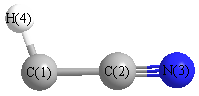
Geometric Data calculated at wB97X-D/cc-pVTZ
Point Group is Cs
Cartesians (Å)
| Atom |
x (Å) |
y (Å) |
z (Å) |
|---|
| C1 |
-0.133 |
-1.218 |
0.000 |
| C2 |
0.000 |
0.090 |
0.000 |
| N3 |
0.058 |
1.275 |
0.000 |
| H4 |
0.387 |
-2.155 |
0.000 |
Atom - Atom Distances (Å)
| |
C1 |
C2 |
N3 |
H4 |
| C1 | | 1.3142 | 2.4998 | 1.0718 |
C2 | 1.3142 | | 1.1864 | 2.2779 | N3 | 2.4998 | 1.1864 | | 3.4454 | H4 | 1.0718 | 2.2779 | 3.4454 | |
 More geometry information
Calculated Bond Angles
| atom1 |
atom2 |
atom3 |
angle |
|
atom1 |
atom2 |
atom3 |
angle |
| C1 |
C2 |
N3 |
177.027 |
|
C2 |
C1 |
H4 |
145.180 |
Electronic energy levels
Charges, Dipole, Quadrupole and Polarizability
Charges from optimized geometry at wB97X-D/cc-pVTZ
Charges (e)
| Number |
Element |
Mulliken |
CHELPG |
AIM |
ESP |
| 1 |
C |
-0.161 |
|
|
|
| 2 |
C |
0.065 |
|
|
|
| 3 |
N |
-0.070 |
|
|
|
| 4 |
H |
0.166 |
|
|
|
Electric dipole moments
Electric dipole components in Debye
(What's a Debye? See section
VII.A.3)
| |
x |
y |
z |
Total |
| |
0.788 |
-3.084 |
0.000 |
3.183 |
| CHELPG |
|
|
|
|
| AIM |
|
|
|
|
| ESP |
|
|
|
|
Electric Quadrupole moment
Quadrupole components in D Å
| Primitive |
|---|
| | x | y | z |
|---|
| x |
-16.740 |
-1.085 |
0.000 |
| y |
-1.085 |
-16.304 |
0.000 |
| z |
0.000 |
0.000 |
-17.236 |
|
| Traceless |
|---|
| | x | y | z |
|---|
| x |
0.030 |
-1.085 |
0.000 |
| y |
-1.085 |
0.684 |
0.000 |
| z |
0.000 |
0.000 |
-0.714 |
|
| Polar |
|---|
| 3z2-r2 | -1.428 |
|---|
| x2-y2 | -0.436 |
|---|
| xy | -1.085 |
|---|
| xz | 0.000 |
|---|
| yz | 0.000 |
|---|
|
Polarizabilities
Components of the polarizability tensor.
Units are
Å
3 (Angstrom cubed)
Change units.
| |
x |
y |
z |
| x |
2.509 |
-0.446 |
0.000 |
| y |
-0.446 |
6.601 |
0.000 |
| z |
0.000 |
0.000 |
2.410 |
<r2> (average value of r
2) Å
2
| <r2> |
35.752 |
| (<r2>)1/2 |
5.979 |
Jump to
S1C1
Energy calculated at wB97X-D/cc-pVTZ
| | hartrees |
|---|
| Energy at 0K | -131.411225 |
| Energy at 298.15K | |
| HF Energy | -131.411225 |
| Nuclear repulsion energy | 47.682433 |
The energy at 298.15K was derived from the energy at 0K
and an integrated heat capacity that used the calculated vibrational frequencies.
Vibrational Frequencies calculated at wB97X-D/cc-pVTZ
| Mode Number |
Symmetry |
Frequency
(cm-1) |
Scaled Frequency
(cm-1) |
IR Intensities
(km mol-1) |
Raman Act
(Å4/u) |
Dep P |
Dep U |
|---|
| 1 |
Σ |
3436 |
3284 |
64.79 |
|
|
|
| 2 |
Σ |
1709 |
1634 |
44.52 |
|
|
|
| 3 |
Σ |
1271 |
1215 |
7.40 |
|
|
|
| 4 |
Π |
442 |
423 |
0.25 |
|
|
|
| 4 |
Π |
442 |
423 |
0.25 |
|
|
|
| 5 |
Π |
311i |
297i |
47.60 |
|
|
|
| 5 |
Π |
311i |
297i |
47.60 |
|
|
|
Unscaled Zero Point Vibrational Energy (zpe) 3338.4 cm
-1
Scaled (by 0.956) Zero Point Vibrational Energy (zpe) 3191.6 cm
-1
See section
III.C.1 List or set vibrational scaling factors
to change the scale factors used here.
See section
III.C.2
Calculate a vibrational scaling factor for a given set of molecules
to determine the least squares best scaling factor.
Geometric Data calculated at wB97X-D/cc-pVTZ
Point Group is C∞v
Cartesians (Å)
| Atom |
x (Å) |
y (Å) |
z (Å) |
|---|
| C1 |
0.000 |
0.000 |
-1.204 |
| C2 |
0.000 |
0.000 |
0.089 |
| N3 |
0.000 |
0.000 |
1.280 |
| H4 |
0.000 |
0.000 |
-2.269 |
Atom - Atom Distances (Å)
| |
C1 |
C2 |
N3 |
H4 |
| C1 | | 1.2932 | 2.4844 | 1.0644 |
C2 | 1.2932 | | 1.1912 | 2.3575 | N3 | 2.4844 | 1.1912 | | 3.5487 | H4 | 1.0644 | 2.3575 | 3.5487 | |
More geometry information
Calculated Bond Angles
| atom1 |
atom2 |
atom3 |
angle |
|
atom1 |
atom2 |
atom3 |
angle |
| C1 |
C2 |
N3 |
180.000 |
|
C2 |
C1 |
H4 |
180.000 |
Electronic energy levels
Charges, Dipole, Quadrupole and Polarizability
Charges from optimized geometry at wB97X-D/cc-pVTZ
Charges (e)
| Number |
Element |
Mulliken |
CHELPG |
AIM |
ESP |
| 1 |
C |
-0.135 |
|
|
|
| 2 |
C |
0.065 |
|
|
|
| 3 |
N |
-0.075 |
|
|
|
| 4 |
H |
0.144 |
|
|
|
Electric dipole moments
Electric dipole components in Debye
(What's a Debye? See section
VII.A.3)
| |
x |
y |
z |
Total |
| |
0.000 |
0.000 |
-3.324 |
3.324 |
| CHELPG |
|
|
|
|
| AIM |
|
|
|
|
| ESP |
|
|
|
|
Electric Quadrupole moment
Quadrupole components in D Å
| Primitive |
|---|
| | x | y | z |
|---|
| x |
-17.221 |
0.000 |
0.000 |
| y |
0.000 |
-17.221 |
0.000 |
| z |
0.000 |
0.000 |
-15.368 |
|
| Traceless |
|---|
| | x | y | z |
|---|
| x |
-0.926 |
0.000 |
0.000 |
| y |
0.000 |
-0.926 |
0.000 |
| z |
0.000 |
0.000 |
1.853 |
|
| Polar |
|---|
| 3z2-r2 | 3.705 |
|---|
| x2-y2 | 0.000 |
|---|
| xy | 0.000 |
|---|
| xz | 0.000 |
|---|
| yz | 0.000 |
|---|
|
Polarizabilities
Components of the polarizability tensor.
Units are
Å
3 (Angstrom cubed)
Change units.
| |
x |
y |
z |
| x |
2.416 |
0.000 |
0.000 |
| y |
0.000 |
2.416 |
0.000 |
| z |
0.000 |
0.000 |
6.680 |
<r2> (average value of r
2) Å
2
| <r2> |
35.729 |
| (<r2>)1/2 |
5.977 |
