return to home page Computational Chemistry Comparison and Benchmark DataBase Release 22 (May 2022) Standard Reference Database 101 National Institute of Standards and Technology
You are here: Calculated > Energy > Optimized > Energy

All results from a given calculation for CH3COCH2 (Acetonyl radical)

using model chemistry: QCISD(T)/cc-pVTZ

19 10 17 12 22

States and conformations

State Conformation minimum conformation conformer description state description
1 1 yes CS 2A"
Energy calculated at QCISD(T)/cc-pVTZ
 hartrees
Energy at 0K-192.174272
Energy at 298.15K-192.179446
HF Energy-191.413234
Nuclear repulsion energy111.789934
The energy at 298.15K was derived from the energy at 0K and an integrated heat capacity that used the calculated vibrational frequencies.
Vibrational Frequencies calculated at QCISD(T)/cc-pVTZ
Mode Number Symmetry Frequency
(cm-1)
Scaled Frequency
(cm-1)
IR Intensities
(km mol-1)
Raman Act
(Å4/u)
Dep P Dep U
1 A' 3281 3113        
2 A' 3167 3004        
3 A' 3160 2997        
4 A' 3056 2899        
5 A' 1638 1554        
6 A' 1508 1430        
7 A' 1462 1387        
8 A' 1411 1339        
9 A' 1286 1219        
10 A' 1087 1032        
11 A' 946 897        
12 A' 834 791        
13 A' 540 512        
14 A' 391 371        
15 A" 3117 2957        
16 A" 1498 1421        
17 A" 1043 989        
18 A" 751 712        
19 A" 520 493        
20 A" 438 416        
21 A" 343 325        

Unscaled Zero Point Vibrational Energy (zpe) 15737.2 cm-1
Scaled (by 0.9486) Zero Point Vibrational Energy (zpe) 14928.3 cm-1
See section III.C.1 List or set vibrational scaling factors to change the scale factors used here.
See section III.C.2 Calculate a vibrational scaling factor for a given set of molecules to determine the least squares best scaling factor.
Rotational Constants (cm-1) from geometry optimized at QCISD(T)/cc-pVTZ
ABC
0.36224 0.30314 0.17024

See section I.F.4 to change rotational constant units
Geometric Data calculated at QCISD(T)/cc-pVTZ

Point Group is Cs

Cartesians (Å)
Atom x (Å) y (Å) z (Å)
C1 0.000 0.150 0.000
O2 0.434 1.304 0.000
C3 -1.427 -0.101 0.000
C4 0.927 -1.051 0.000
H5 -2.105 0.741 0.000
H6 -1.824 -1.108 0.000
H7 1.962 -0.713 0.000
H8 0.746 -1.672 0.881
H9 0.746 -1.672 -0.881

Atom - Atom Distances (Å)
  C1 O2 C3 C4 H5 H6 H7 H8 H9
C11.23331.44851.51712.18612.21542.14382.15642.1564
O21.23332.33152.40632.59993.30382.53143.11933.1193
C31.44852.33152.53831.08141.08223.44382.82192.8219
C41.51712.40632.53833.52202.75171.08851.09261.0926
H52.18612.59991.08143.52201.87054.31933.83733.8373
H62.21543.30381.08222.75171.87053.80662.77452.7745
H72.14382.53143.44381.08854.31933.80661.78131.7813
H82.15643.11932.82191.09263.83732.77451.78131.7611
H92.15643.11932.82191.09263.83732.77451.78131.7611

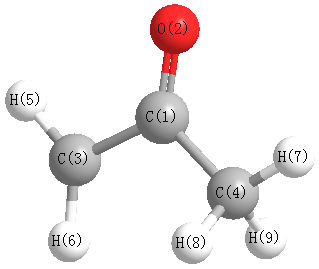
picture of Acetonyl radical state 1 conformation 1
More geometry information
Calculated Bond Angles
atom1 atom2 atom3 angle atom1 atom2 atom3 angle
C1 C3 H5 118.843 C1 C3 H6 121.504
C1 C4 H7 109.629 C1 C4 H8 110.387
C1 C4 H9 110.387 O2 C1 C3 120.563
O2 C1 C4 121.730 C3 C1 C4 117.707
H5 C3 H6 119.653 H7 C4 H8 109.503
H7 C4 H9 109.503 H8 C4 H9 107.396
Electronic energy levels
Charges, Dipole, Quadrupole and Polarizability