return to home page Computational Chemistry Comparison and Benchmark DataBase Release 22 (May 2022) Standard Reference Database 101 National Institute of Standards and Technology
You are here: Calculated > Energy > Optimized > Energy

All results from a given calculation for CH3COCH2 (Acetonyl radical)

using model chemistry: CCSD(T)/cc-pVTZ

19 10 17 12 22

States and conformations

State Conformation minimum conformation conformer description state description
1 1 yes CS 2A"
Energy calculated at CCSD(T)/cc-pVTZ
 hartrees
Energy at 0K-192.173065
Energy at 298.15K 
HF Energy-191.413331
Nuclear repulsion energy111.855524
The energy at 298.15K was derived from the energy at 0K and an integrated heat capacity that used the calculated vibrational frequencies.
Vibrational Frequencies calculated at CCSD(T)/cc-pVTZ
Mode Number Symmetry Frequency
(cm-1)
Scaled Frequency
(cm-1)
IR Intensities
(km mol-1)
Raman Act
(Å4/u)
Dep P Dep U
1 A' 3268 3186        
2 A' 3152 3073        
3 A' 3142 3063        
4 A' 3027 2951        
5 A' 1639 1598        
6 A' 1479 1442        
7 A' 1458 1422        
8 A' 1378 1343        
9 A' 1260 1228        
10 A' 1048 1022        
11 A' 903 880        
12 A' 813 793        
13 A' 496 483        
14 A' 365 355        
15 A" 3105 3026        
16 A" 1477 1440        
17 A" 1012 987        
18 A" 693 676        
19 A" 493 481        
20 A" 214 208        
21 A" 355i 346i        

Unscaled Zero Point Vibrational Energy (zpe) 15032.8 cm-1
Scaled (by 0.9748) Zero Point Vibrational Energy (zpe) 14654.0 cm-1
See section III.C.1 List or set vibrational scaling factors to change the scale factors used here.
See section III.C.2 Calculate a vibrational scaling factor for a given set of molecules to determine the least squares best scaling factor.
Rotational Constants (cm-1) from geometry optimized at CCSD(T)/cc-pVTZ
ABC
0.36286 0.30330 0.17044

See section I.F.4 to change rotational constant units
Geometric Data calculated at CCSD(T)/cc-pVTZ

Point Group is Cs

Cartesians (Å)
Atom x (Å) y (Å) z (Å)
C1 0.000 0.150 0.000
O2 0.430 1.304 0.000
C3 -1.426 -0.104 0.000
C4 0.930 -1.048 0.000
H5 -2.105 0.737 0.000
H6 -1.819 -1.112 0.000
H7 1.964 -0.707 0.000
H8 0.749 -1.668 0.881
H9 0.749 -1.668 -0.881

Atom - Atom Distances (Å)
  C1 O2 C3 C4 H5 H6 H7 H8 H9
C11.23131.44871.51682.18562.21452.14272.15482.1548
O21.23132.32982.40462.59793.30122.52933.11623.1162
C31.44872.32982.53831.08091.08233.44312.82032.8203
C41.51682.40462.53833.52132.75021.08821.09251.0925
H52.18562.59791.08093.52131.87134.31763.83513.8351
H62.21453.30121.08232.75021.87133.80462.77162.7716
H72.14272.52933.44311.08824.31763.80461.78161.7816
H82.15483.11622.82031.09253.83512.77161.78161.7622
H92.15483.11622.82031.09253.83512.77161.78161.7622

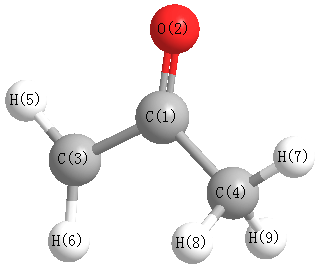
picture of Acetonyl radical state 1 conformation 1
More geometry information
Calculated Bond Angles
atom1 atom2 atom3 angle atom1 atom2 atom3 angle
C1 C3 H5 118.817 C1 C3 H6 121.408
C1 C4 H7 109.577 C1 C4 H8 110.289
C1 C4 H9 110.289 O2 C1 C3 120.545
O2 C1 C4 121.743 C3 C1 C4 117.712
H5 C3 H6 119.775 H7 C4 H8 109.570
H7 C4 H9 109.570 H8 C4 H9 107.516
Electronic energy levels
Charges, Dipole, Quadrupole and Polarizability