return to home page Computational Chemistry Comparison and Benchmark DataBase Release 22 (May 2022) Standard Reference Database 101 National Institute of Standards and Technology
You are here: Calculated > Energy > Optimized > Energy

All results from a given calculation for CH (Methylidyne)

using model chemistry: QCISD(T)/cc-pVTZ

19 10 17 12 22

States and conformations

State Conformation minimum conformation conformer description state description
1 1 yes C*V 2Π1/2
3 1 yes C*V 4Σ-

State 1 (2Π1/2)

Jump to S2C1 S3C1
Energy calculated at QCISD(T)/cc-pVTZ
 hartrees
Energy at 0K-38.410425
Energy at 298.15K 
HF Energy-38.281284
Nuclear repulsion energy2.825461
The energy at 298.15K was derived from the energy at 0K and an integrated heat capacity that used the calculated vibrational frequencies.
Vibrational Frequencies calculated at QCISD(T)/cc-pVTZ
Mode Number Symmetry Frequency
(cm-1)
Scaled Frequency
(cm-1)
IR Intensities
(km mol-1)
Raman Act
(Å4/u)
Dep P Dep U
1 Σ 2834 2688        

Unscaled Zero Point Vibrational Energy (zpe) 1416.9 cm-1
Scaled (by 0.9486) Zero Point Vibrational Energy (zpe) 1344.0 cm-1
See section III.C.1 List or set vibrational scaling factors to change the scale factors used here.
See section III.C.2 Calculate a vibrational scaling factor for a given set of molecules to determine the least squares best scaling factor.
Rotational Constants (cm-1) from geometry optimized at QCISD(T)/cc-pVTZ
B
14.37322

See section I.F.4 to change rotational constant units
Geometric Data calculated at QCISD(T)/cc-pVTZ

Point Group is C∞v

Cartesians (Å)
Atom x (Å) y (Å) z (Å)
C1 0.000 0.000 0.160
H2 0.000 0.000 -0.963

Atom - Atom Distances (Å)
  C1 H2
C11.1232
H21.1232

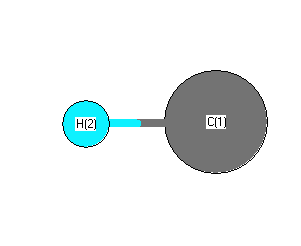
picture of Methylidyne state 1 conformation 1
More geometry information
Electronic energy levels
Charges, Dipole, Quadrupole and Polarizability

State 2 (2Π3/2)

Jump to S1C1 S3C1
Energy calculated at QCISD(T)/cc-pVTZ
 hartrees
Energy at 0K-38.410425
Energy at 298.15K 
HF Energy-38.281284
Nuclear repulsion energy2.825461
The energy at 298.15K was derived from the energy at 0K and an integrated heat capacity that used the calculated vibrational frequencies.
Vibrational Frequencies calculated at QCISD(T)/cc-pVTZ
Rotational Constants (cm-1) from geometry optimized at QCISD(T)/cc-pVTZ
B
14.37322

See section I.F.4 to change rotational constant units
Geometric Data calculated at QCISD(T)/cc-pVTZ

Point Group is C∞v

Electronic energy levels
Charges, Dipole, Quadrupole and Polarizability

State 3 (4Σ-)

Jump to S1C1 S2C1
Energy calculated at QCISD(T)/cc-pVTZ
 hartrees
Energy at 0K-38.385333
Energy at 298.15K-38.383982
HF Energy-38.289032
Nuclear repulsion energy2.911149
The energy at 298.15K was derived from the energy at 0K and an integrated heat capacity that used the calculated vibrational frequencies.
Vibrational Frequencies calculated at QCISD(T)/cc-pVTZ
Mode Number Symmetry Frequency
(cm-1)
Scaled Frequency
(cm-1)
IR Intensities
(km mol-1)
Raman Act
(Å4/u)
Dep P Dep U
1 Σ 3109 2949        

Unscaled Zero Point Vibrational Energy (zpe) 1554.4 cm-1
Scaled (by 0.9486) Zero Point Vibrational Energy (zpe) 1474.5 cm-1
See section III.C.1 List or set vibrational scaling factors to change the scale factors used here.
See section III.C.2 Calculate a vibrational scaling factor for a given set of molecules to determine the least squares best scaling factor.
Rotational Constants (cm-1) from geometry optimized at QCISD(T)/cc-pVTZ
B
15.25769

See section I.F.4 to change rotational constant units
Geometric Data calculated at QCISD(T)/cc-pVTZ

Point Group is C∞v

Cartesians (Å)
Atom x (Å) y (Å) z (Å)
C1 0.000 0.000 0.156
H2 0.000 0.000 -0.934

Atom - Atom Distances (Å)
  C1 H2
C11.0901
H21.0901

picture of Methylidyne state 3 conformation 1
More geometry information
Electronic energy levels
Charges, Dipole, Quadrupole and Polarizability