Jump to
S1C2
Energy calculated at MP3/cc-pVTZ
| | hartrees |
|---|
| Energy at 0K | -958.004109 |
| Energy at 298.15K | |
| HF Energy | -957.447872 |
| Nuclear repulsion energy | 126.030672 |
The energy at 298.15K was derived from the energy at 0K
and an integrated heat capacity that used the calculated vibrational frequencies.
Vibrational Frequencies calculated at MP3/cc-pVTZ
| Mode Number |
Symmetry |
Frequency
(cm-1) |
Scaled Frequency
(cm-1) |
IR Intensities
(km mol-1) |
Raman Act
(Å4/u) |
Dep P |
Dep U |
|---|
| 1 |
A1 |
3333 |
3149 |
0.41 |
|
|
|
| 2 |
A1 |
769 |
727 |
9.17 |
|
|
|
| 3 |
A1 |
315 |
297 |
0.46 |
|
|
|
| 4 |
B1 |
400i |
378i |
39.53 |
|
|
|
| 5 |
B2 |
1270 |
1200 |
56.85 |
|
|
|
| 6 |
B2 |
954 |
901 |
127.86 |
|
|
|
Unscaled Zero Point Vibrational Energy (zpe) 3120.3 cm
-1
Scaled (by 0.9447) Zero Point Vibrational Energy (zpe) 2947.7 cm
-1
See section
III.C.1 List or set vibrational scaling factors
to change the scale factors used here.
See section
III.C.2
Calculate a vibrational scaling factor for a given set of molecules
to determine the least squares best scaling factor.
Geometric Data calculated at MP3/cc-pVTZ
Point Group is C2v
Cartesians (Å)
| Atom |
x (Å) |
y (Å) |
z (Å) |
|---|
| C1 |
0.000 |
0.000 |
0.673 |
| H2 |
0.000 |
0.000 |
1.744 |
| Cl3 |
0.000 |
1.472 |
-0.170 |
| Cl4 |
0.000 |
-1.472 |
-0.170 |
Atom - Atom Distances (Å)
| |
C1 |
H2 |
Cl3 |
Cl4 |
| C1 | | 1.0709 | 1.6959 | 1.6959 |
H2 | 1.0709 | | 2.4142 | 2.4142 | Cl3 | 1.6959 | 2.4142 | | 2.9433 | Cl4 | 1.6959 | 2.4142 | 2.9433 | |
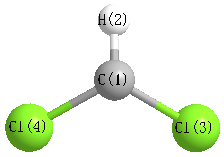 More geometry information
Calculated Bond Angles
| atom1 |
atom2 |
atom3 |
angle |
|
atom1 |
atom2 |
atom3 |
angle |
| Cl3 |
C1 |
H2 |
119.799 |
|
Cl3 |
C1 |
Cl4 |
120.403 |
| Cl4 |
C1 |
H2 |
119.799 |
|
Electronic energy levels
Charges, Dipole, Quadrupole and Polarizability
Jump to
S1C1
Energy calculated at MP3/cc-pVTZ
| | hartrees |
|---|
| Energy at 0K | -958.005031 |
| Energy at 298.15K | -958.005872 |
| HF Energy | -957.449458 |
| Nuclear repulsion energy | 125.828458 |
The energy at 298.15K was derived from the energy at 0K
and an integrated heat capacity that used the calculated vibrational frequencies.
Vibrational Frequencies calculated at MP3/cc-pVTZ
| Mode Number |
Symmetry |
Frequency
(cm-1) |
Scaled Frequency
(cm-1) |
IR Intensities
(km mol-1) |
Raman Act
(Å4/u) |
Dep P |
Dep U |
|---|
| 1 |
A' |
3286 |
3104 |
0.90 |
|
|
|
| 2 |
A' |
776 |
733 |
14.56 |
|
|
|
| 3 |
A' |
515 |
486 |
19.90 |
|
|
|
| 4 |
A' |
309 |
291 |
0.52 |
|
|
|
| 5 |
A" |
1270 |
1200 |
46.50 |
|
|
|
| 6 |
A" |
922 |
871 |
149.01 |
|
|
|
Unscaled Zero Point Vibrational Energy (zpe) 3538.9 cm
-1
Scaled (by 0.9447) Zero Point Vibrational Energy (zpe) 3343.2 cm
-1
See section
III.C.1 List or set vibrational scaling factors
to change the scale factors used here.
See section
III.C.2
Calculate a vibrational scaling factor for a given set of molecules
to determine the least squares best scaling factor.
Geometric Data calculated at MP3/cc-pVTZ
Point Group is Cs
Cartesians (Å)
| Atom |
x (Å) |
y (Å) |
z (Å) |
|---|
| C1 |
0.012 |
0.697 |
0.000 |
| H2 |
-0.478 |
1.654 |
0.000 |
| Cl3 |
0.012 |
-0.172 |
1.468 |
| Cl4 |
0.012 |
-0.172 |
-1.468 |
Atom - Atom Distances (Å)
| |
C1 |
H2 |
Cl3 |
Cl4 |
| C1 | | 1.0747 | 1.7060 | 1.7060 |
H2 | 1.0747 | | 2.3932 | 2.3932 | Cl3 | 1.7060 | 2.3932 | | 2.9366 | Cl4 | 1.7060 | 2.3932 | 2.9366 | |
More geometry information
Calculated Bond Angles
| atom1 |
atom2 |
atom3 |
angle |
|
atom1 |
atom2 |
atom3 |
angle |
| Cl3 |
C1 |
H2 |
116.948 |
|
Cl3 |
C1 |
Cl4 |
118.785 |
| Cl4 |
C1 |
H2 |
116.948 |
|
Electronic energy levels
Charges, Dipole, Quadrupole and Polarizability
