Jump to
S1C2
Energy calculated at MP2=FULL/cc-pVTZ
| | hartrees |
|---|
| Energy at 0K | -148.560584 |
| Energy at 298.15K | -148.562880 |
| Nuclear repulsion energy | 59.188393 |
The energy at 298.15K was derived from the energy at 0K
and an integrated heat capacity that used the calculated vibrational frequencies.
Vibrational Frequencies calculated at MP2=FULL/cc-pVTZ
| Mode Number |
Symmetry |
Frequency
(cm-1) |
Scaled Frequency
(cm-1) |
IR Intensities
(km mol-1) |
Raman Act
(Å4/u) |
Dep P |
Dep U |
|---|
| 1 |
A' |
3601 |
3418 |
48.66 |
|
|
|
| 2 |
A' |
2281 |
2165 |
64.87 |
|
|
|
| 3 |
A' |
1648 |
1565 |
39.04 |
|
|
|
| 4 |
A' |
1083 |
1029 |
9.17 |
|
|
|
| 5 |
A' |
642 |
610 |
204.99 |
|
|
|
| 6 |
A' |
480 |
456 |
25.75 |
|
|
|
| 7 |
A" |
3700 |
3513 |
68.33 |
|
|
|
| 8 |
A" |
1211 |
1150 |
0.00 |
|
|
|
| 9 |
A" |
405 |
384 |
0.43 |
|
|
|
Unscaled Zero Point Vibrational Energy (zpe) 7525.4 cm
-1
Scaled (by 0.9494) Zero Point Vibrational Energy (zpe) 7144.7 cm
-1
See section
III.C.1 List or set vibrational scaling factors
to change the scale factors used here.
See section
III.C.2
Calculate a vibrational scaling factor for a given set of molecules
to determine the least squares best scaling factor.
Geometric Data calculated at MP2=FULL/cc-pVTZ
Point Group is Cs
Cartesians (Å)
| Atom |
x (Å) |
y (Å) |
z (Å) |
|---|
| C1 |
0.000 |
0.216 |
0.000 |
| N2 |
-0.024 |
1.384 |
0.000 |
| N3 |
0.100 |
-1.125 |
0.000 |
| H4 |
-0.265 |
-1.554 |
0.834 |
| H5 |
-0.265 |
-1.554 |
-0.834 |
Atom - Atom Distances (Å)
| |
C1 |
N2 |
N3 |
H4 |
H5 |
| C1 | | 1.1682 | 1.3448 | 1.9746 | 1.9746 |
N2 | 1.1682 | | 2.5120 | 3.0636 | 3.0636 | N3 | 1.3448 | 2.5120 | | 1.0063 | 1.0063 | H4 | 1.9746 | 3.0636 | 1.0063 | | 1.6682 | H5 | 1.9746 | 3.0636 | 1.0063 | 1.6682 | |
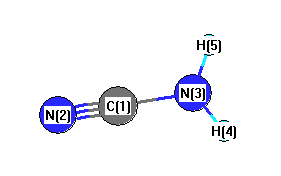 More geometry information
Calculated Bond Angles
| atom1 |
atom2 |
atom3 |
angle |
|
atom1 |
atom2 |
atom3 |
angle |
| C1 |
N3 |
H4 |
113.471 |
|
C1 |
N3 |
H5 |
113.471 |
| N2 |
C1 |
N3 |
176.933 |
|
H4 |
N3 |
H5 |
111.957 |
Electronic energy levels
Charges, Dipole, Quadrupole and Polarizability
Jump to
S1C1
Energy calculated at MP2=FULL/cc-pVTZ
| | hartrees |
|---|
| Energy at 0K | -148.558631 |
| Energy at 298.15K | |
| HF Energy | -147.964247 |
| Nuclear repulsion energy | 59.393041 |
The energy at 298.15K was derived from the energy at 0K
and an integrated heat capacity that used the calculated vibrational frequencies.
Vibrational Frequencies calculated at MP2=FULL/cc-pVTZ
| Mode Number |
Symmetry |
Frequency
(cm-1) |
Scaled Frequency
(cm-1) |
IR Intensities
(km mol-1) |
Raman Act
(Å4/u) |
Dep P |
Dep U |
|---|
| 1 |
A1 |
3685 |
3498 |
86.75 |
|
|
|
| 2 |
A1 |
2307 |
2191 |
102.62 |
|
|
|
| 3 |
A1 |
1641 |
1558 |
47.88 |
|
|
|
| 4 |
A1 |
1120 |
1063 |
15.66 |
|
|
|
| 5 |
B1 |
511 |
485 |
|
|
|
|
| 6 |
B1 |
473i |
449i |
252.23 |
|
|
|
| 7 |
B2 |
3810 |
3617 |
110.58 |
|
|
|
| 8 |
B2 |
1139 |
1082 |
2.30 |
|
|
|
| 9 |
B2 |
403 |
383 |
0.00 |
|
|
|
Unscaled Zero Point Vibrational Energy (zpe) 7071.9 cm
-1
Scaled (by 0.9494) Zero Point Vibrational Energy (zpe) 6714.0 cm
-1
See section
III.C.1 List or set vibrational scaling factors
to change the scale factors used here.
See section
III.C.2
Calculate a vibrational scaling factor for a given set of molecules
to determine the least squares best scaling factor.
Geometric Data calculated at MP2=FULL/cc-pVTZ
Point Group is C2v
Cartesians (Å)
| Atom |
x (Å) |
y (Å) |
z (Å) |
|---|
| C1 |
0.000 |
0.000 |
0.217 |
| N2 |
0.000 |
0.000 |
1.386 |
| N3 |
0.000 |
0.000 |
-1.110 |
| H4 |
0.000 |
0.862 |
-1.614 |
| H5 |
0.000 |
-0.862 |
-1.614 |
Atom - Atom Distances (Å)
| |
C1 |
N2 |
N3 |
H4 |
H5 |
| C1 | | 1.1688 | 1.3269 | 2.0235 | 2.0235 |
N2 | 1.1688 | | 2.4957 | 3.1208 | 3.1208 | N3 | 1.3269 | 2.4957 | | 0.9986 | 0.9986 | H4 | 2.0235 | 3.1208 | 0.9986 | | 1.7246 | H5 | 2.0235 | 3.1208 | 0.9986 | 1.7246 | |
More geometry information
Calculated Bond Angles
| atom1 |
atom2 |
atom3 |
angle |
|
atom1 |
atom2 |
atom3 |
angle |
| C1 |
N3 |
H4 |
120.288 |
|
C1 |
N3 |
H5 |
120.288 |
| N2 |
C1 |
N3 |
180.000 |
|
H4 |
N3 |
H5 |
119.425 |
Electronic energy levels
Charges, Dipole, Quadrupole and Polarizability
