Jump to
S1C2
Energy calculated at QCISD/cc-pVTZ
| | hartrees |
|---|
| Energy at 0K | -148.525718 |
| Energy at 298.15K | -148.528037 |
| Nuclear repulsion energy | 59.215530 |
The energy at 298.15K was derived from the energy at 0K
and an integrated heat capacity that used the calculated vibrational frequencies.
Vibrational Frequencies calculated at QCISD/cc-pVTZ
| Mode Number |
Symmetry |
Frequency
(cm-1) |
Scaled Frequency
(cm-1) |
IR Intensities
(km mol-1) |
Raman Act
(Å4/u) |
Dep P |
Dep U |
|---|
| 1 |
A' |
3588 |
3428 |
38.12 |
|
|
|
| 2 |
A' |
2351 |
2247 |
73.61 |
|
|
|
| 3 |
A' |
1661 |
1587 |
36.32 |
|
|
|
| 4 |
A' |
1077 |
1029 |
7.06 |
|
|
|
| 5 |
A' |
677 |
647 |
201.25 |
|
|
|
| 6 |
A' |
486 |
464 |
23.20 |
|
|
|
| 7 |
A" |
3682 |
3518 |
53.11 |
|
|
|
| 8 |
A" |
1232 |
1177 |
0.14 |
|
|
|
| 9 |
A" |
404 |
386 |
0.64 |
|
|
|
Unscaled Zero Point Vibrational Energy (zpe) 7578.7 cm
-1
Scaled (by 0.9555) Zero Point Vibrational Energy (zpe) 7241.5 cm
-1
See section
III.C.1 List or set vibrational scaling factors
to change the scale factors used here.
See section
III.C.2
Calculate a vibrational scaling factor for a given set of molecules
to determine the least squares best scaling factor.
Geometric Data calculated at QCISD/cc-pVTZ
Point Group is Cs
Cartesians (Å)
| Atom |
x (Å) |
y (Å) |
z (Å) |
|---|
| C1 |
0.000 |
0.222 |
0.000 |
| N2 |
-0.039 |
1.380 |
0.000 |
| N3 |
0.114 |
-1.127 |
0.000 |
| H4 |
-0.262 |
-1.552 |
0.833 |
| H5 |
-0.262 |
-1.552 |
-0.833 |
Atom - Atom Distances (Å)
| |
C1 |
N2 |
N3 |
H4 |
H5 |
| C1 | | 1.1590 | 1.3541 | 1.9770 | 1.9770 |
N2 | 1.1590 | | 2.5124 | 3.0562 | 3.0562 | N3 | 1.3541 | 2.5124 | | 1.0077 | 1.0077 | H4 | 1.9770 | 3.0562 | 1.0077 | | 1.6666 | H5 | 1.9770 | 3.0562 | 1.0077 | 1.6666 | |
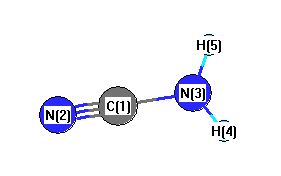 More geometry information
Calculated Bond Angles
| atom1 |
atom2 |
atom3 |
angle |
|
atom1 |
atom2 |
atom3 |
angle |
| C1 |
N3 |
H4 |
112.843 |
|
C1 |
N3 |
H5 |
112.843 |
| N2 |
C1 |
N3 |
177.112 |
|
H4 |
N3 |
H5 |
111.579 |
Electronic energy levels
Charges, Dipole, Quadrupole and Polarizability
Jump to
S1C1
Energy calculated at QCISD/cc-pVTZ
| | hartrees |
|---|
| Energy at 0K | -148.523382 |
| Energy at 298.15K | |
| HF Energy | -147.965349 |
| Nuclear repulsion energy | 59.449142 |
The energy at 298.15K was derived from the energy at 0K
and an integrated heat capacity that used the calculated vibrational frequencies.
Vibrational Frequencies calculated at QCISD/cc-pVTZ
| Mode Number |
Symmetry |
Frequency
(cm-1) |
Scaled Frequency
(cm-1) |
IR Intensities
(km mol-1) |
Raman Act
(Å4/u) |
Dep P |
Dep U |
|---|
| 1 |
A1 |
3682 |
3518 |
74.43 |
|
|
|
| 2 |
A1 |
2350 |
2245 |
113.21 |
|
|
|
| 3 |
A1 |
1643 |
1570 |
45.48 |
|
|
|
| 4 |
A1 |
1122 |
1072 |
15.71 |
|
|
|
| 5 |
B1 |
521 |
498 |
0.31 |
|
|
|
| 6 |
B1 |
496i |
474i |
256.35 |
|
|
|
| 7 |
B2 |
3807 |
3638 |
95.89 |
|
|
|
| 8 |
B2 |
1151 |
1100 |
1.41 |
|
|
|
| 9 |
B2 |
399 |
381 |
0.00 |
|
|
|
Unscaled Zero Point Vibrational Energy (zpe) 7090.1 cm
-1
Scaled (by 0.9555) Zero Point Vibrational Energy (zpe) 6774.6 cm
-1
See section
III.C.1 List or set vibrational scaling factors
to change the scale factors used here.
See section
III.C.2
Calculate a vibrational scaling factor for a given set of molecules
to determine the least squares best scaling factor.
Geometric Data calculated at QCISD/cc-pVTZ
Point Group is C2v
Cartesians (Å)
| Atom |
x (Å) |
y (Å) |
z (Å) |
|---|
| C1 |
0.000 |
0.000 |
0.222 |
| N2 |
0.000 |
0.000 |
1.382 |
| N3 |
0.000 |
0.000 |
-1.111 |
| H4 |
0.000 |
0.864 |
-1.613 |
| H5 |
0.000 |
-0.864 |
-1.613 |
Atom - Atom Distances (Å)
| |
C1 |
N2 |
N3 |
H4 |
H5 |
| C1 | | 1.1608 | 1.3329 | 2.0281 | 2.0281 |
N2 | 1.1608 | | 2.4937 | 3.1178 | 3.1178 | N3 | 1.3329 | 2.4937 | | 0.9990 | 0.9990 | H4 | 2.0281 | 3.1178 | 0.9990 | | 1.7273 | H5 | 2.0281 | 3.1178 | 0.9990 | 1.7273 | |
More geometry information
Calculated Bond Angles
| atom1 |
atom2 |
atom3 |
angle |
|
atom1 |
atom2 |
atom3 |
angle |
| C1 |
N3 |
H4 |
120.173 |
|
C1 |
N3 |
H5 |
120.173 |
| N2 |
C1 |
N3 |
180.000 |
|
H4 |
N3 |
H5 |
119.654 |
Electronic energy levels
Charges, Dipole, Quadrupole and Polarizability
