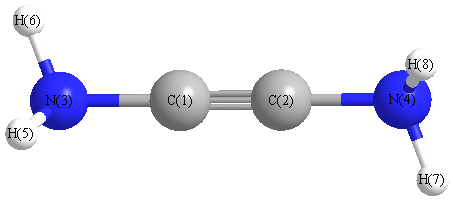
Vibrational Frequencies calculated at HF/cc-pVTZ
| Mode Number |
Symmetry |
Frequency
(cm-1) |
Scaled Frequency
(cm-1) |
IR Intensities
(km mol-1) |
Raman Act
(Å4/u) |
Dep P |
Dep U |
|---|
| 1 |
A |
3857 |
3511 |
32.71 |
|
|
|
| 2 |
A |
3766 |
3427 |
3.24 |
|
|
|
| 3 |
A |
2531 |
2304 |
0.04 |
|
|
|
| 4 |
A |
1790 |
1629 |
10.62 |
|
|
|
| 5 |
A |
1312 |
1194 |
0.57 |
|
|
|
| 6 |
A |
864 |
786 |
6.65 |
|
|
|
| 7 |
A |
658 |
599 |
122.91 |
|
|
|
| 8 |
A |
514 |
468 |
14.30 |
|
|
|
| 9 |
A |
386 |
351 |
23.23 |
|
|
|
| 10 |
A |
251 |
228 |
24.57 |
|
|
|
| 11 |
B |
3858 |
3511 |
31.97 |
|
|
|
| 12 |
B |
3766 |
3428 |
27.36 |
|
|
|
| 13 |
B |
1790 |
1629 |
40.16 |
|
|
|
| 14 |
B |
1409 |
1283 |
114.46 |
|
|
|
| 15 |
B |
1312 |
1194 |
0.60 |
|
|
|
| 16 |
B |
709 |
646 |
311.15 |
|
|
|
| 17 |
B |
519 |
472 |
38.55 |
|
|
|
| 18 |
B |
251 |
229 |
25.78 |
|
|
|
Unscaled Zero Point Vibrational Energy (zpe) 14771.7 cm
-1
Scaled (by 0.9101) Zero Point Vibrational Energy (zpe) 13443.8 cm
-1
See section
III.C.1 List or set vibrational scaling factors
to change the scale factors used here.
See section
III.C.2
Calculate a vibrational scaling factor for a given set of molecules
to determine the least squares best scaling factor.
Charges, Dipole, Quadrupole and Polarizability
Charges from optimized geometry at HF/cc-pVTZ
Charges (e)
| Number |
Element |
Mulliken |
CHELPG |
AIM |
ESP |
| 1 |
C |
-0.084 |
|
|
|
| 2 |
C |
-0.084 |
|
|
|
| 3 |
N |
-0.267 |
|
|
|
| 4 |
N |
-0.267 |
|
|
|
| 5 |
H |
0.175 |
|
|
|
| 6 |
H |
0.176 |
|
|
|
| 7 |
H |
0.175 |
|
|
|
| 8 |
H |
0.176 |
|
|
|
Electric dipole moments
Electric dipole components in Debye
(What's a Debye? See section
VII.A.3)
| |
x |
y |
z |
Total |
| |
0.000 |
0.000 |
1.499 |
1.499 |
| CHELPG |
|
|
|
|
| AIM |
|
|
|
|
| ESP |
|
|
|
|
Electric Quadrupole moment
Quadrupole components in D Å
| Primitive |
|---|
| | x | y | z |
|---|
| x |
-23.670 |
4.254 |
0.000 |
| y |
4.254 |
-14.742 |
0.000 |
| z |
0.000 |
0.000 |
-23.810 |
|
| Traceless |
|---|
| | x | y | z |
|---|
| x |
-4.394 |
4.254 |
0.000 |
| y |
4.254 |
8.998 |
0.000 |
| z |
0.000 |
0.000 |
-4.604 |
|
| Polar |
|---|
| 3z2-r2 | -9.209 |
|---|
| x2-y2 | -8.928 |
|---|
| xy | 4.254 |
|---|
| xz | 0.000 |
|---|
| yz | 0.000 |
|---|
|
Polarizabilities
Components of the polarizability tensor.
Units are
Å
3 (Angstrom cubed)
Change units.
| |
x |
y |
z |
| x |
3.653 |
0.193 |
0.000 |
| y |
0.193 |
8.373 |
0.000 |
| z |
0.000 |
0.000 |
3.647 |
<r2> (average value of r
2) Å
2
| <r2> |
95.727 |
| (<r2>)1/2 |
9.784 |