Jump to
S1C2
Energy calculated at CCSD(T)/cc-pVTZ
| | hartrees |
|---|
| Energy at 0K | -218.043327 |
| Energy at 298.15K | -218.051169 |
| HF Energy | -217.197218 |
| Nuclear repulsion energy | 128.170522 |
The energy at 298.15K was derived from the energy at 0K
and an integrated heat capacity that used the calculated vibrational frequencies.
Vibrational Frequencies calculated at CCSD(T)/cc-pVTZ
| Mode Number |
Symmetry |
Frequency
(cm-1) |
Scaled Frequency
(cm-1) |
IR Intensities
(km mol-1) |
Raman Act
(Å4/u) |
Dep P |
Dep U |
|---|
| 1 |
A' |
3119 |
3040 |
|
|
|
|
| 2 |
A' |
3053 |
2976 |
|
|
|
|
| 3 |
A' |
3040 |
2963 |
|
|
|
|
| 4 |
A' |
3035 |
2958 |
|
|
|
|
| 5 |
A' |
1528 |
1489 |
|
|
|
|
| 6 |
A' |
1515 |
1477 |
|
|
|
|
| 7 |
A' |
1499 |
1462 |
|
|
|
|
| 8 |
A' |
1442 |
1406 |
|
|
|
|
| 9 |
A' |
1417 |
1381 |
|
|
|
|
| 10 |
A' |
1338 |
1304 |
|
|
|
|
| 11 |
A' |
1147 |
1118 |
|
|
|
|
| 12 |
A' |
1091 |
1064 |
|
|
|
|
| 13 |
A' |
1050 |
1024 |
|
|
|
|
| 14 |
A' |
907 |
884 |
|
|
|
|
| 15 |
A' |
454 |
442 |
|
|
|
|
| 16 |
A' |
266 |
259 |
|
|
|
|
| 17 |
A" |
3113 |
3035 |
|
|
|
|
| 18 |
A" |
3095 |
3017 |
|
|
|
|
| 19 |
A" |
3078 |
3000 |
|
|
|
|
| 20 |
A" |
1509 |
1471 |
|
|
|
|
| 21 |
A" |
1326 |
1292 |
|
|
|
|
| 22 |
A" |
1280 |
1248 |
|
|
|
|
| 23 |
A" |
1201 |
1171 |
|
|
|
|
| 24 |
A" |
897 |
875 |
|
|
|
|
| 25 |
A" |
765 |
746 |
|
|
|
|
| 26 |
A" |
228 |
222 |
|
|
|
|
| 27 |
A" |
129 |
126 |
|
|
|
|
Unscaled Zero Point Vibrational Energy (zpe) 21260.8 cm
-1
Scaled (by 0.9748) Zero Point Vibrational Energy (zpe) 20725.0 cm
-1
See section
III.C.1 List or set vibrational scaling factors
to change the scale factors used here.
See section
III.C.2
Calculate a vibrational scaling factor for a given set of molecules
to determine the least squares best scaling factor.
Geometric Data calculated at CCSD(T)/cc-pVTZ
Point Group is Cs
Electronic energy levels
Charges, Dipole, Quadrupole and Polarizability
Jump to
S1C1
Energy calculated at CCSD(T)/cc-pVTZ
| | hartrees |
|---|
| Energy at 0K | -218.043764 |
| Energy at 298.15K | |
| HF Energy | -217.197317 |
| Nuclear repulsion energy | 130.562479 |
The energy at 298.15K was derived from the energy at 0K
and an integrated heat capacity that used the calculated vibrational frequencies.
Vibrational Frequencies calculated at CCSD(T)/cc-pVTZ
| Mode Number |
Symmetry |
Frequency
(cm-1) |
Scaled Frequency
(cm-1) |
IR Intensities
(km mol-1) |
Raman Act
(Å4/u) |
Dep P |
Dep U |
|---|
| 1 |
A |
3126 |
3048 |
|
|
|
|
| 2 |
A |
3112 |
3034 |
|
|
|
|
| 3 |
A |
3099 |
3020 |
|
|
|
|
| 4 |
A |
3080 |
3002 |
|
|
|
|
| 5 |
A |
3045 |
2968 |
|
|
|
|
| 6 |
A |
3038 |
2962 |
|
|
|
|
| 7 |
A |
3037 |
2961 |
|
|
|
|
| 8 |
A |
1524 |
1485 |
|
|
|
|
| 9 |
A |
1515 |
1477 |
|
|
|
|
| 10 |
A |
1503 |
1465 |
|
|
|
|
| 11 |
A |
1480 |
1442 |
|
|
|
|
| 12 |
A |
1436 |
1400 |
|
|
|
|
| 13 |
A |
1415 |
1380 |
|
|
|
|
| 14 |
A |
1383 |
1348 |
|
|
|
|
| 15 |
A |
1307 |
1274 |
|
|
|
|
| 16 |
A |
1284 |
1252 |
|
|
|
|
| 17 |
A |
1185 |
1155 |
|
|
|
|
| 18 |
A |
1133 |
1105 |
|
|
|
|
| 19 |
A |
1105 |
1077 |
|
|
|
|
| 20 |
A |
989 |
964 |
|
|
|
|
| 21 |
A |
923 |
900 |
|
|
|
|
| 22 |
A |
885 |
863 |
|
|
|
|
| 23 |
A |
771 |
751 |
|
|
|
|
| 24 |
A |
479 |
467 |
|
|
|
|
| 25 |
A |
314 |
306 |
|
|
|
|
| 26 |
A |
220 |
214 |
|
|
|
|
| 27 |
A |
141 |
137 |
|
|
|
|
Unscaled Zero Point Vibrational Energy (zpe) 21262.7 cm
-1
Scaled (by 0.9748) Zero Point Vibrational Energy (zpe) 20726.9 cm
-1
See section
III.C.1 List or set vibrational scaling factors
to change the scale factors used here.
See section
III.C.2
Calculate a vibrational scaling factor for a given set of molecules
to determine the least squares best scaling factor.
Geometric Data calculated at CCSD(T)/cc-pVTZ
Point Group is C1
Cartesians (Å)
| Atom |
x (Å) |
y (Å) |
z (Å) |
|---|
| C1 |
0.795 |
0.511 |
0.302 |
| C2 |
-0.593 |
0.659 |
-0.287 |
| C3 |
-1.521 |
-0.485 |
0.119 |
| F4 |
1.389 |
-0.655 |
-0.174 |
| H5 |
1.440 |
1.347 |
0.024 |
| H6 |
0.754 |
0.436 |
1.392 |
| H7 |
-0.508 |
0.712 |
-1.376 |
| H8 |
-0.999 |
1.618 |
0.050 |
| H9 |
-2.510 |
-0.367 |
-0.327 |
| H10 |
-1.112 |
-1.443 |
-0.205 |
| H11 |
-1.642 |
-0.519 |
1.205 |
Atom - Atom Distances (Å)
| |
C1 |
C2 |
C3 |
F4 |
H5 |
H6 |
H7 |
H8 |
H9 |
H10 |
H11 |
| C1 | | 1.5149 | 2.5276 | 1.3916 | 1.0920 | 1.0938 | 2.1329 | 2.1231 | 3.4771 | 2.7760 | 2.7955 |
C2 | 1.5149 | | 1.5278 | 2.3804 | 2.1684 | 2.1640 | 1.0933 | 1.0949 | 2.1749 | 2.1661 | 2.1712 | C3 | 2.5276 | 1.5278 | | 2.9298 | 3.4830 | 2.7651 | 2.1663 | 2.1681 | 1.0911 | 1.0908 | 1.0933 | F4 | 1.3916 | 2.3804 | 2.9298 | | 2.0120 | 2.0114 | 2.6280 | 3.3041 | 3.9126 | 2.6219 | 3.3324 | H5 | 1.0920 | 2.1684 | 3.4830 | 2.0120 | | 1.7811 | 2.4803 | 2.4536 | 4.3201 | 3.7872 | 3.7914 | H6 | 1.0938 | 2.1640 | 2.7651 | 2.0114 | 1.7811 | | 3.0539 | 2.5039 | 3.7757 | 3.0919 | 2.5862 | H7 | 2.1329 | 1.0933 | 2.1663 | 2.6280 | 2.4803 | 3.0539 | | 1.7597 | 2.5052 | 2.5253 | 3.0760 | H8 | 2.1231 | 1.0949 | 2.1681 | 3.3041 | 2.4536 | 2.5039 | 1.7597 | | 2.5240 | 3.0736 | 2.5134 | H9 | 3.4771 | 2.1749 | 1.0911 | 3.9126 | 4.3201 | 3.7757 | 2.5052 | 2.5240 | | 1.7683 | 1.7674 | H10 | 2.7760 | 2.1661 | 1.0908 | 2.6219 | 3.7872 | 3.0919 | 2.5253 | 3.0736 | 1.7683 | | 1.7665 | H11 | 2.7955 | 2.1712 | 1.0933 | 3.3324 | 3.7914 | 2.5862 | 3.0760 | 2.5134 | 1.7674 | 1.7665 | |
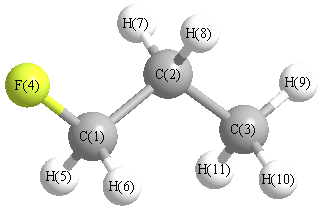 More geometry information
Calculated Bond Angles
| atom1 |
atom2 |
atom3 |
angle |
|
atom1 |
atom2 |
atom3 |
angle |
| C1 |
C2 |
C3 |
112.345 |
|
C1 |
C2 |
H7 |
108.644 |
| C1 |
C2 |
H8 |
107.793 |
|
C2 |
C1 |
F4 |
109.894 |
| C2 |
C1 |
H5 |
111.534 |
|
C2 |
C1 |
H6 |
111.078 |
| C2 |
C3 |
H9 |
111.203 |
|
C2 |
C3 |
H10 |
110.513 |
| C2 |
C3 |
H11 |
110.770 |
|
C3 |
C2 |
H7 |
110.384 |
| C3 |
C2 |
H8 |
110.434 |
|
F4 |
C1 |
H5 |
107.598 |
| F4 |
C1 |
H6 |
107.444 |
|
H5 |
C1 |
H6 |
109.146 |
| H7 |
C2 |
H8 |
107.059 |
|
H9 |
C3 |
H10 |
108.276 |
| H9 |
C3 |
H11 |
108.014 |
|
H10 |
C3 |
H11 |
107.949 |
Electronic energy levels
Charges, Dipole, Quadrupole and Polarizability
