Jump to
S1C2
Energy calculated at B2PLYP=FULL/cc-pVTZ
| | hartrees |
|---|
| Energy at 0K | -168.536053 |
| Energy at 298.15K | |
| HF Energy | -168.320006 |
| Nuclear repulsion energy | 60.491773 |
The energy at 298.15K was derived from the energy at 0K
and an integrated heat capacity that used the calculated vibrational frequencies.
Vibrational Frequencies calculated at B2PLYP=FULL/cc-pVTZ
| Mode Number |
Symmetry |
Frequency
(cm-1) |
Scaled Frequency
(cm-1) |
IR Intensities
(km mol-1) |
Raman Act
(Å4/u) |
Dep P |
Dep U |
|---|
| 1 |
Σ |
3522 |
3366 |
259.20 |
29.08 |
0.25 |
0.40 |
| 2 |
Σ |
2289 |
2188 |
408.66 |
21.27 |
0.06 |
0.11 |
| 3 |
Σ |
1289 |
1232 |
90.19 |
27.42 |
0.27 |
0.42 |
| 4 |
Π |
563 |
538 |
2.18 |
0.18 |
0.75 |
0.86 |
| 4 |
Π |
563 |
538 |
2.18 |
0.18 |
0.75 |
0.86 |
| 5 |
Π |
164i |
157i |
78.51 |
4.23 |
0.75 |
0.86 |
| 5 |
Π |
164i |
157i |
78.51 |
4.23 |
0.75 |
0.86 |
Unscaled Zero Point Vibrational Energy (zpe) 3948.9 cm
-1
Scaled (by 0.9558) Zero Point Vibrational Energy (zpe) 3774.3 cm
-1
See section
III.C.1 List or set vibrational scaling factors
to change the scale factors used here.
See section
III.C.2
Calculate a vibrational scaling factor for a given set of molecules
to determine the least squares best scaling factor.
Geometric Data calculated at B2PLYP=FULL/cc-pVTZ
Point Group is C∞v
Cartesians (Å)
| Atom |
x (Å) |
y (Å) |
z (Å) |
|---|
| O1 |
0.000 |
0.000 |
1.181 |
| N2 |
0.000 |
0.000 |
-0.018 |
| C3 |
0.000 |
0.000 |
-1.181 |
| H4 |
0.000 |
0.000 |
-2.237 |
Atom - Atom Distances (Å)
| |
O1 |
N2 |
C3 |
H4 |
| O1 | | 1.1987 | 2.3621 | 3.4184 |
N2 | 1.1987 | | 1.1634 | 2.2197 | C3 | 2.3621 | 1.1634 | | 1.0563 | H4 | 3.4184 | 2.2197 | 1.0563 | |
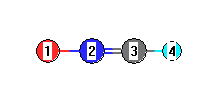 More geometry information
Calculated Bond Angles
| atom1 |
atom2 |
atom3 |
angle |
|
atom1 |
atom2 |
atom3 |
angle |
| O1 |
N2 |
C3 |
180.000 |
|
N2 |
C3 |
H4 |
180.000 |
Electronic energy levels
Charges, Dipole, Quadrupole and Polarizability
Jump to
S1C1
Energy calculated at B2PLYP=FULL/cc-pVTZ
| | hartrees |
|---|
| Energy at 0K | -168.536118 |
| Energy at 298.15K | -168.536657 |
| HF Energy | -168.319100 |
| Nuclear repulsion energy | 60.484238 |
The energy at 298.15K was derived from the energy at 0K
and an integrated heat capacity that used the calculated vibrational frequencies.
Vibrational Frequencies calculated at B2PLYP=FULL/cc-pVTZ
| Mode Number |
Symmetry |
Frequency
(cm-1) |
Scaled Frequency
(cm-1) |
IR Intensities
(km mol-1) |
Raman Act
(Å4/u) |
Dep P |
Dep U |
|---|
| 1 |
A' |
3504 |
3349 |
226.16 |
|
|
|
| 2 |
A' |
2275 |
2175 |
416.68 |
|
|
|
| 3 |
A' |
1293 |
1236 |
78.94 |
|
|
|
| 4 |
A' |
562 |
537 |
3.19 |
|
|
|
| 5 |
A' |
226 |
216 |
118.70 |
|
|
|
| 6 |
A" |
563 |
538 |
2.23 |
|
|
|
Unscaled Zero Point Vibrational Energy (zpe) 4211.3 cm
-1
Scaled (by 0.9558) Zero Point Vibrational Energy (zpe) 4025.2 cm
-1
See section
III.C.1 List or set vibrational scaling factors
to change the scale factors used here.
See section
III.C.2
Calculate a vibrational scaling factor for a given set of molecules
to determine the least squares best scaling factor.
Geometric Data calculated at B2PLYP=FULL/cc-pVTZ
Point Group is Cs
Cartesians (Å)
| Atom |
x (Å) |
y (Å) |
z (Å) |
|---|
| O1 |
-0.704 |
-0.946 |
0.000 |
| N2 |
0.000 |
0.022 |
0.000 |
| C3 |
0.746 |
0.919 |
0.000 |
| H4 |
1.159 |
1.893 |
0.000 |
Atom - Atom Distances (Å)
| |
O1 |
N2 |
C3 |
H4 |
| O1 | | 1.1971 | 2.3628 | 3.3956 |
N2 | 1.1971 | | 1.1669 | 2.2008 | C3 | 2.3628 | 1.1669 | | 1.0576 | H4 | 3.3956 | 2.2008 | 1.0576 | |
More geometry information
Calculated Bond Angles
| atom1 |
atom2 |
atom3 |
angle |
|
atom1 |
atom2 |
atom3 |
angle |
| O1 |
N2 |
C3 |
176.302 |
|
N2 |
C3 |
H4 |
163.213 |
Electronic energy levels
Charges, Dipole, Quadrupole and Polarizability
