Jump to
S1C2
Energy calculated at QCISD(T)/cc-pVTZ
| | hartrees |
|---|
| Energy at 0K | -93.802461 |
| Energy at 298.15K | -93.803758 |
| HF Energy | -93.431573 |
| Nuclear repulsion energy | 28.101695 |
The energy at 298.15K was derived from the energy at 0K
and an integrated heat capacity that used the calculated vibrational frequencies.
Vibrational Frequencies calculated at QCISD(T)/cc-pVTZ
| Mode Number |
Symmetry |
Frequency
(cm-1) |
Scaled Frequency
(cm-1) |
IR Intensities
(km mol-1) |
Raman Act
(Å4/u) |
Dep P |
Dep U |
|---|
| 1 |
A' |
3348 |
3176 |
|
|
|
|
| 2 |
A' |
3006 |
2852 |
|
|
|
|
| 3 |
A' |
1801 |
1708 |
|
|
|
|
| 4 |
A' |
1036 |
982 |
|
|
|
|
| 5 |
A' |
869 |
824 |
|
|
|
|
| 6 |
A" |
899 |
852 |
|
|
|
|
Unscaled Zero Point Vibrational Energy (zpe) 5478.6 cm
-1
Scaled (by 0.9486) Zero Point Vibrational Energy (zpe) 5197.0 cm
-1
See section
III.C.1 List or set vibrational scaling factors
to change the scale factors used here.
See section
III.C.2
Calculate a vibrational scaling factor for a given set of molecules
to determine the least squares best scaling factor.
Geometric Data calculated at QCISD(T)/cc-pVTZ
Point Group is Cs
Cartesians (Å)
| Atom |
x (Å) |
y (Å) |
z (Å) |
|---|
| C1 |
0.112 |
0.641 |
0.000 |
| N2 |
0.112 |
-0.592 |
0.000 |
| H3 |
-0.677 |
1.401 |
0.000 |
| H4 |
-0.779 |
-1.099 |
0.000 |
Atom - Atom Distances (Å)
| |
C1 |
N2 |
H3 |
H4 |
| C1 | | 1.2330 | 1.0960 | 1.9541 |
N2 | 1.2330 | | 2.1442 | 1.0246 | H3 | 1.0960 | 2.1442 | | 2.5021 | H4 | 1.9541 | 1.0246 | 2.5021 | |
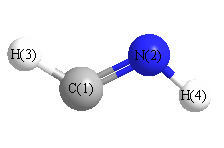 More geometry information
Calculated Bond Angles
| atom1 |
atom2 |
atom3 |
angle |
|
atom1 |
atom2 |
atom3 |
angle |
| C1 |
N2 |
H4 |
119.606 |
|
H3 |
C1 |
N2 |
133.961 |
Electronic energy levels
Charges, Dipole, Quadrupole and Polarizability
Jump to
S1C1
Energy calculated at QCISD(T)/cc-pVTZ
| | hartrees |
|---|
| Energy at 0K | -93.810356 |
| Energy at 298.15K | -93.811703 |
| HF Energy | -93.436666 |
| Nuclear repulsion energy | 28.015242 |
The energy at 298.15K was derived from the energy at 0K
and an integrated heat capacity that used the calculated vibrational frequencies.
Vibrational Frequencies calculated at QCISD(T)/cc-pVTZ
| Mode Number |
Symmetry |
Frequency
(cm-1) |
Scaled Frequency
(cm-1) |
IR Intensities
(km mol-1) |
Raman Act
(Å4/u) |
Dep P |
Dep U |
|---|
| 1 |
A' |
3461 |
3283 |
|
|
|
|
| 2 |
A' |
3046 |
2890 |
|
|
|
|
| 3 |
A' |
1743 |
1653 |
|
|
|
|
| 4 |
A' |
1210 |
1148 |
|
|
|
|
| 5 |
A' |
919 |
871 |
|
|
|
|
| 6 |
A" |
981 |
931 |
|
|
|
|
Unscaled Zero Point Vibrational Energy (zpe) 5679.9 cm
-1
Scaled (by 0.9486) Zero Point Vibrational Energy (zpe) 5388.0 cm
-1
See section
III.C.1 List or set vibrational scaling factors
to change the scale factors used here.
See section
III.C.2
Calculate a vibrational scaling factor for a given set of molecules
to determine the least squares best scaling factor.
Geometric Data calculated at QCISD(T)/cc-pVTZ
Point Group is Cs
Cartesians (Å)
| Atom |
x (Å) |
y (Å) |
z (Å) |
|---|
| C1 |
0.000 |
0.653 |
0.000 |
| N2 |
0.000 |
-0.591 |
0.000 |
| H3 |
0.902 |
1.273 |
0.000 |
| H4 |
-0.908 |
-1.053 |
0.000 |
Atom - Atom Distances (Å)
| |
C1 |
N2 |
H3 |
H4 |
| C1 | | 1.2438 | 1.0945 | 1.9325 |
N2 | 1.2438 | | 2.0707 | 1.0194 | H3 | 1.0945 | 2.0707 | | 2.9474 | H4 | 1.9325 | 1.0194 | 2.9474 | |
More geometry information
Calculated Bond Angles
| atom1 |
atom2 |
atom3 |
angle |
|
atom1 |
atom2 |
atom3 |
angle |
| C1 |
N2 |
H4 |
116.929 |
|
H3 |
C1 |
N2 |
124.511 |
Electronic energy levels
Charges, Dipole, Quadrupole and Polarizability
