Jump to
S1C2
Energy calculated at mPW1PW91/cc-pVTZ
| | hartrees |
|---|
| Energy at 0K | -93.968532 |
| Energy at 298.15K | -93.969832 |
| HF Energy | -93.968532 |
| Nuclear repulsion energy | 28.350923 |
The energy at 298.15K was derived from the energy at 0K
and an integrated heat capacity that used the calculated vibrational frequencies.
Vibrational Frequencies calculated at mPW1PW91/cc-pVTZ
| Mode Number |
Symmetry |
Frequency
(cm-1) |
Scaled Frequency
(cm-1) |
IR Intensities
(km mol-1) |
Raman Act
(Å4/u) |
Dep P |
Dep U |
|---|
| 1 |
A' |
3356 |
3219 |
2.51 |
|
|
|
| 2 |
A' |
2999 |
2877 |
47.62 |
|
|
|
| 3 |
A' |
1874 |
1798 |
29.45 |
|
|
|
| 4 |
A' |
1023 |
981 |
147.12 |
|
|
|
| 5 |
A' |
870 |
834 |
104.92 |
|
|
|
| 6 |
A" |
922 |
884 |
4.08 |
|
|
|
Unscaled Zero Point Vibrational Energy (zpe) 5521.5 cm
-1
Scaled (by 0.9592) Zero Point Vibrational Energy (zpe) 5296.2 cm
-1
See section
III.C.1 List or set vibrational scaling factors
to change the scale factors used here.
See section
III.C.2
Calculate a vibrational scaling factor for a given set of molecules
to determine the least squares best scaling factor.
Geometric Data calculated at mPW1PW91/cc-pVTZ
Point Group is Cs
Cartesians (Å)
| Atom |
x (Å) |
y (Å) |
z (Å) |
|---|
| C1 |
0.111 |
0.633 |
0.000 |
| N2 |
0.111 |
-0.584 |
0.000 |
| H3 |
-0.673 |
1.400 |
0.000 |
| H4 |
-0.767 |
-1.110 |
0.000 |
Atom - Atom Distances (Å)
| |
C1 |
N2 |
H3 |
H4 |
| C1 | | 1.2171 | 1.0966 | 1.9516 |
N2 | 1.2171 | | 2.1333 | 1.0230 | H3 | 1.0966 | 2.1333 | | 2.5119 | H4 | 1.9516 | 1.0230 | 2.5119 | |
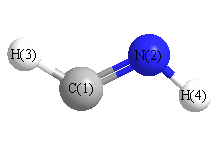 More geometry information
Calculated Bond Angles
| atom1 |
atom2 |
atom3 |
angle |
|
atom1 |
atom2 |
atom3 |
angle |
| C1 |
N2 |
H4 |
120.952 |
|
H3 |
C1 |
N2 |
134.375 |
Electronic energy levels
Charges, Dipole, Quadrupole and Polarizability
Charges from optimized geometry at mPW1PW91/cc-pVTZ
Charges (e)
| Number |
Element |
Mulliken |
CHELPG |
AIM |
ESP |
| 1 |
C |
-0.081 |
|
|
|
| 2 |
N |
-0.168 |
|
|
|
| 3 |
H |
0.095 |
|
|
|
| 4 |
H |
0.154 |
|
|
|
Electric dipole moments
Electric dipole components in Debye
(What's a Debye? See section
VII.A.3)
| |
x |
y |
z |
Total |
| |
-2.120 |
0.384 |
0.000 |
2.155 |
| CHELPG |
|
|
|
|
| AIM |
|
|
|
|
| ESP |
|
|
|
|
Electric Quadrupole moment
Quadrupole components in D Å
| Primitive |
|---|
| | x | y | z |
|---|
| x |
-12.107 |
0.614 |
0.000 |
| y |
0.614 |
-11.061 |
0.000 |
| z |
0.000 |
0.000 |
-12.619 |
|
| Traceless |
|---|
| | x | y | z |
|---|
| x |
-0.268 |
0.614 |
0.000 |
| y |
0.614 |
1.302 |
0.000 |
| z |
0.000 |
0.000 |
-1.035 |
|
| Polar |
|---|
| 3z2-r2 | -2.069 |
|---|
| x2-y2 | -1.047 |
|---|
| xy | 0.614 |
|---|
| xz | 0.000 |
|---|
| yz | 0.000 |
|---|
|
Polarizabilities
Components of the polarizability tensor.
Units are
Å
3 (Angstrom cubed)
Change units.
| |
x |
y |
z |
| x |
2.490 |
0.078 |
0.000 |
| y |
0.078 |
4.107 |
0.000 |
| z |
0.000 |
0.000 |
1.810 |
<r2> (average value of r
2) Å
2
| <r2> |
16.636 |
| (<r2>)1/2 |
4.079 |
Jump to
S1C1
Energy calculated at mPW1PW91/cc-pVTZ
| | hartrees |
|---|
| Energy at 0K | -93.975493 |
| Energy at 298.15K | -93.976839 |
| HF Energy | -93.975493 |
| Nuclear repulsion energy | 28.280996 |
The energy at 298.15K was derived from the energy at 0K
and an integrated heat capacity that used the calculated vibrational frequencies.
Vibrational Frequencies calculated at mPW1PW91/cc-pVTZ
| Mode Number |
Symmetry |
Frequency
(cm-1) |
Scaled Frequency
(cm-1) |
IR Intensities
(km mol-1) |
Raman Act
(Å4/u) |
Dep P |
Dep U |
|---|
| 1 |
A' |
3470 |
3328 |
7.50 |
|
|
|
| 2 |
A' |
3040 |
2916 |
26.23 |
|
|
|
| 3 |
A' |
1826 |
1752 |
30.69 |
|
|
|
| 4 |
A' |
1195 |
1147 |
11.55 |
|
|
|
| 5 |
A' |
911 |
874 |
223.80 |
|
|
|
| 6 |
A" |
983 |
943 |
110.02 |
|
|
|
Unscaled Zero Point Vibrational Energy (zpe) 5712.9 cm
-1
Scaled (by 0.9592) Zero Point Vibrational Energy (zpe) 5479.8 cm
-1
See section
III.C.1 List or set vibrational scaling factors
to change the scale factors used here.
See section
III.C.2
Calculate a vibrational scaling factor for a given set of molecules
to determine the least squares best scaling factor.
Geometric Data calculated at mPW1PW91/cc-pVTZ
Point Group is Cs
Cartesians (Å)
| Atom |
x (Å) |
y (Å) |
z (Å) |
|---|
| C1 |
0.000 |
0.644 |
0.000 |
| N2 |
0.000 |
-0.582 |
0.000 |
| H3 |
0.895 |
1.276 |
0.000 |
| H4 |
-0.897 |
-1.064 |
0.000 |
Atom - Atom Distances (Å)
| |
C1 |
N2 |
H3 |
H4 |
| C1 | | 1.2265 | 1.0952 | 1.9289 |
N2 | 1.2265 | | 2.0625 | 1.0179 | H3 | 1.0952 | 2.0625 | | 2.9467 | H4 | 1.9289 | 1.0179 | 2.9467 | |
More geometry information
Calculated Bond Angles
| atom1 |
atom2 |
atom3 |
angle |
|
atom1 |
atom2 |
atom3 |
angle |
| C1 |
N2 |
H4 |
118.207 |
|
H3 |
C1 |
N2 |
125.242 |
Electronic energy levels
Charges, Dipole, Quadrupole and Polarizability
Charges from optimized geometry at mPW1PW91/cc-pVTZ
Charges (e)
| Number |
Element |
Mulliken |
CHELPG |
AIM |
ESP |
| 1 |
C |
-0.115 |
|
|
|
| 2 |
N |
-0.176 |
|
|
|
| 3 |
H |
0.118 |
|
|
|
| 4 |
H |
0.173 |
|
|
|
Electric dipole moments
Electric dipole components in Debye
(What's a Debye? See section
VII.A.3)
| |
x |
y |
z |
Total |
| |
-0.447 |
0.181 |
0.000 |
0.482 |
| CHELPG |
|
|
|
|
| AIM |
|
|
|
|
| ESP |
|
|
|
|
Electric Quadrupole moment
Quadrupole components in D Å
| Primitive |
|---|
| | x | y | z |
|---|
| x |
-11.277 |
3.109 |
0.000 |
| y |
3.109 |
-11.396 |
0.000 |
| z |
0.000 |
0.000 |
-12.655 |
|
| Traceless |
|---|
| | x | y | z |
|---|
| x |
0.748 |
3.109 |
0.000 |
| y |
3.109 |
0.570 |
0.000 |
| z |
0.000 |
0.000 |
-1.318 |
|
| Polar |
|---|
| 3z2-r2 | -2.637 |
|---|
| x2-y2 | 0.119 |
|---|
| xy | 3.109 |
|---|
| xz | 0.000 |
|---|
| yz | 0.000 |
|---|
|
Polarizabilities
Components of the polarizability tensor.
Units are
Å
3 (Angstrom cubed)
Change units.
| |
x |
y |
z |
| x |
2.634 |
0.368 |
0.000 |
| y |
0.368 |
3.936 |
0.000 |
| z |
0.000 |
0.000 |
1.856 |
<r2> (average value of r
2) Å
2
| <r2> |
16.582 |
| (<r2>)1/2 |
4.072 |
