Jump to
S1C2
Energy calculated at wB97X-D/cc-pVTZ
| | hartrees |
|---|
| Energy at 0K | -93.959046 |
| Energy at 298.15K | -93.960348 |
| HF Energy | -93.959046 |
| Nuclear repulsion energy | 28.355594 |
The energy at 298.15K was derived from the energy at 0K
and an integrated heat capacity that used the calculated vibrational frequencies.
Vibrational Frequencies calculated at wB97X-D/cc-pVTZ
| Mode Number |
Symmetry |
Frequency
(cm-1) |
Scaled Frequency
(cm-1) |
IR Intensities
(km mol-1) |
Raman Act
(Å4/u) |
Dep P |
Dep U |
|---|
| 1 |
A' |
3389 |
3240 |
2.60 |
|
|
|
| 2 |
A' |
3006 |
2873 |
40.97 |
|
|
|
| 3 |
A' |
1877 |
1794 |
33.31 |
|
|
|
| 4 |
A' |
1025 |
980 |
142.82 |
|
|
|
| 5 |
A' |
870 |
831 |
116.46 |
|
|
|
| 6 |
A" |
924 |
883 |
4.33 |
|
|
|
Unscaled Zero Point Vibrational Energy (zpe) 5545.1 cm
-1
Scaled (by 0.956) Zero Point Vibrational Energy (zpe) 5301.1 cm
-1
See section
III.C.1 List or set vibrational scaling factors
to change the scale factors used here.
See section
III.C.2
Calculate a vibrational scaling factor for a given set of molecules
to determine the least squares best scaling factor.
Geometric Data calculated at wB97X-D/cc-pVTZ
Point Group is Cs
Cartesians (Å)
| Atom |
x (Å) |
y (Å) |
z (Å) |
|---|
| C1 |
0.111 |
0.634 |
0.000 |
| N2 |
0.111 |
-0.583 |
0.000 |
| H3 |
-0.685 |
1.388 |
0.000 |
| H4 |
-0.764 |
-1.109 |
0.000 |
Atom - Atom Distances (Å)
| |
C1 |
N2 |
H3 |
H4 |
| C1 | | 1.2170 | 1.0969 | 1.9508 |
N2 | 1.2170 | | 2.1261 | 1.0216 | H3 | 1.0969 | 2.1261 | | 2.4988 | H4 | 1.9508 | 1.0216 | 2.4988 | |
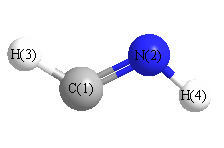 More geometry information
Calculated Bond Angles
| atom1 |
atom2 |
atom3 |
angle |
|
atom1 |
atom2 |
atom3 |
angle |
| C1 |
N2 |
H4 |
121.006 |
|
H3 |
C1 |
N2 |
133.442 |
Electronic energy levels
Charges, Dipole, Quadrupole and Polarizability
Charges from optimized geometry at wB97X-D/cc-pVTZ
Charges (e)
| Number |
Element |
Mulliken |
CHELPG |
AIM |
ESP |
| 1 |
C |
-0.099 |
|
|
|
| 2 |
N |
-0.164 |
|
|
|
| 3 |
H |
0.102 |
|
|
|
| 4 |
H |
0.161 |
|
|
|
Electric dipole moments
Electric dipole components in Debye
(What's a Debye? See section
VII.A.3)
| |
x |
y |
z |
Total |
| |
-2.173 |
0.360 |
0.000 |
2.203 |
| CHELPG |
|
|
|
|
| AIM |
|
|
|
|
| ESP |
|
|
|
|
Electric Quadrupole moment
Quadrupole components in D Å
| Primitive |
|---|
| | x | y | z |
|---|
| x |
-12.102 |
0.603 |
0.000 |
| y |
0.603 |
-11.033 |
0.000 |
| z |
0.000 |
0.000 |
-12.628 |
|
| Traceless |
|---|
| | x | y | z |
|---|
| x |
-0.272 |
0.603 |
0.000 |
| y |
0.603 |
1.332 |
0.000 |
| z |
0.000 |
0.000 |
-1.060 |
|
| Polar |
|---|
| 3z2-r2 | -2.120 |
|---|
| x2-y2 | -1.069 |
|---|
| xy | 0.603 |
|---|
| xz | 0.000 |
|---|
| yz | 0.000 |
|---|
|
Polarizabilities
Components of the polarizability tensor.
Units are
Å
3 (Angstrom cubed)
Change units.
| |
x |
y |
z |
| x |
2.476 |
0.072 |
0.000 |
| y |
0.072 |
4.102 |
0.000 |
| z |
0.000 |
0.000 |
1.819 |
<r2> (average value of r
2) Å
2
| <r2> |
16.622 |
| (<r2>)1/2 |
4.077 |
Jump to
S1C1
Energy calculated at wB97X-D/cc-pVTZ
| | hartrees |
|---|
| Energy at 0K | -93.966038 |
| Energy at 298.15K | -93.967383 |
| HF Energy | -93.966038 |
| Nuclear repulsion energy | 28.279975 |
The energy at 298.15K was derived from the energy at 0K
and an integrated heat capacity that used the calculated vibrational frequencies.
Vibrational Frequencies calculated at wB97X-D/cc-pVTZ
| Mode Number |
Symmetry |
Frequency
(cm-1) |
Scaled Frequency
(cm-1) |
IR Intensities
(km mol-1) |
Raman Act
(Å4/u) |
Dep P |
Dep U |
|---|
| 1 |
A' |
3484 |
3330 |
9.43 |
|
|
|
| 2 |
A' |
3038 |
2905 |
23.40 |
|
|
|
| 3 |
A' |
1827 |
1746 |
33.10 |
|
|
|
| 4 |
A' |
1194 |
1142 |
10.63 |
|
|
|
| 5 |
A' |
908 |
868 |
230.79 |
|
|
|
| 6 |
A" |
982 |
938 |
113.95 |
|
|
|
Unscaled Zero Point Vibrational Energy (zpe) 5716.2 cm
-1
Scaled (by 0.956) Zero Point Vibrational Energy (zpe) 5464.7 cm
-1
See section
III.C.1 List or set vibrational scaling factors
to change the scale factors used here.
See section
III.C.2
Calculate a vibrational scaling factor for a given set of molecules
to determine the least squares best scaling factor.
Geometric Data calculated at wB97X-D/cc-pVTZ
Point Group is Cs
Cartesians (Å)
| Atom |
x (Å) |
y (Å) |
z (Å) |
|---|
| C1 |
-0.000 |
0.644 |
0.000 |
| N2 |
-0.000 |
-0.582 |
0.000 |
| H3 |
0.901 |
1.267 |
0.000 |
| H4 |
-0.898 |
-1.061 |
0.000 |
Atom - Atom Distances (Å)
| |
C1 |
N2 |
H3 |
H4 |
| C1 | | 1.2262 | 1.0948 | 1.9268 |
N2 | 1.2262 | | 2.0562 | 1.0172 | H3 | 1.0948 | 2.0562 | | 2.9411 | H4 | 1.9268 | 1.0172 | 2.9411 | |
More geometry information
Calculated Bond Angles
| atom1 |
atom2 |
atom3 |
angle |
|
atom1 |
atom2 |
atom3 |
angle |
| C1 |
N2 |
H4 |
118.083 |
|
H3 |
C1 |
N2 |
124.632 |
Electronic energy levels
Charges, Dipole, Quadrupole and Polarizability
Charges from optimized geometry at wB97X-D/cc-pVTZ
Charges (e)
| Number |
Element |
Mulliken |
CHELPG |
AIM |
ESP |
| 1 |
C |
-0.127 |
|
|
|
| 2 |
N |
-0.170 |
|
|
|
| 3 |
H |
0.123 |
|
|
|
| 4 |
H |
0.174 |
|
|
|
Electric dipole moments
Electric dipole components in Debye
(What's a Debye? See section
VII.A.3)
| |
x |
y |
z |
Total |
| |
-0.439 |
0.182 |
0.000 |
0.475 |
| CHELPG |
|
|
|
|
| AIM |
|
|
|
|
| ESP |
|
|
|
|
Electric Quadrupole moment
Quadrupole components in D Å
| Primitive |
|---|
| | x | y | z |
|---|
| x |
-11.268 |
3.150 |
0.000 |
| y |
3.150 |
-11.377 |
0.000 |
| z |
0.000 |
0.000 |
-12.664 |
|
| Traceless |
|---|
| | x | y | z |
|---|
| x |
0.752 |
3.150 |
0.000 |
| y |
3.150 |
0.589 |
0.000 |
| z |
0.000 |
0.000 |
-1.341 |
|
| Polar |
|---|
| 3z2-r2 | -2.682 |
|---|
| x2-y2 | 0.109 |
|---|
| xy | 3.150 |
|---|
| xz | 0.000 |
|---|
| yz | 0.000 |
|---|
|
Polarizabilities
Components of the polarizability tensor.
Units are
Å
3 (Angstrom cubed)
Change units.
| |
x |
y |
z |
| x |
2.633 |
0.342 |
0.000 |
| y |
0.342 |
3.959 |
0.000 |
| z |
0.000 |
0.000 |
1.865 |
<r2> (average value of r
2) Å
2
| <r2> |
16.580 |
| (<r2>)1/2 |
4.072 |
