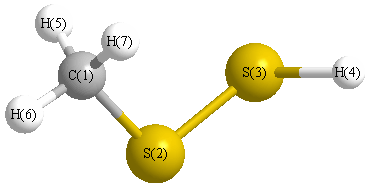
Vibrational Frequencies calculated at B1B95/cc-pVTZ
| Mode Number |
Symmetry |
Frequency
(cm-1) |
Scaled Frequency
(cm-1) |
IR Intensities
(km mol-1) |
Raman Act
(Å4/u) |
Dep P |
Dep U |
|---|
| 1 |
A |
3172 |
3036 |
5.73 |
56.35 |
0.75 |
0.86 |
| 2 |
A |
3155 |
3019 |
5.27 |
87.06 |
0.75 |
0.85 |
| 3 |
A |
3064 |
2933 |
16.73 |
179.31 |
0.02 |
0.05 |
| 4 |
A |
2654 |
2540 |
5.78 |
163.50 |
0.25 |
0.40 |
| 5 |
A |
1477 |
1413 |
8.47 |
7.24 |
0.74 |
0.85 |
| 6 |
A |
1456 |
1394 |
8.81 |
8.68 |
0.75 |
0.86 |
| 7 |
A |
1340 |
1283 |
2.38 |
0.84 |
0.62 |
0.77 |
| 8 |
A |
974 |
932 |
5.78 |
2.38 |
0.34 |
0.51 |
| 9 |
A |
969 |
927 |
3.59 |
1.85 |
0.56 |
0.72 |
| 10 |
A |
884 |
846 |
4.43 |
14.50 |
0.58 |
0.73 |
| 11 |
A |
715 |
685 |
1.98 |
11.69 |
0.25 |
0.40 |
| 12 |
A |
527 |
504 |
0.67 |
10.84 |
0.20 |
0.33 |
| 13 |
A |
340 |
325 |
13.47 |
6.09 |
0.75 |
0.86 |
| 14 |
A |
237 |
227 |
0.19 |
4.88 |
0.58 |
0.74 |
| 15 |
A |
164 |
157 |
0.45 |
0.02 |
0.63 |
0.78 |
Unscaled Zero Point Vibrational Energy (zpe) 10563.6 cm
-1
Scaled (by 0.9571) Zero Point Vibrational Energy (zpe) 10110.5 cm
-1
See section
III.C.1 List or set vibrational scaling factors
to change the scale factors used here.
See section
III.C.2
Calculate a vibrational scaling factor for a given set of molecules
to determine the least squares best scaling factor.
Charges, Dipole, Quadrupole and Polarizability
Charges from optimized geometry at B1B95/cc-pVTZ
Charges (e)
| Number |
Element |
Mulliken |
CHELPG |
AIM |
ESP |
| 1 |
C |
-0.320 |
|
|
|
| 2 |
S |
-0.052 |
|
|
|
| 3 |
S |
-0.150 |
|
|
|
| 4 |
H |
0.127 |
|
|
|
| 5 |
H |
0.141 |
|
|
|
| 6 |
H |
0.124 |
|
|
|
| 7 |
H |
0.131 |
|
|
|
Electric dipole moments
Electric dipole components in Debye
(What's a Debye? See section
VII.A.3)
| |
x |
y |
z |
Total |
| |
-1.036 |
1.197 |
0.796 |
1.772 |
| CHELPG |
|
|
|
|
| AIM |
|
|
|
|
| ESP |
|
|
|
|
Electric Quadrupole moment
Quadrupole components in D Å
| Primitive |
|---|
| | x | y | z |
|---|
| x |
-30.604 |
-0.213 |
1.599 |
| y |
-0.213 |
-34.629 |
0.566 |
| z |
1.599 |
0.566 |
-32.860 |
|
| Traceless |
|---|
| | x | y | z |
|---|
| x |
3.140 |
-0.213 |
1.599 |
| y |
-0.213 |
-2.897 |
0.566 |
| z |
1.599 |
0.566 |
-0.243 |
|
| Polar |
|---|
| 3z2-r2 | -0.485 |
|---|
| x2-y2 | 4.025 |
|---|
| xy | -0.213 |
|---|
| xz | 1.599 |
|---|
| yz | 0.566 |
|---|
|
Polarizabilities
Components of the polarizability tensor.
Units are
Å
3 (Angstrom cubed)
Change units.
| |
x |
y |
z |
| x |
9.822 |
0.249 |
0.171 |
| y |
0.249 |
6.618 |
0.089 |
| z |
0.171 |
0.089 |
5.756 |
<r2> (average value of r
2) Å
2
| <r2> |
101.142 |
| (<r2>)1/2 |
10.057 |