return to home page Computational Chemistry Comparison and Benchmark DataBase Release 22 (May 2022) Standard Reference Database 101 National Institute of Standards and Technology
You are here: Calculated > Energy > Optimized > Energy

All results from a given calculation for C2H4O3 (1,2,3-trioxolane)

using model chemistry: CCSD(T)/cc-pVTZ

19 10 17 12 22

States and conformations

State Conformation minimum conformation conformer description state description
1 1 yes CS 1A'
Energy calculated at CCSD(T)/cc-pVTZ
 hartrees
Energy at 0K-303.662943
Energy at 298.15K-303.669483
HF Energy-302.542014
Nuclear repulsion energy193.078397
The energy at 298.15K was derived from the energy at 0K and an integrated heat capacity that used the calculated vibrational frequencies.
Vibrational Frequencies calculated at CCSD(T)/cc-pVTZ
Mode Number Symmetry Frequency
(cm-1)
Scaled Frequency
(cm-1)
IR Intensities
(km mol-1)
Raman Act
(Å4/u)
Dep P Dep U
1 A' 3148 3068        
2 A' 3071 2993        
3 A' 1524 1486        
4 A' 1351 1317        
5 A' 1249 1217        
6 A' 1026 1000        
7 A' 952 928        
8 A' 892 870        
9 A' 861 839        
10 A' 700 683        
11 A' 413 402        
12 A" 3129 3050        
13 A" 3060 2982        
14 A" 1506 1468        
15 A" 1357 1322        
16 A" 1232 1201        
17 A" 1161 1132        
18 A" 1039 1012        
19 A" 749 731        
20 A" 708 691        
21 A" 113 111        

Unscaled Zero Point Vibrational Energy (zpe) 14619.6 cm-1
Scaled (by 0.9748) Zero Point Vibrational Energy (zpe) 14251.2 cm-1
See section III.C.1 List or set vibrational scaling factors to change the scale factors used here.
See section III.C.2 Calculate a vibrational scaling factor for a given set of molecules to determine the least squares best scaling factor.
Rotational Constants (cm-1) from geometry optimized at CCSD(T)/cc-pVTZ
ABC
0.27449 0.25210 0.14766

See section I.F.4 to change rotational constant units
Geometric Data calculated at CCSD(T)/cc-pVTZ

Point Group is Cs

Cartesians (Å)
Atom x (Å) y (Å) z (Å)
O1 -0.582 -1.048 0.000
O2 0.145 -0.488 1.114
O3 0.145 -0.488 -1.114
C4 0.145 0.896 0.775
C5 0.145 0.896 -0.775
H6 1.047 1.323 1.209
H7 1.047 1.323 -1.209
H8 -0.744 1.394 1.165
H9 -0.744 1.394 -1.165

Atom - Atom Distances (Å)
  O1 O2 O3 C4 C5 H6 H7 H8 H9
O11.44351.44352.21542.21543.12063.12062.71082.7108
O21.44352.22811.42432.34172.02513.08052.08203.0865
O31.44352.22812.34171.42433.08052.02513.08652.0820
C42.21541.42432.34171.55061.08872.22151.09142.1919
C52.21542.34171.42431.55062.22151.08872.19191.0914
H63.12062.02513.08051.08872.22152.41831.79372.9754
H73.12063.08052.02512.22151.08872.41832.97541.7937
H82.71082.08203.08651.09142.19191.79372.97542.3302
H92.71083.08652.08202.19191.09142.97541.79372.3302

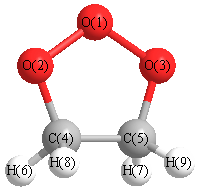
picture of 1,2,3-trioxolane state 1 conformation 1
More geometry information
Calculated Bond Angles
atom1 atom2 atom3 angle atom1 atom2 atom3 angle
O1 O2 C4 101.160 O1 O3 C5 101.160
O2 O1 O3 101.027 O2 C4 C5 103.759
O2 C4 H6 106.626 O2 C4 H8 111.018
O3 C5 C4 103.759 O3 C5 H7 106.626
O3 C5 H9 111.018 C4 C5 H7 113.487
C4 C5 H9 110.928 C5 C4 H6 113.487
C5 C4 H8 110.928 H6 C4 H8 110.734
H7 C5 H9 110.734
Electronic energy levels
Charges, Dipole, Quadrupole and Polarizability