return to home page Computational Chemistry Comparison and Benchmark DataBase Release 22 (May 2022) Standard Reference Database 101 National Institute of Standards and Technology
You are here: Calculated > Energy > Optimized > Energy

All results from a given calculation for CH3SCH3 (Dimethyl sulfide)

using model chemistry: CCSD(T)/cc-pVTZ

19 10 17 12 22

States and conformations

State Conformation minimum conformation conformer description state description
1 1 yes C2V 1A1
Energy calculated at CCSD(T)/cc-pVTZ
 hartrees
Energy at 0K-477.406549
Energy at 298.15K 
HF Energy-476.801989
Nuclear repulsion energy110.713624
The energy at 298.15K was derived from the energy at 0K and an integrated heat capacity that used the calculated vibrational frequencies.
Vibrational Frequencies calculated at CCSD(T)/cc-pVTZ
Mode Number Symmetry Frequency
(cm-1)
Scaled Frequency
(cm-1)
IR Intensities
(km mol-1)
Raman Act
(Å4/u)
Dep P Dep U
1 A1 3141 3061        
2 A1 3036 2960        
3 A1 1494 1456        
4 A1 1367 1332        
5 A1 1049 1023        
6 A1 707 689        
7 A1 261 254        
8 A2 3123 3044        
9 A2 1470 1433        
10 A2 954 930        
11 A2 174 169        
12 B1 3116 3037        
13 B1 1479 1442        
14 B1 990 965        
15 B1 183 179        
16 B2 3141 3062        
17 B2 3040 2963        
18 B2 1486 1449        
19 B2 1342 1308        
20 B2 912 889        
21 B2 759 740        

Unscaled Zero Point Vibrational Energy (zpe) 16611.0 cm-1
Scaled (by 0.9748) Zero Point Vibrational Energy (zpe) 16192.4 cm-1
See section III.C.1 List or set vibrational scaling factors to change the scale factors used here.
See section III.C.2 Calculate a vibrational scaling factor for a given set of molecules to determine the least squares best scaling factor.
Rotational Constants (cm-1) from geometry optimized at CCSD(T)/cc-pVTZ
ABC
0.58175 0.25461 0.18992

See section I.F.4 to change rotational constant units
Geometric Data calculated at CCSD(T)/cc-pVTZ

Point Group is C2v

Cartesians (Å)
Atom x (Å) y (Å) z (Å)
S1 0.000 0.000 0.669
C2 0.000 1.371 -0.519
C3 0.000 -1.371 -0.519
H4 0.000 2.299 0.052
H5 0.000 -2.299 0.052
H6 0.893 1.340 -1.145
H7 -0.893 1.340 -1.145
H8 -0.893 -1.340 -1.145
H9 0.893 -1.340 -1.145

Atom - Atom Distances (Å)
  S1 C2 C3 H4 H5 H6 H7 H8 H9
S11.81431.81432.38022.38022.42582.42582.42582.4258
C21.81432.74201.08963.71401.09081.09082.92182.9218
C31.81432.74203.71401.08962.92182.92181.09081.0908
H42.38021.08963.71404.59761.77501.77503.93323.9332
H52.38023.71401.08964.59763.93323.93321.77501.7750
H62.42581.09082.92181.77503.93321.78523.21982.6795
H72.42581.09082.92181.77503.93321.78522.67953.2198
H82.42582.92181.09083.93321.77503.21982.67951.7852
H92.42582.92181.09083.93321.77502.67953.21981.7852

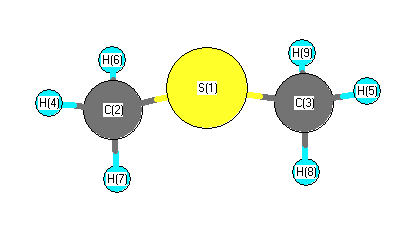
picture of Dimethyl sulfide state 1 conformation 1
More geometry information
Calculated Bond Angles
atom1 atom2 atom3 angle atom1 atom2 atom3 angle
S1 C2 H4 107.459 S1 C2 H6 110.756
S1 C2 H7 110.756 S1 C3 H5 107.459
S1 C3 H8 110.756 S1 C3 H9 110.756
C2 S1 C3 98.163 H4 C2 H6 108.988
H4 C2 H7 108.988 H5 C3 H8 108.988
H5 C3 H9 108.988 H6 C2 H7 109.829
H8 C3 H9 109.829
Electronic energy levels
Charges, Dipole, Quadrupole and Polarizability